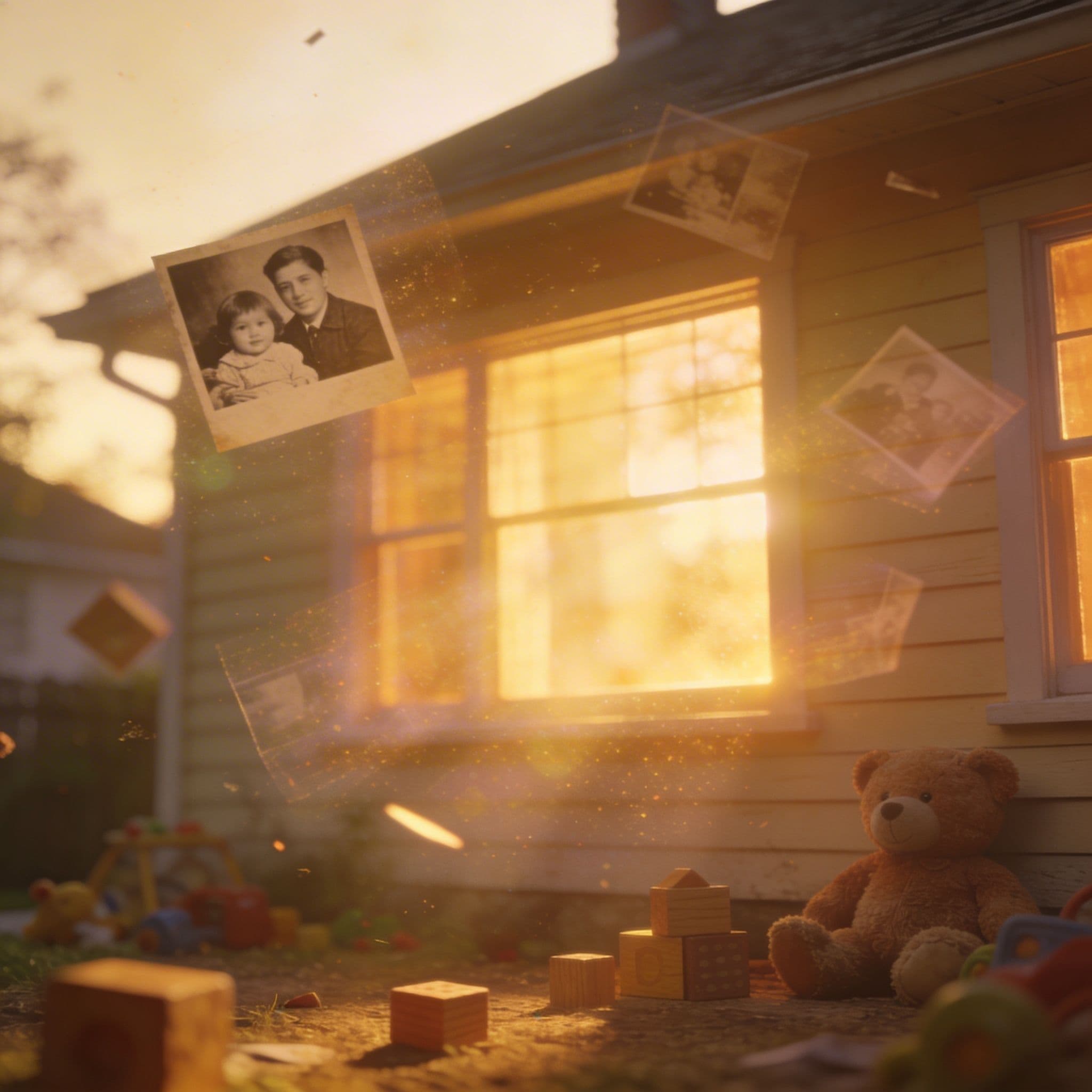
Childhood Home Dreams: What Your Brain Is Processing
Dreaming of your childhood home is one of the most neurologically deliberate experiences your sleeping mind can generate, your brain is not replaying the past for its own sake, but using its most deeply mapped environment to process something unresolved in your present life. These dreams cluster around stress, identity transitions, and emotional turning points precisely because that house is the original coordinate your nervous system uses to define safety. The setting is familiar. The subject is always now.
What Your Childhood Home Represents in Dreams
Your childhood home is your brain's earliest and most thoroughly encoded spatial memory, during the years of peak neuroplasticity, every hallway, staircase, and room was mapped with a density that no later address can replicate. During REM sleep, when the hippocampus reactivates and reorganizes emotionally significant memories, that floor plan becomes the default staging ground for processing current complexity. Research confirms that REM sleep plays a central role in consolidating emotionally salient experiences, and familiar spatial frameworks are among the most efficient scaffolding the sleeping brain can use.
Had a dream about Childhood Home Dreams: What Your Brain Is Processing?
Get your personalized AI interpretation in seconds
When adult life feels destabilizing, the mind does not collapse, it retreats to its original operating system and runs its diagnostics from there.
The Psychological Perspective
Jung
For Jung, the house in dreams is one of the most consistent and reliable symbols of the self, its rooms representing layers of the psyche, its foundation representing the unconscious, and its upper floors representing aspiration and conscious awareness. The childhood home carries the additional weight of being the earliest version of that structure: the place where identity first formed, where emotional patterns were first installed, and where the persona was first constructed to meet the demands of others.
Returning to it in a dream is not regression, it is the psyche conducting an architectural inspection. Something in the original blueprint is being cross-referenced against who you are becoming. If rooms are locked, unfamiliar, or inaccessible, the unconscious is signaling a layer of the self that has not yet been integrated into your current identity.
Freud
Freud read the house in dreams as a direct representation of the self and the body. Returning to the childhood home, in his framework, represents the unconscious revisiting the primary scene of psychic formation, the place where desire, frustration, attachment, and loss first took shape before you had the language to name them.
Sleep research confirms that emotionally salient autobiographical memories receive priority processing during REM sleep, which supports Freud's core intuition: the most formative material keeps resurfacing until it is consciously acknowledged and worked through. The childhood home appears in dreams because it holds the densest concentration of that unfinished emotional material.
Cultural & Spiritual Perspectives
Islamic Tradition
In Islamic dream interpretation, Ibn Sirin taught that a house in a dream represents the dreamer's life, inner condition, and family. The state of the house is the primary signal: a well-maintained, spacious home indicates peace, spiritual health, and blessed roots, while a damaged or collapsing structure calls attention to something neglected, a relationship, a spiritual obligation, or an aspect of character that requires honest examination.
Al-Nabulsi extended this by connecting the childhood home specifically to the concept of fitrah, the innate, original human disposition toward goodness and sincerity. Dreaming of returning to your childhood home may indicate a spiritual need to examine how far you have drifted from your core values, or a call to repair family bonds that have weakened with time and distance. The condition of the house in the dream is a mirror of what needs attention in waking life. God alone knows best.
Biblical & Western Tradition
In the Biblical and Western symbolic tradition, the house has long been understood as an image of the soul and its foundations. Proverbs 24:3 states that "by wisdom a house is built, and by understanding it is established", framing the dwelling as something actively constructed through choices, values, and discernment. Western folk dream traditions consistently treat the childhood home as a symbol of origin, rootedness, and the self before it was shaped by the pressures of adult life.
Modern psychotherapy reads these dreams practically and compassionately: they are the mind's way of anchoring itself during instability, using a known coordinate to navigate an unknown present.
Common Scenarios
1. The house looks different, new rooms, wrong layout, unfamiliar additions
When the floor plan shifts or expands, your psyche is remodeling its own blueprint. This almost always reflects identity growth, the unconscious updating its self-concept to match who you are currently becoming.
2. You cannot find your room
Searching the house without finding your bedroom typically surfaces during periods of decision paralysis or identity confusion, a feeling that you no longer have a clear place, role, or sense of direction in your current circumstances.
3. Strangers are living there
New occupants in your childhood home most often surface during major life transitions when continuity with your past feels disrupted. They can represent aspects of your personality you have outgrown, or a fear that your history is being erased by distance, change, or time.
4. The house is damaged or deteriorating
Structural damage, flooding, or decay points to something foundational that has been neglected, a family relationship, a core value, or an aspect of your psychological health that has not received the attention it needs. Research on emotion regulation and sleep confirms that REM dreaming is a primary mechanism for reprocessing unresolved emotional stress.
5. You are a child again, not just visiting
When you are your childhood age inside the dream rather than an adult revisiting, the brain is most likely activating an early emotional pattern that is being triggered by something in your present life. The people present and the emotional atmosphere are the most important details to record.
6. There is a room you have never entered
A locked door, a hidden staircase, or a room that did not exist in the real house is one of the most symbolically rich versions of this dream. In Jungian terms it represents an unintegrated dimension of the self, the shadow does not always appear as a threat. Sometimes it appears as a door you have never opened.
7. You are packing up the house to move again
Urgently loading boxes and deciding what to keep signals that the mind is processing a current life transition, symbolically closing one chapter and preparing, with some anxiety, for what comes next.
The Neuroscience Dimension
Neuroscientists have identified specialized hippocampal neurons called place cells that encode physical locations with extraordinary specificity. Your childhood home has the densest place-cell network of any space you have inhabited, because you lived there during the years when those networks were most actively forming. REM sleep is the phase in which these spatial and emotional memory networks are reactivated and reorganized, which is why that floor plan becomes a recurring cognitive stage rather than a fading recollection.
Research further shows that dreaming plays an active rather than passive role in emotional memory processing, the sleeping brain is not simply replaying the past but selectively editing it, comparing it to the present, and extracting meaning that waking consciousness has not yet fully processed. Your childhood home is the most resource-efficient environment your brain can deploy for that work. No other location is as completely mapped, and no other space carries as much foundational emotional weight.
Try the Fassir Dream Interpreter for a personalized reading based on Islamic tradition, Jungian psychology, and modern sleep science.
Practical Application: What Should You Do?
- Log which rooms appear and how they feel. The kitchen often relates to nourishment and family dynamics. The basement to what is hidden or suppressed. The attic to stored memory and higher thinking. The bedroom to private identity and rest. Recurring rooms carry repeating signals worth investigating.
- Identify what is currently in transition. These dreams cluster around change, new jobs, relocations, relationship shifts, grief, and burnout. If the dreams are frequent, give the current transition conscious attention rather than leaving it entirely to night-time processing.
- Assess emotional tone over plot. A warm childhood home dream and a distressing one point to very different things. Comfort signals the nervous system seeking grounding. Distress signals something foundational that feels at risk.
- Keep a one-week dream journal. Patterns in setting, recurring figures, and dominant emotions will reveal which specific waking-life issue your brain is trying to resolve.
- Take recurring distressing versions seriously. If the childhood home keeps appearing damaged, invaded, or inaccessible and the dream disturbs you on waking, it may be flagging unprocessed family dynamics, grief, or identity stress that benefits from direct attention, in conversation, in writing, or with professional support.
Related Dream Symbols
- Home dreams, safety, identity, and the architecture of the self
- Door dreams, opportunity, transition, and what you are ready or not ready to open
- Room dreams, compartmentalized aspects of the self and what each space contains
- Stairs dreams, movement between levels of awareness, progress, and regression
- Basement dreams, the unconscious, suppressed fears, and what has been stored out of sight
- Shadow dreams, unintegrated dimensions of the self waiting to be acknowledged
- Mother dreams, nurture, origin, and the emotional blueprint of early attachment
- Father dreams, authority, structure, and the models of protection you inherited
- Childhood dreams, early identity, formative memory, and the self before adult complexity
- Flooding dreams, emotional overwhelm and what can no longer be contained
- Fire dreams, transformation, destruction, and the clearing of what no longer serves
- Falling dreams, loss of footing, insecurity, and transitions that feel out of control
- Nightmares, unresolved stress signaling that something in waking life needs attention
- Keys dreams, access, control, and what you are ready to unlock
Try the Fassir Dream Interpreter for a personalized reading based on Islamic tradition, Jungian psychology, and modern sleep science.
Don't let the message slip away. Get a profound, personalized analysis that reveals what your subconscious is trying to tell you.
Frequently Asked Questions

A team of researchers and editors dedicated to dream interpretation, combining religious traditions, classical wisdom, psychological insight, and modern analytical methods.
Read Next

Why Your Snake Dreams Won't Go Away: A Deep Psychological Dive
That Stranger in Your Dream Isn't a Stranger at All, Here's Why
Islamic Dream Interpretation: A Complete Guide for Muslims