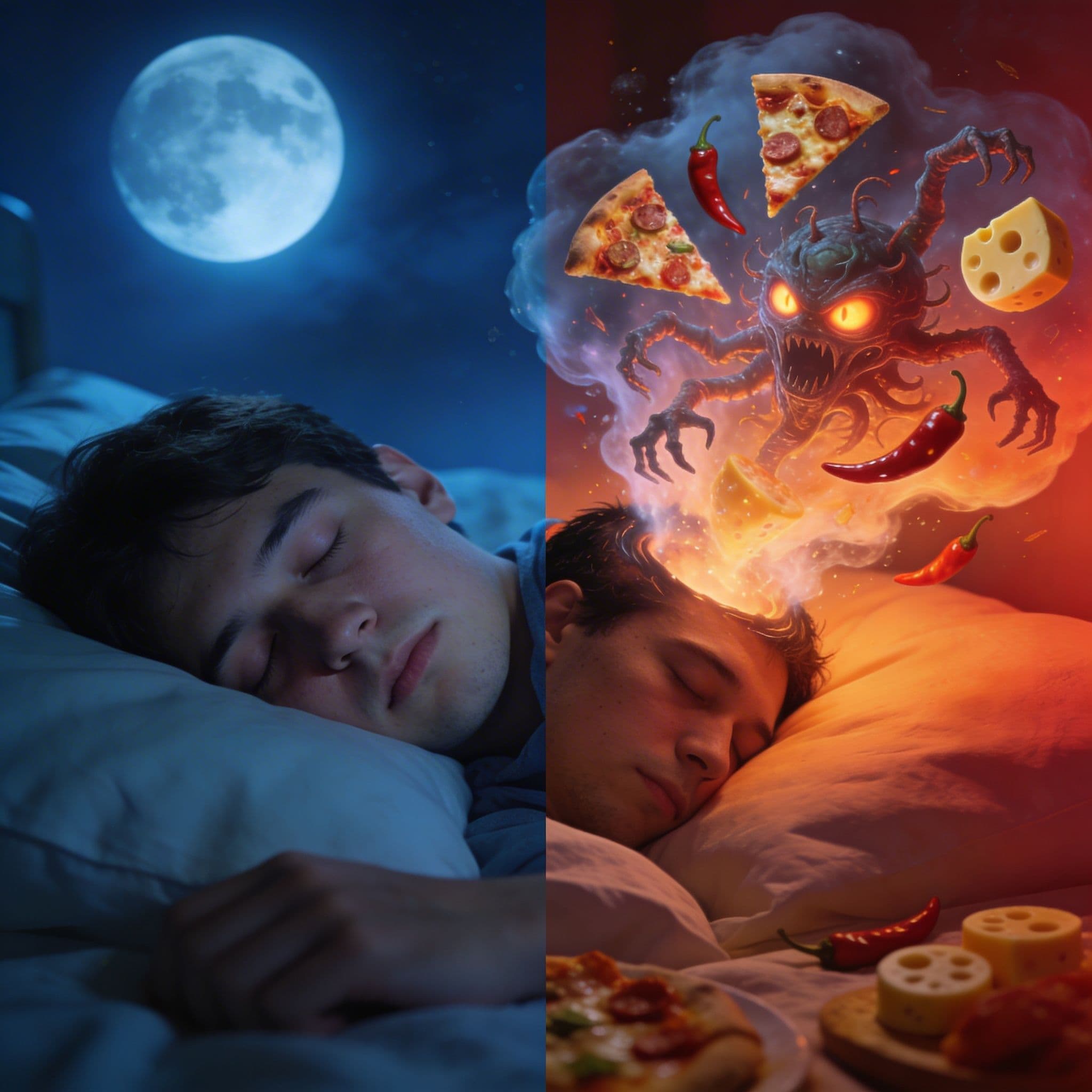
Can Eating Before Bed Really Change Your Dreams? The Science Says Yes
The idea that a late-night snack triggers wild dreams has been dismissed as folklore for decades. But the science tells a more nuanced story: what you eat before bed doesn't directly script your dreams, but it absolutely influences the neurological conditions under which they occur, and that changes everything about their intensity, vividness, and emotional charge.
The Short Answer
Food affects dreams indirectly, by altering body temperature, blood sugar, brain chemistry, and sleep architecture, particularly the depth and duration of REM sleep, which is where your most vivid and emotionally intense dreaming happens.
Had a dream about Can Eating Before Bed Really Change Your Dreams? The Science Says Yes?
Get your personalized AI interpretation in seconds
According to research published in Dreaming and the Brain (PMC), dreaming is deeply tied to the neurological conditions of REM sleep, conditions that are far more sensitive to physiological inputs like body temperature, metabolism, and neurochemistry than most people realize.
What Food Actually Does to Your Sleep
Your body doesn't stop working when you fall asleep. Digestion, temperature regulation, blood sugar management, and neurotransmitter production all continue, and all directly affect the quality and character of your REM cycles.
The key mechanism is simple: anything that raises your core body temperature, spikes your blood sugar, or alters your brain's neurochemical balance will shift your sleep architecture. More disrupted or activated sleep architecture means more vivid, bizarre, or emotionally intense dreams, not because the food "causes" specific dream content, but because it changes the neurological environment in which dreaming occurs.
A 2024 study published in Nature confirmed that dreaming plays an active role in overnight emotional memory processing, meaning when that process is amplified by physiological activation, the dreams that result carry more emotional weight and are more likely to be remembered upon waking.
The Psychological Perspective
Freud: The Stomach Speaks to the Unconscious
Freud acknowledged the role of physical stimuli in shaping dream content, what he called somatic sources of dreams. In The Interpretation of Dreams, he described how bodily sensations during sleep (hunger, warmth, discomfort) are woven into dream narratives by the unconscious mind.
A spicy meal causing physical discomfort at 3 AM doesn't create a nightmare from nothing, but it gives the dreaming mind raw material, a sense of unease or urgency that the unconscious then translates into symbolic imagery. The food is the trigger. The dream is the interpretation.
Jung: Disrupted Sleep as a Window to the Shadow
Jung would note that the most disturbing or vivid food-triggered dreams tend to occur when the physiological disruption is strong enough to lower the ego's defenses during sleep. Deep, undisturbed sleep maintains a certain psychological equilibrium. When that equilibrium is disrupted, by digestive activation, temperature spikes, or blood sugar fluctuations, the Shadow has easier access, and material that would normally stay in the background breaks through with unusual intensity.
Cultural & Spiritual Perspectives
The connection between food and dreams is one of the oldest documented observations in human culture.
The ancient Romans believed that rich feasts before sleep opened the mind to prophetic dreams, or, alternatively, to demonic ones. The god of dreams, Morpheus, was thought to be more easily reached from a state of physical satiation. This dual interpretation, food as dream amplifier for both good and bad, runs through virtually every ancient tradition.
In Islamic tradition, scholars have long advised moderation before sleep as part of spiritual preparation. Overeating before bed was considered an obstacle to the ru'ya salihah (righteous vision), the reasoning being that a body laboring with heavy digestion could not achieve the quality of sleep in which true, meaningful dreams arise. Ibn Sirin's tradition emphasized that the spiritual clarity of a dream was partly a function of the physical state of the dreamer.
In Western folk culture, the concept of "cheese dreams" has persisted for centuries, the idea that eating cheese before bed produces particularly vivid or bizarre dreams. This was studied formally in 2005 by the British Cheese Board, which found that different cheeses appeared to produce different categories of dream content, though the study was modest in scale and not peer-reviewed.
5 Foods That Research and Tradition Link to Dream Changes
1. Spicy Food
The most well-documented connection. Spicy foods raise core body temperature and can cause gastric discomfort, both of which fragment sleep and activate the brain's threat-processing systems during REM. A 2015 study by researchers Tore Nielsen and Russell Powell, published in Frontiers in Psychology, found that spicy and junk food were among the most commonly reported dietary triggers of bizarre and disturbing dreams.
The mechanism: elevated body temperature during sleep has been directly linked to increased REM density, more dreaming, more vividly.
2. Cheese and Dairy
Dairy is high in tryptophan, an amino acid that the body converts to serotonin and then to melatonin, both key regulators of sleep. Higher tryptophan availability can deepen and extend REM sleep, producing more vivid dreams. Different dairy products may affect this process differently depending on their specific fat, sugar, and tryptophan content.
3. Foods High in Vitamin B6
Vitamin B6, found in fish, poultry, bananas, chickpeas, and fortified cereals, is directly involved in the conversion of tryptophan to serotonin. Several small studies have suggested that B6 supplementation increases dream vividness and recall, likely by enhancing the neurochemical conditions of REM sleep. According to Harvard Medical School sleep researchers, REM sleep's emotional intensity is closely tied to serotonergic activity, the exact system B6 influences.
4. Sugar and High-Glycemic Carbohydrates
A blood sugar spike followed by a rapid crash, common after sugary snacks, white bread, or processed carbohydrates late at night, can trigger micro-awakenings during sleep. These awakenings interrupt REM cycles and create a fragmented sleep architecture where shorter, more intense REM bursts replace the smooth, sustained REM of normal sleep. The result: more frequent but more unsettling dream experiences.
5. Alcohol
Alcohol is the most potent and well-documented disruptor of dream sleep. It suppresses REM sleep in the first half of the night, reducing dream activity when you'd normally have it. Then, as alcohol metabolizes in the second half of the night, REM rebounds dramatically, producing the intense, sometimes nightmarish dreams that many people experience after drinking. This is known as REM rebound, documented extensively in sleep medicine literature.
What's Happening in Your Brain
The central mechanism linking food to dreams is REM sleep architecture. Your brain cycles through sleep stages approximately every 90 minutes, with REM periods growing longer as the night progresses. The richest, most emotionally intense dreaming occurs in the final two hours before natural waking.
Anything that disrupts these cycles, physiological arousal from digestion, temperature changes, blood sugar fluctuations, or neurochemical shifts, compresses, fragments, or intensifies REM. According to a 2011 review in Frontiers in Psychology, the emotional intensity of dreams is directly related to the depth and duration of REM engagement. Disrupted REM doesn't produce fewer dreams, it often produces more vivid ones, because the brain is cycling through emotional processing in shorter, more intense bursts.
The amygdala, your brain's threat-detection and emotional processing center, is particularly sensitive to physiological arousal states during REM. Elevated body temperature, metabolic activity, or neurochemical changes all increase amygdala activation, which translates directly into more emotionally charged dream content.
Had an unusually vivid or disturbing dream after a late meal? Try the Fassir Dream Interpreter and find out what the content of that dream is really processing, beyond just what you ate.
Practical Steps: How to Eat for Better Dreams
- Stop eating at least 2–3 hours before bed. This is the single most effective dietary intervention for dream quality. It gives your digestive system time to wind down before sleep begins, keeping body temperature stable and avoiding the metabolic activation that fragments REM.
- Avoid alcohol in the evening. Even moderate alcohol consumption measurably suppresses and then rebounds REM sleep. If you're going through a period of emotionally intense or disturbing dreams, eliminating evening alcohol for two weeks is often the most immediately effective change you can make.
- If you need a late snack, choose tryptophan-rich foods. A small amount of cheese, a banana, or a glass of warm milk, foods that support serotonin and melatonin production, is more likely to deepen and stabilize REM than to disrupt it. Avoid sugar, spice, and heavy fat in the final hour before sleep.
- Track the connection in your dream journal. Note what you ate the evening before particularly vivid or disturbing dreams. Patterns become visible within two weeks and are often surprisingly consistent, your personal food-dream triggers may differ from the general research.
- Use food intentionally for dream recall. If your goal is to remember more dreams, a small B6-rich snack in the early evening, combined with a stable sleep schedule, may genuinely improve recall. But the quality of your sleep hygiene overall matters far more than any single food.
Related Dream Symbols
If food-related dream disruption is producing recurring themes, these symbols are worth exploring:
- Falling : often triggered by fragmented REM sleep from physical disruption
- Being Chased : elevated amygdala activation translating into threat scenarios
- Water : emotional overwhelm surfacing through physiologically activated dreaming
- Fire : intense energy and uncontrolled activation in the body and mind
- House : the self under pressure, its structure responding to what you feed it
What you eat before bed doesn't write your dreams, but it absolutely shapes the neurological conditions in which they play out. The brain is not a closed system at night. It's a living environment, responding in real time to everything you consumed, felt, and left unresolved during the day. Feed it well, and it tends to process quietly. Disturb it, and it amplifies everything.
Try the Fassir Dream Interpreter to decode what your dreams are telling you, whatever triggered them in the first place.
Don't let the message slip away. Get a profound, personalized analysis that reveals what your subconscious is trying to tell you.
Frequently Asked Questions

A team of researchers and editors dedicated to dream interpretation, combining religious traditions, classical wisdom, psychological insight, and modern analytical methods.
Read Next

Why Your Snake Dreams Won't Go Away: A Deep Psychological Dive
That Stranger in Your Dream Isn't a Stranger at All, Here's Why

Islamic Dream Interpretation: A Complete Guide for Muslims