
Why Do the Dead Visit Our Dreams Years After They're Gone?
Dreams of deceased loved ones that appear years, even decades, after the loss are not random. They are your brain actively maintaining what grief researchers call a continuing bond: a healthy, evolving relationship with the person who died that does not require their physical presence to remain meaningful. These dreams arrive with precision, almost always connected to a specific waking-life transition, and they carry a different quality than the raw, painful dreams of early grief.
Why These Dreams Surface Years Later
The timing is not coincidental. Modern grief science has overturned the older model, based on Freud's Mourning and Melancholia, that treated healthy grief as the complete severing of bonds with the deceased. Research now confirms that maintaining an ongoing inner relationship with the deceased is not only normal but often beneficial to long-term bereavement adaptation.
Had a dream about Why Do the Dead Visit Our Dreams Years After They're Gone??
Get your personalized AI interpretation in seconds
Your relationship with the person who died does not end, it transforms. And the brain revisits that relationship in sleep precisely when waking-life circumstances make their presence most relevant.
These delayed dream visits most commonly coincide with:
- Major life transitions, marriage, becoming a parent, career change, divorce
- Reaching the age at which they died
- Facing a challenge they once navigated themselves
- Anniversary reactions, birthdays, death dates, seasonal holidays
- Encountering a decision they never got to make
- Periods of significant identity questioning or personal reinvention
The passage of time also changes what the dream can do. When grief is fresh, these dreams are often too emotionally overwhelming to process clearly. Years later, the nervous system has sufficient distance to receive the deeper content, not as acute pain, but as meaningful communication.
The Psychological Perspective
Jung: The Transcendent Function and the Deceased
Carl Jung viewed dreams of the deceased as one of the clearest expressions of what he called the transcendent function, the psyche's capacity to bridge conscious and unconscious content in ways that produce genuine psychological growth. In Jung's framework, the deceased does not simply represent a memory. They represent an internalized archetype, a symbolic embodiment of qualities, values, or relational patterns that the dreamer has absorbed from that person over a lifetime.
When those qualities become relevant again, because the dreamer is facing a challenge that person once navigated, or because a part of the shadow self is asking to be integrated, the psyche calls them forward. The dream is not nostalgia. It is the unconscious deploying a specific resource precisely when it is needed.
A 2021 PubMed study of 216 bereaved individuals confirmed that dreams of the deceased serve three distinct measurable psychological functions: processing trauma, maintaining a continuing bond, and regulating difficult emotions. Crucially, post-dream reactions, how the dreamer feels after waking, directly influenced both their perception of the dream and the overall trajectory of their grief.
Freud: Unfinished Business and Emotional Debt
Freud's earlier framework viewed healthy mourning as requiring the withdrawal of emotional investment from the deceased. Modern grief science has largely moved past this model, but Freud's concept of unfinished business remains clinically relevant. If the relationship with the deceased carried unresolved conflict, unexpressed love, or guilt, the dreaming mind will return to it during periods of stress or transition.
Dreams featuring a deceased person in confrontational or uncomfortable scenarios, rather than warm reunions — often reflect this category. They are not visitations. They are the psyche working through what was left incomplete.
The Continuity Hypothesis
Research from PMC confirms that dreaming serves a measurable emotional adaptive function, with the continuity hypothesis of dreaming showing that waking emotional experiences, particularly stress, unresolved tension, and grief, carry directly into sleep content. This is why a dream of your late father does not appear randomly, it appears the week you make a major financial decision, or the day after you heard something that reminded you of him. The brain is not haunted. It is processing.
Cultural & Spiritual Perspectives
Islamic Dream Interpretation
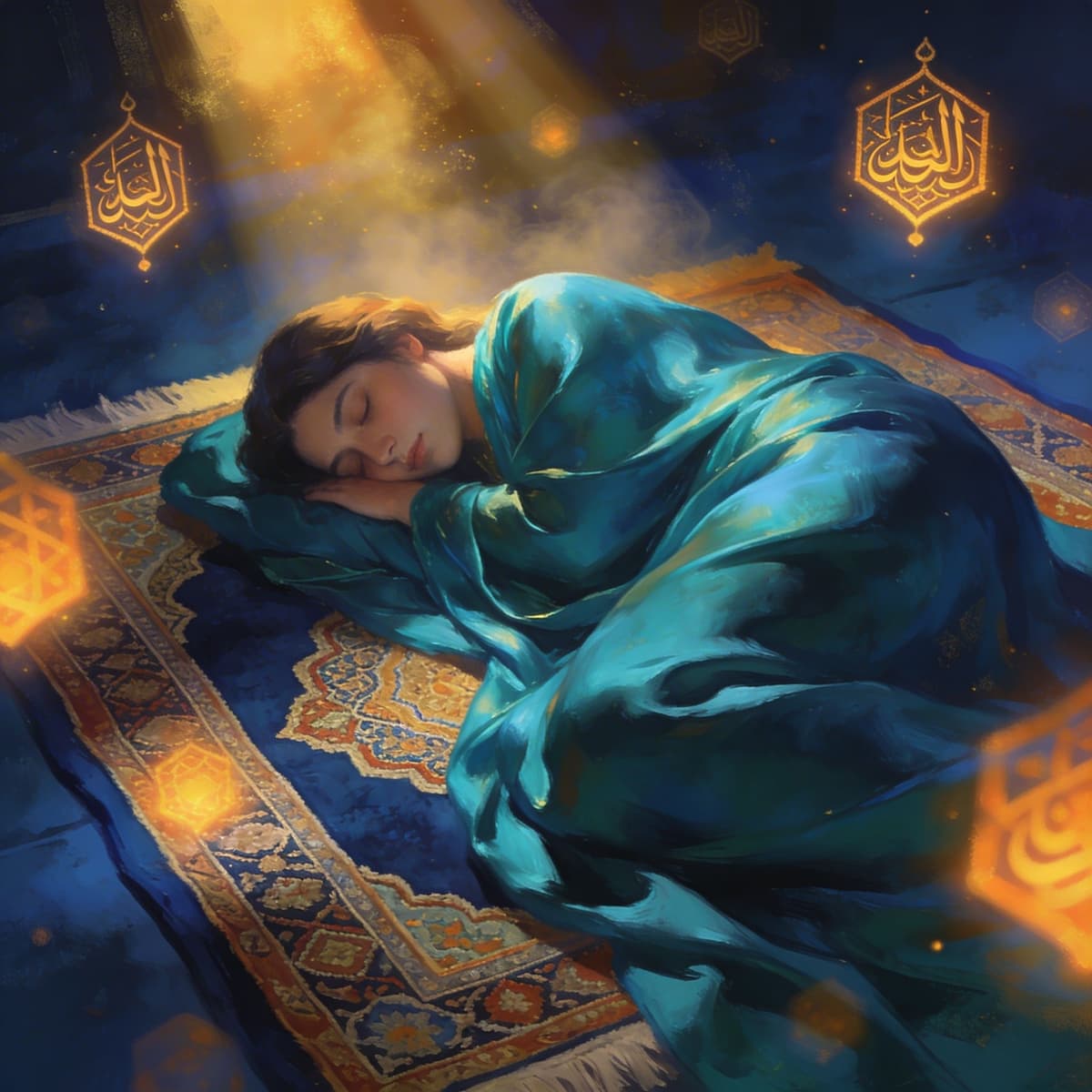
In Islamic tradition, dreams of the deceased hold some of the highest interpretive authority in classical dream scholarship. Ibn Sirin taught that dreams of the dead are more likely to carry genuine spiritual meaning after the rawness of grief has passed, precisely because the dreamer's emotional state has stabilized enough to receive and accurately interpret the message.
Classical Islamic dream scholarship categorizes these dreams into three types:
- Bushra (Glad Tidings), The deceased appears healthy, luminous, and at peace. This is among the most positive signs in Islamic dream interpretation: confirmation of Allah's mercy, and an indication that the deceased is in a good state. It brings comfort and renewed shukr (gratitude).
- Warning or Guidance Dreams, The deceased delivers specific counsel about a current life situation. Ibn Sirin taught that this type arrives most powerfully during periods when the dreamer faces a significant crossroads, and that the guidance should be reflected upon carefully rather than acted on impulsively.
- Du'a Requests, The deceased asks for prayers, sadaqah (charity), or the fulfillment of an unpaid obligation. Islamic scholars regard this as a genuine spiritual signal: the soul of the deceased may still benefit from acts performed on their behalf in the living world.
If a dream of a deceased loved one carries distress, Al-Nabulsi advised seeking refuge in Allah (ta'awwudh), offering charity on the deceased's behalf, and making du'a for their elevation in rank. If the dream carries peace and warmth, it is to be received with gratitude and remembered. Wallahu A'lam.
Biblical & Christian Perspective
Scripture holds a nuanced position on dreams of the deceased. The Biblical tradition does not encourage seeking the dead, Deuteronomy 18:10–11 warns against consulting mediums. However, it also recognizes that God communicates through dreams (Job 33:14–15), and that the saints who have died remain present in the communion of the faithful (Hebrews 12:1).
In Christian tradition, dreams of deceased loved ones are often understood not as the dreamer seeking the dead, but as grace arriving unsought — a gift of comfort rather than a practice to be pursued. The emotional quality of the dream is the primary interpretive guide: peace and warmth point toward consolation; distress and confusion point toward the need for prayer and emotional healing.
The Christian response is not analysis but gratitude, and a renewed attentiveness to what the person represented, and what qualities of theirs the dreamer may be called to embody in their own waking life.
Try the Fassir Dream Interpreter, share the details of your dream and receive a full personalized interpretation through Islamic, Biblical, and Jungian lenses in seconds, for free.
Common Dream Patterns Years After Loss
Dreams of the deceased that arrive years later tend to follow distinct patterns, each carrying a specific psychological function.
The Conversation Dream
Lengthy, meaningful dialogue with the deceased, often about a current life challenge, not the death itself. This is the clearest expression of the continuing bonds function: the psyche maintaining access to the wisdom and relational quality that person carried.
The Everyday Interaction Dream
Mundane, domestic scenes, sharing a meal, sitting in comfortable silence, moving through a familiar home. These dreams often feel more real than dramatic reunion dreams, and they tend to leave the dreamer with a profound sense of peace rather than grief. Research from PMC confirms that bereaved individuals whose dreams featured friendly interactions with the deceased showed significantly lower grief intensity and depression scores compared to those whose dreams contained less positive interactions.
The Unfinished Business Dream
The deceased appears in an uncomfortable or unresolved scenario, an old argument, a question never asked, a goodbye that never happened. PMC research confirms that bereaved individuals frequently perceive dreams involving the deceased as opportunities to process unfinished business, and that these dreams can facilitate self-forgiveness and forgiveness of the deceased for past wrongs. These dreams are not punishments. They are invitations to complete what was left open.
The Warning or Guidance Dream
The deceased delivers a specific message, sometimes verbally, sometimes through gesture or atmosphere, that connects directly to a waking-life decision. These are the dreams that people most commonly describe as feeling "too real to be just a dream." In both Islamic and Jungian frameworks, this category deserves the most careful reflection.
What the Dream Is Actually Processing
The content of the dream almost always maps onto something specific in waking life. The most common connections:
Dream Scenario
Likely Waking-Life Counterpart
Deceased parent giving advice
Major decision requiring their type of wisdom
Grandmother or grandfather in domestic scene
Longing for rootedness; identity transition
Deceased friend in current life setting
Grief for a former version of yourself
Deceased appearing ill or distressed
Unresolved guilt or unfulfilled obligation
Deceased appearing healthy and peaceful
Grief completing; emotional integration
Conflict or argument with the deceased
Unfinished relational business requiring resolution
Deceased handing you money or gold
Ancestral blessing; inherited values being activated
Deceased crying
Dreamer's own unexpressed grief surfacing
The Neuroscience of Delayed Grief Dreams
The brain does not process loss in a single arc. Research confirms that grief responses operate in waves, with significant psychological reorganization occurring long after the initial bereavement, particularly during new life transitions that reactivate attachment memories.
During REM sleep, the brain consolidates emotionally significant memories and processes attachment-related content. Research confirms that REM sleep plays a central role in processing emotional memories, including those tied to fear, loss, and unresolved attachment, with rhythmic theta-band interactions driving the emotional reprocessing that occurs during dreaming.
This is why a dream of your late mother may arrive with more clarity and emotional richness ten years after her death than it did in the weeks immediately following. The acute grief that once overwhelmed the dream system has settled enough for the REM architecture to do its deepest work.
Practical Application: What Should You Do?
1. Record Every Detail Immediately
Write down upon waking:
- The setting, was it a familiar home, a neutral space, somewhere unexpected?
- The emotional quality, warmth, sorrow, tension, peace?
- What was communicated, verbally or through atmosphere?
- What is currently happening in your waking life?
The correlation between the dream content and your present circumstances is almost always visible within one or two honest reflections.
2. Identify the Quality They Represented
Ask: What did this person embody that I most needed? Patience, courage, humor, unconditional love, practical wisdom? The dream is often less about the person themselves and more about a quality the psyche is asking you to activate or reclaim in your own life right now.
3. Complete What Was Left Open
If the dream carried an unresolved quality, an old argument, an unspoken truth, a goodbye that never happened, write the conversation you never had. This is not magical thinking; it is the cognitive processing of attachment material that the brain needs to complete in order to reorganize healthily.
4. Perform a Spiritual Act (Islamic Practice)
If the dream carried a request, explicit or felt, consider giving sadaqah (charity) in the deceased's name, reciting Surah Al-Fatiha for their soul, or fulfilling any known obligation they left behind. Ibn Sirin regarded these acts as honoring the dream's message and providing ongoing spiritual benefit to the deceased.
5. Share It With Someone Who Knew Them
Discussing these dreams with family members who knew the deceased often reveals shared experiences, similar dreams, similar timing, and deepens the collective processing of loss. It also honors the person's legacy by keeping their memory alive in conscious conversation, not just in dreams.
6. Recognize When Professional Support Is Needed
Most delayed grief dreams are healthy and adaptive. However, if dreams of the deceased are accompanied by persistent daily distress, intrusive waking imagery, or an inability to function in key life areas, this may indicate prolonged grief disorder, a recognized clinical condition that responds well to targeted therapy. Research confirms that a minority of bereaved individuals will develop prolonged grief disorder, characterized by intense grief that does not diminish and significantly impairs functioning. A grief-specialized therapist can help distinguish adaptive grief from complicated grief.
Related Dream Symbols to Explore
- Dead Parents : Ancestral wisdom, inherited identity
- Dead Person : Specific symbolic role of the deceased
- Grandmother : Nurturing legacy, ancestral rootedness
- Grandfather : Strength, authority, inherited values
- People from the Past : Former selves, old relationships resurfacing
- Money : Blessing, trust, inheritance passed down
- Gold : Divine favor, lasting value of what they left
- Home : Safety, identity, where they lived in memory
- Crying : Grief completing, emotional release
- Funeral : Processing the reality of loss
- Ghost : Unresolved presence, unfinished emotional business
- Shadow : Inherited traits not yet integrated
- Marriage : Major transition triggering the dream
- Birth : New life stage activating grief memories
- Child : Innocence, early memories of the deceased
Dreams of deceased loved ones that arrive years after their passing are not signs of unresolved pathology, they are signs of a psyche doing its deepest, most careful work. The brain returns to these figures precisely when their presence is most needed, using the architecture of sleep to deliver what waking life cannot. Receive them with attention, not alarm.
Try the Fassir Dream Interpreter, share every detail of your dream and receive a personalized interpretation through Islamic tradition, Jungian psychology, and modern grief science. Free, in under a minute.
For the full symbol entry, visit the Fassir Dead Parents Dream Dictionary
Don't let the message slip away. Get a profound, personalized analysis that reveals what your subconscious is trying to tell you.
Frequently Asked Questions

A team of researchers and editors dedicated to dream interpretation, combining religious traditions, classical wisdom, psychological insight, and modern analytical methods.
Read Next

Why Your Snake Dreams Won't Go Away: A Deep Psychological Dive

That Stranger in Your Dream Isn't a Stranger at All, Here's Why
Islamic Dream Interpretation: A Complete Guide for Muslims