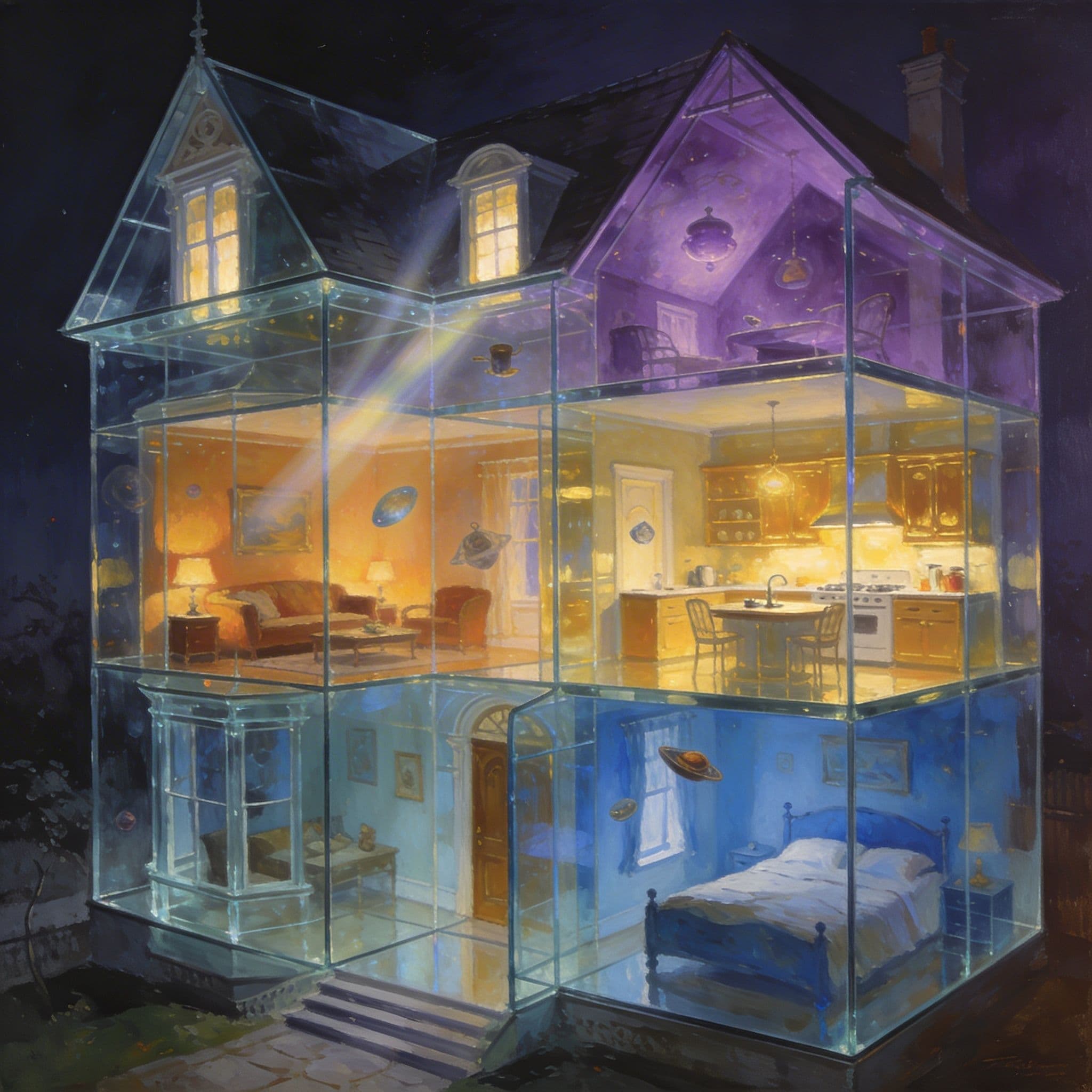
What Each Room in Your House Dreams Reveals About Your Mind
Dreaming about rooms in a house maps directly onto the architecture of your psyche, each room represents a distinct dimension of your inner life, from your public social self to your deepest buried memories. The room you find yourself in, its condition, and what you do there together form one of the most precise psychological mirrors the dreaming mind produces.
What House Room Dreams Represent
The house in a dream is you. This is not metaphor, it is the consistent finding of over a century of depth psychology, confirmed by every major school from Freud to Jung to modern cognitive dream research. Each room is a compartment of self: some you inhabit daily, some you avoid, and some you discover only in the dream state.
Had a dream about What Each Room in Your House Dreams Reveals About Your Mind?
Get your personalized AI interpretation in seconds
The rooms that appear most persistently in your dreams are the ones your psyche is currently trying to process, heal, or integrate. A home you know well but find strangely altered in a dream is not a dream about the building, it is a dream about the version of yourself that building represents.
The Psychological Perspective
Jung: The House as the Total Psyche
Carl Jung was the first to systematically map the house dream onto the structure of the psyche. For Jung, the different floors of a dream house correspond directly to different levels of consciousness: the upper floors represent aspirational, intellectual, and spiritual dimensions; the ground floor represents everyday waking consciousness and social functioning; and the basement, the most psychologically charged room in Jungian theory, represents the personal unconscious, the repository of everything repressed, forgotten, or not yet integrated.
Jung called the process of exploring these lower rooms Shadow work — the courageous descent into what has been stored out of sight. A recurring dream about a dark basement is not a nightmare to be feared. It is an invitation to integrate. The shadow does not dissolve by being avoided, it dissolves by being faced.
Freud: Rooms as Wish and Concealment
Freud viewed the rooms of a dream house through the lens of concealment and desire. Locked doors represent repressed content, wishes or memories the waking self has sealed away. Stairs between floors represent transitions between levels of awareness, and the difficulty of climbing them reflects the psychic resistance to accessing what lives above or below.
Freud was particularly interested in hidden rooms, what he interpreted as compartments of the psyche that consciousness has never fully entered. Discovering a new room in a dream was, for Freud, almost always significant: it points to a capacity, a memory, or a desire that the dreamer has not yet claimed as their own.
Cultural & Spiritual Perspectives
Islamic Dream Interpretation
In Islamic tradition, the house in a dream represents the dreamer's life, self, and family as a unified whole. Ibn Sirin taught that the condition of each room carries specific meaning: a clean, well-lit room indicates blessings, spiritual clarity, and well-being in the corresponding life area, while a dark or neglected room suggests a dimension of the self that requires attention, repentance, or renewal.
A room in which prayer is being performed represents the dreamer's connection to Allah and the strength of their spiritual practice. A locked room may indicate knowledge or blessing not yet accessible, something that will be revealed in its time. Al-Nabulsi emphasized that discovering a new room in a dream often signals an expansion of provision, awareness, or spiritual station, particularly if the room is bright and spacious. Wallahu A'lam.
Biblical & Western Perspective
In the Biblical tradition, the house as a symbol of the self appears repeatedly, most explicitly in Jesus's teaching: "In my Father's house are many rooms" (John 14:2), used to describe dimensions of divine dwelling that exceed human categories. The Western spiritual tradition treats the exploration of inner rooms as a journey toward wholeness. Teresa of Ávila's Interior Castle (1577) is perhaps the most elaborate spiritual mapping of inner rooms ever written, each "mansion" representing a deeper level of prayer, self-knowledge, and union with God.
Room-by-Room Guide
The Living Room, Your Social Self
The living room is where you present yourself to others, and in dreams it reflects your social identity, family dynamics, and public-facing persona. A cluttered, uncomfortable living room points to social anxiety, unresolved family tension, or a disconnect between who you are in public and who you are in private. A warm, well-ordered living room signals social ease and alignment between your inner and outer worlds.
The Kitchen, Nourishment and Creation
The kitchen represents how you nourish yourself emotionally and creatively, and how well you care for others. Dreams of cooking in a full kitchen often accompany creative breakthroughs or periods of active personal growth. An empty or neglected kitchen signals emotional depletion: you are giving more than you are receiving, or you have stopped attending to your own basic needs.
The Bedroom, Intimacy and Rest
The bed and bedroom govern the most private dimension of self: rest, vulnerability, and intimacy. A peaceful bedroom dream reflects inner harmony and a healthy relationship with your own needs. A chaotic or invaded bedroom points to boundary violations, either by others or by your own relentless inner critic that follows you even into rest.
The Bathroom, Release and Cleansing
The bathroom governs what you release: emotionally, physically, and psychologically. It is the room of privacy and purging. A blocked or overflowing bathroom indicates emotional content that is not moving — feelings you are holding rather than processing. A clean, functional bathroom suggests healthy emotional hygiene and the ability to let go of what no longer serves you.
The Attic, Memory and Aspiration
The attic holds what has been stored rather than discarded, memories, identities, and chapters of life that are no longer active but have not been released. Finding meaningful objects in an attic dream almost always points to rediscovering a forgotten aspect of yourself: a talent abandoned, a younger version of yourself that deserves acknowledgment, or a memory that holds something unresolved.
The Basement, The Unconscious
The basement is the most psychologically significant room in the house dream. It is where the unconscious lives, the repository of everything repressed, suppressed, or simply too heavy to carry upstairs. A dark or flooded basement reflects unprocessed emotional material pressing upward toward consciousness. A well-lit, organized basement is a remarkably positive dream sign: it means your shadow integration work is progressing and what was once threatening has become resource.
Hidden and Undiscovered Rooms
Discovering a room that should not exist, a door behind a wall, a staircase that leads somewhere new, is among the most significant dream experiences the house symbol produces. It consistently accompanies periods of genuine self-expansion: a new capability coming online, a repressed memory surfacing, or a life possibility becoming visible for the first time. The emotional quality of the discovered room tells you everything: warmth and light indicate a positive integration, while darkness and dread indicate something that needs careful, supported exploration.
The Neuroscience: Why the Brain Uses Houses
Research published in PMC confirms that dreaming serves an active emotional processing function, linking waking-life concerns to symbolic content in order to gradually reduce their psychological charge. The house, as the most familiar spatial structure the brain stores, is the default container for this processing. Your brain uses the rooms you know best as a ready-made map onto which it projects the emotional content it is currently working through.
UC Berkeley research confirms that during REM sleep, stress neurochemicals shut down while the brain actively reprocesses emotional memory, softening its psychological impact by morning. This is why the same room can appear threatening one night and peaceful the next, the processing is working. The emotional charge attached to what that room represents is being gradually reduced.
Research further confirms that REM sleep measurably reduces amygdala reactivity to previous emotional experiences, meaning the brain uses the dream state to lower the emotional intensity of difficult memories and feelings. A recurring dream about a specific room is the brain's signal that the emotional content assigned to that room has not yet been fully processed, and it will keep returning until the work is complete.
Try the Fassir Dream Interpreter, describe the room you dreamed about, its condition, and what you felt, and receive a personalized interpretation through Islamic tradition, Jungian psychology, and modern sleep science. Free, in under a minute.
Practical Application: What Should You Do?
1. Identify the Room and Its Life Counterpart
Every room maps to a life domain. Start there:
- Living room → social life, family dynamics, public identity
- Kitchen → creativity, self-nourishment, caregiving
- Bedroom → intimacy, rest, personal boundaries
- Bathroom → emotional release, privacy, letting go
- Attic → memory, aspiration, forgotten self
- Basement → unconscious, repressed emotion, shadow material
- Hidden room → emerging capacity, undiscovered potential
2. Read the Condition, Not Just the Location
A bright living room and a dark living room are different messages. The condition of the room is as important as the room itself. Ask: Is it clean or cluttered? Familiar or distorted? Welcoming or threatening? The answers point directly to the current state of the life domain that room represents.
3. Note What You Do Inside
Action inside the room matters. Cleaning points to active emotional processing. Being trapped points to feeling restricted. Renovating points to intentional self-improvement. Discovering points to expansion. The verb is the message.
4. Track Patterns Over Time
Keep a brief dream log for 30 days. Note which rooms appear, their condition, and your emotional state inside them. Patterns across multiple dreams reveal which life area your psyche is most persistently trying to process, and that is exactly where your waking attention needs to go.
5. Act on What the Room Reveals
The dream delivers the diagnosis. You supply the action. If your kitchen keeps appearing empty and neglected, the question is not "What does this dream mean?", it is "Where in my waking life am I failing to nourish myself, and what one concrete step can I take today?"
Related Dream Symbols to Explore
- Home, the whole self, overall psychological state
- Door, transition, opportunity, boundary between states of mind
- Window, perspective, desire to see beyond current limits
- Stairs, movement between levels of consciousness
- Keys, access, authority, readiness to open what has been locked
- Bed, rest, intimacy, vulnerability, private self
- Mirror, self-perception, identity, how you truly see yourself
- House on Fire, perceived threat to the self or family structure
- Flood, emotional overwhelm, feelings rising beyond containment
- Shadow, the unconscious self, Jungian repressed material
- Drowning, feeling submerged by unprocessed emotional content
- Ghost, unresolved past, emotional presence still inhabiting a space
- Room, isolated aspect of self currently under examination
- Clothes, identity, how you present yourself in each context
- Falling, loss of control, instability in a core life area
The rooms of your dream house are not random scenery. They are a precise, personalized map of where your psychological work currently lives, drawn by the most honest part of your mind, in the only hours it gets to speak without interruption.
Try the Fassir Dream Interpreter, describe your dream room in detail and receive a personalized reading combining Islamic tradition, Jungian psychology, and verified sleep science. Free, in under a minute.
For the full house symbol entry, visit the Fassir House Dream Dictionary.
Don't let the message slip away. Get a profound, personalized analysis that reveals what your subconscious is trying to tell you.
Frequently Asked Questions

A team of researchers and editors dedicated to dream interpretation, combining religious traditions, classical wisdom, psychological insight, and modern analytical methods.
Read Next

Why Your Snake Dreams Won't Go Away: A Deep Psychological Dive

That Stranger in Your Dream Isn't a Stranger at All, Here's Why

Islamic Dream Interpretation: A Complete Guide for Muslims