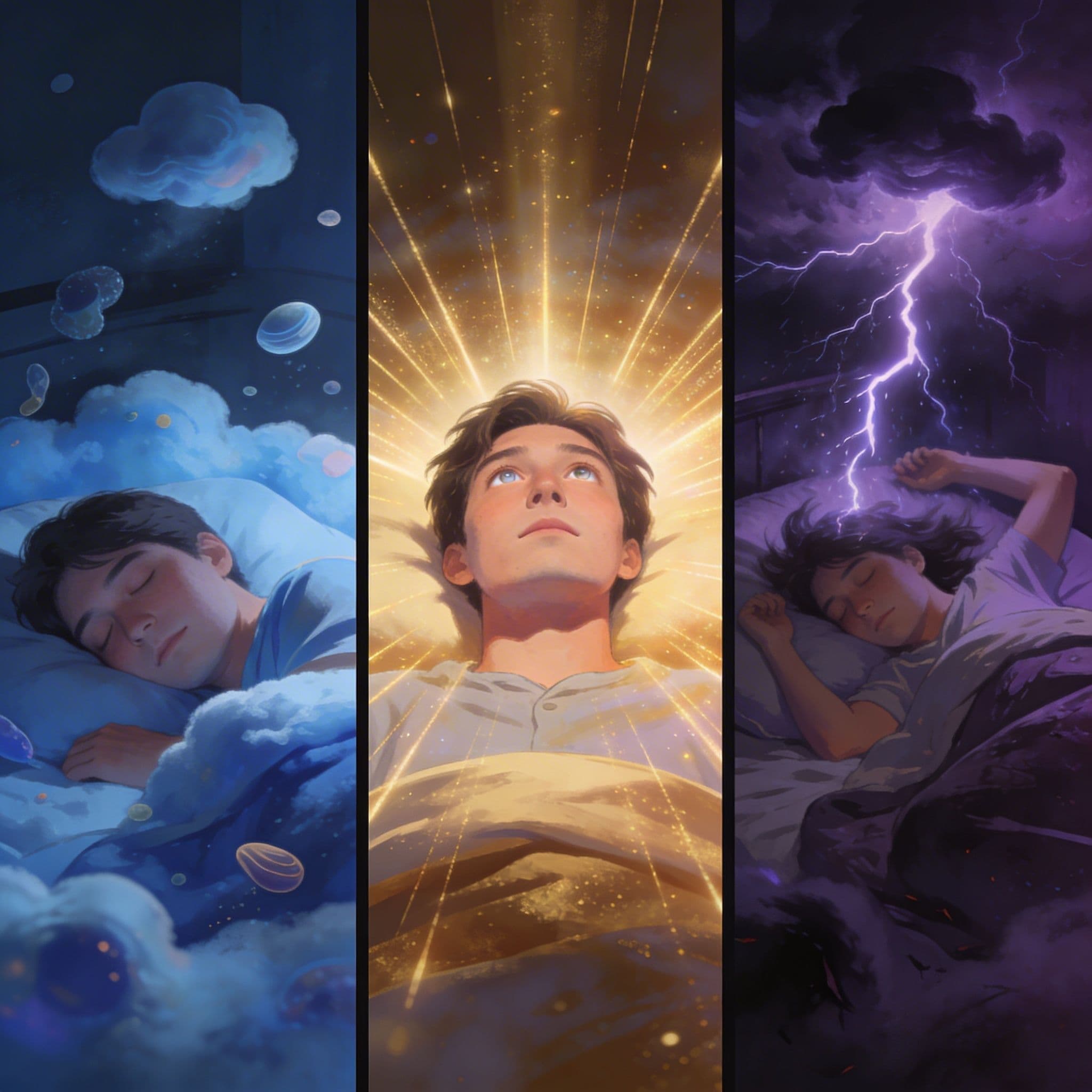
Dream vs Vision vs Nightmare: The Complete Guide
Most people use these three words interchangeably , but they describe fundamentally different mental events, each with its own neurological signature, psychological function, and emotional weight. Understanding the difference isn't just academic. It changes how you respond to what your mind produces at night.
Defining the Three States
What Is a Dream?
A dream is any spontaneous mental experience , images, emotions, narratives, sensations , that occurs during sleep, most prominently during REM (Rapid Eye Movement) sleep. Dreams are the brain's default mode during sleep: it processes memories, emotions, and unresolved experiences by weaving them into often-strange, non-linear stories.
Had a dream about Dream vs Vision vs Nightmare: The Complete Guide?
Get your personalized AI interpretation in seconds
According to research published in Dreaming and the Brain (PMC), dreaming involves a complex interplay between the limbic system, the visual cortex, and the prefrontal cortex , the same regions responsible for emotion, memory, and self-awareness during waking life.
Most dreams are emotionally neutral or mildly positive. They are not warnings, prophecies, or spiritual communications by default. They are, above all, biological.
What Is a Vision?
A vision occupies a different category entirely. Psychologically, a vision is a vivid, often singular mental experience , during sleep or waking , characterized by unusual clarity, symbolic coherence, and a strong sense of significance or external origin.
Visions have been reported across every major spiritual and religious tradition: the prophetic dreams of the Hebrew Bible, the ru'ya salihah (righteous vision) in Islamic tradition, and shamanic journeys in Indigenous cultures. What distinguishes a vision from an ordinary dream is not its content, but its quality , a felt sense that something meaningful and intentional has been communicated.
From a psychological standpoint, Carl Jung described vision-like experiences as eruptions of archetypal content from the collective unconscious , material so universally significant that it breaks through with unusual force and clarity.
What Is a Nightmare?
A nightmare is a dream with a specific emotional profile: intense fear, dread, or horror, vivid enough to wake the sleeper and leave a lasting emotional residue. Nightmares occur predominantly during late-stage REM sleep, when REM periods are longest and most emotionally intense.
Antti Revonsuo's Threat Simulation Theory frames nightmares as an extreme activation of the brain's threat-rehearsal system , the amygdala running high-stakes simulations of danger. A 2024 study in Nature confirmed that emotionally intense dreams, including nightmares, play an active role in overnight emotional memory consolidation.
How They Compare
Sleep stage
Dream: REM (any stage)
Vision: REM or hypnagogic
Nightmare: Late REM
Emotional tone
Dream: Neutral to mixed
Vision: Awe, clarity, significance
Nightmare: Fear, dread, horror
Clarity on waking
Dream: Fades quickly
Vision: Often vividly remembered
Nightmare: Lingers, hard to shake
Psychological origin
Dream: Memory & emotion processing
Vision: Archetypal / deep unconscious
Nightmare: Amygdala threat simulation
Recurrence
Dream: Variable
Vision: Rare, often singular
Nightmare: Can become chronic
Waking you up
Dream: Rarely
Vision: Sometimes
Nightmare: Frequently
The Psychological Perspective
Freud: All Three as Wish Fulfillment Gone Wrong
For Freud, all dream states including nightmares , were rooted in the same engine: the unconscious wish. Ordinary dreams disguise wishes in symbolic form. Nightmares occur when the dream's censorship mechanism fails, and the raw, threatening material surfaces directly. Visions, in Freud's secular framework, were simply highly charged dreams the conscious mind retrospectively elevated to spiritual status.
Jung: Three Distinct Levels of the Psyche
Jung offered a richer framework. He distinguished between little dreams (personal, everyday processing), big dreams (archetypal, collective, vision-like experiences carrying life significance), and the compensatory nightmare (the psyche forcibly correcting a dangerous imbalance in the conscious attitude).
For Jung, a vision wasn't superstition , it was evidence that the deepest layer of the unconscious had something urgent to communicate. He took his own visionary experiences seriously enough to document them in The Red Book.
Cultural & Spiritual Perspectives
In Islamic tradition, the Prophet Muhammad (peace be upon him) described three types of dreams: the ru'ya (true vision from God), the hulum (ordinary dream from the self), and the disturbing dream from Shaytan. This tripartite framework, preserved in the hadith literature, maps remarkably closely to the modern psychological distinction between visions, ordinary dreams, and nightmares.
In the Hebrew Bible, dreams and visions are treated as distinct divine channels , Joseph's dreams were interpretable symbols, while prophetic visions carried direct communicative weight. The Book of Joel explicitly distinguishes: "your old men shall dream dreams, your young men shall see visions."
In many Indigenous traditions, the vision quest , a deliberate, ritual induction of visionary experience through fasting and isolation , recognizes that visions operate on a different spiritual frequency than ordinary sleep dreams.
4 Ways to Tell Them Apart Upon Waking
1. How quickly does the memory fade?
Ordinary dreams dissolve within minutes of waking. If you remember a sleep experience with photographic clarity hours later , including specific colors, words, or symbolic images , that's a strong indicator of a vision-class experience.
2. What is the emotional residue?
Dreams leave a vague emotional mood. Nightmares leave fear and dread that can persist for hours. Visions leave a sense of weight or significance , not necessarily pleasant, but meaningful. The feeling that something was communicated rather than merely experienced.
3. Was there a coherent symbolic message?
Ordinary dreams are narrative but often incoherent. Visions tend to carry a symbolic logic , a single, clear image or scene that feels complete, like a message rather than a story. If you woke up thinking "that meant something specific," pay attention.
4. Is it recurring?
Recurring nightmares are a clinical concern , research consistently links them to unresolved trauma, chronic anxiety, and elevated psychological distress. A recurring vision-type dream, on the other hand, may signal an unintegrated psychological truth your conscious mind keeps dismissing.
What's Happening in Your Brain
All three states share the same sleep stage (REM) but differ dramatically in their neurochemical profile. During ordinary dreams, the brain's prefrontal cortex is partially suppressed , logical analysis is reduced, which is why dreams feel coherent while you're in them but bizarre in retrospect.
During nightmares, Harvard Medical School sleep researchers have documented significantly elevated amygdala activation , the brain's alarm system firing at high intensity, triggering the same physiological stress response as real danger.
Vision-like experiences are associated with heightened activity in the default mode network , the same brain network active during deep meditation, creative insight, and self-reflection. A 2011 review in Frontiers in Psychology noted that highly vivid, emotionally significant dream experiences involve broader and more integrated brain activation than ordinary dreaming.
Not sure which category your last dream falls into? Try the Fassir Dream Interpreter and get a personalized, psychology-backed reading that identifies what your mind is actually processing.
Practical Steps for Each Type
If it was an ordinary dream:
- Note the dominant emotion, not the narrative. That emotion is the message.
- Ask where you feel that same emotion in waking life right now.
If it felt like a vision:
- Write it down immediately and in full , every image, color, and feeling.
- Sit with it for 24–48 hours before interpreting. Visions often clarify with time.
- Look for recurring symbols across multiple dream sessions.
If it was a nightmare:
- Do not dismiss it as meaningless. Identify what the threat in the dream represents in waking life.
- If nightmares recur more than twice in two weeks, treat it as a mental health signal worth discussing with a professional.
- Practice Image Rehearsal Therapy , a clinically validated technique where you rewrite the nightmare's ending while awake to reduce its recurrence.
Related Dream Symbols
- Being Chased : the nightmare's most common signature
- Flying : the vision's most common form of liberation
- Death : appears in all three types, each time with different meaning
- Light : the defining visual marker of vision-class experiences
- Falling : the body's most common nightmare trigger
A dream processes your past. A nightmare forces you to confront what you've been avoiding. A vision points toward something you haven't yet become. All three are your mind doing exactly what it's built to do , the question is whether you're paying enough attention to hear it.
Try the Fassir Dream Interpreter and discover which category your experience falls into , and what it's asking of you.
Don't let the message slip away. Get a profound, personalized analysis that reveals what your subconscious is trying to tell you.
Frequently Asked Questions

A team of researchers and editors dedicated to dream interpretation, combining religious traditions, classical wisdom, psychological insight, and modern analytical methods.
Read Next

Why Your Snake Dreams Won't Go Away: A Deep Psychological Dive
That Stranger in Your Dream Isn't a Stranger at All, Here's Why
Islamic Dream Interpretation: A Complete Guide for Muslims