
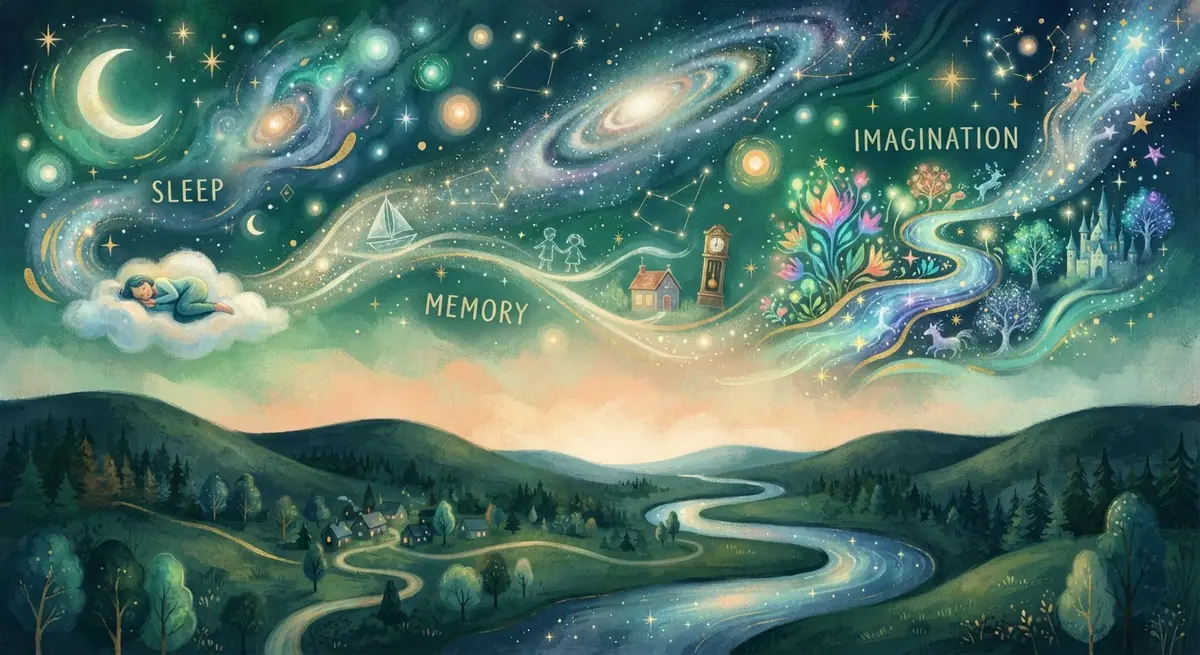
Types of dreams include ordinary, vivid, lucid, recurring, stress-related, grief-related, nightmare, claimed prophetic, and daydream-like experiences. They differ in how they feel, how often they happen, and whether you know you are dreaming—not in having one fixed meaning. A dream can reflect memories or emotions, but its content alone cannot diagnose a condition or prove that it predicts the future.
What the symbol/experience represents in dreams (general meaning)
Dreams are experiences during sleep that can include images, feelings, thoughts, and story-like events. Some are easy to recall; others fade quickly or leave only an emotion behind. There is no single dictionary that can reliably assign the same meaning to a dream for everyone.
Get your personalized AI interpretation in seconds
Here are nine common kinds of dreams and what sets them apart:
- Ordinary dreams are everyday sleep experiences that may combine familiar people, places, and recent concerns. They can feel mundane or strange without being especially vivid.
- Vivid dreams are unusually clear or emotionally intense, often with detailed scenes. Vividness describes how a dream feels, not whether it carries a special message.
- Lucid dreams involve recognizing, while still dreaming, that the experience is a dream. Some people can influence what happens, but control is not required for a dream to count as lucid.
- Recurring dreams repeat a similar scene, theme, or feeling over time. They may reflect a persistent concern, but repetition does not prove that a hidden message is being sent.
- Stress dreams often feature pressure, confusion, or being unprepared. They can accompany demanding periods, though they do not predict that something bad will happen.
- Grief dreams involve someone who has died or feelings connected with loss. They can be comforting, upsetting, or neutral; people respond to them in different ways.
- Nightmares are distressing dreams that can prompt a person to wake and remember the experience. For information on nightmares and their common themes, consider how the dream affected you rather than treating it as a forecast.
- Claimed prophetic dreams are dreams that someone interprets as foretelling an event. The claim is a spiritual or personal interpretation, not something dream content alone can verify.
- Daydream-like dreams are loose, drifting experiences around sleep or waking, sometimes with fragments of thought or imagery. They are not necessarily the same as a fully formed dream during sleep.
These categories can overlap: a recurring dream may be vivid, and a nightmare may also be lucid. The labels describe different features rather than mutually exclusive types.
The Psychological Perspective
Jung
Carl Jung viewed dreams as meaningful expressions of the psyche and explored how images might relate to a person’s inner life. In a Jungian reading, symbols may invite reflection on personal themes or tensions, but they do not have one universal definition. This is an interpretive framework, not a scientifically established decoding system.
Freud
Sigmund Freud proposed that dreams could express wishes or conflicts in disguised form. His distinction between a dream’s remembered content and a possible underlying meaning remains influential in the history of psychology, but it is not a proven method for discovering what every dream “really” means. A careful interpretation should not override the dreamer’s own context or assume that a particular image has a fixed meaning.
Both approaches can offer prompts for reflection, but neither makes a dream a diagnosis or a reliable prediction. Current psychological perspectives also consider how emotion, memory, and recent experience may shape dream content.
Cultural & Spiritual Perspective
For many English-speaking readers, Christian and biblical stories are a familiar lens for thinking about dreams. In the Bible, Joseph and Daniel interpret dreams in particular religious narratives; these accounts may inspire faith-based reflection, but they do not establish that every modern dream is a divine message. Christians may differ in how they understand dreams, and personal belief should not be presented as scientific proof.
A dream about a prophet may prompt questions about guidance or belief, but its meaning depends on the dreamer and their tradition. People seeking a specifically Islamic approach can consult Islamic dream etiquette; that is a distinct tradition, not a default interpretation for all readers.
Common Scenarios
- A dream about arriving unprepared at work: It may echo pressure or concerns about performance, especially during a demanding period. An office dream is not evidence that you will fail at work.
- A familiar scene that repeats: The repeated setting or emotion may be worth noting alongside current life stressors. A recurring dream is not, by itself, proof of a hidden trauma or a supernatural warning.
- Realizing you are dreaming while the scene continues: This is the defining feature of a lucid dream. You may be able to change the scene, but many lucid dreamers have limited control.
- Dreaming of someone who has died: The dream may bring up memories, affection, unresolved feelings, or simply an unexpected image. A ghost dream should not be treated as proof of contact with the dead.
- A dream that seems to foretell a choice or event: People may interpret such dreams as prophetic, especially when a later event feels similar. Similarity after the fact does not establish that the dream predicted it.
- A vivid dream that fades soon after waking: Strong detail can make a dream feel important, but vividness alone does not show that it has a special meaning. Writing it down promptly may help preserve what you remember.
- A drifting image as you fall asleep or wake: Brief, dream-like impressions can happen around the transition between sleep and wakefulness. A crossroads dream may be used as a personal reflection prompt, not as a universal sign that a major decision is required.
Explore more dream themes with Fassir’s dream interpretation guides.
The Neuroscience / Physical Dimension
Dreaming is not limited to one sleep stage. Research reviews challenge the idea that dreams happen only during REM sleep; people can also report dreams after waking from non-REM sleep (review of REM sleep and dreaming). REM dream reports are, on average, more vivid, emotional, and story-like than non-REM reports, though there is variation (comparison of REM and non-REM dream reports).
Studies have also linked dream reports in both REM and non-REM sleep with changes in brain activity, including findings in posterior brain regions (high-density EEG study of non-REM dreaming). This research helps describe sleep and dream experiences, but it does not provide a universal key to what a particular dream means.
People vary in how often they remember dreams and which kinds they recall (research on individual differences in dream recall). Stress, sleep disruption, medication, and health can affect sleep or dream experiences; if disturbing dreams are frequent or interfere with daily life, a qualified healthcare professional can help assess what may be contributing.
Practical Application: What Should You Do?
- Write down what you remember. Note the scene, feelings, and any details that stood out soon after waking.
- Name the kind of experience. Was it vivid, recurring, lucid, upsetting, or more like a drifting image near sleep?
- Connect it to your own context. Consider recent events, stress, memories, and emotions without assuming a symbol has one fixed meaning.
- Choose a grounded response. If the dream raises a practical concern, identify one realistic step you can take while awake. Avoid making major decisions solely because of a dream.
- Seek help when needed. If nightmares or disrupted sleep persist or affect daily life, talk with a qualified healthcare professional.
Related Dream Symbols
Explore your dream themes with Fassir.ai.