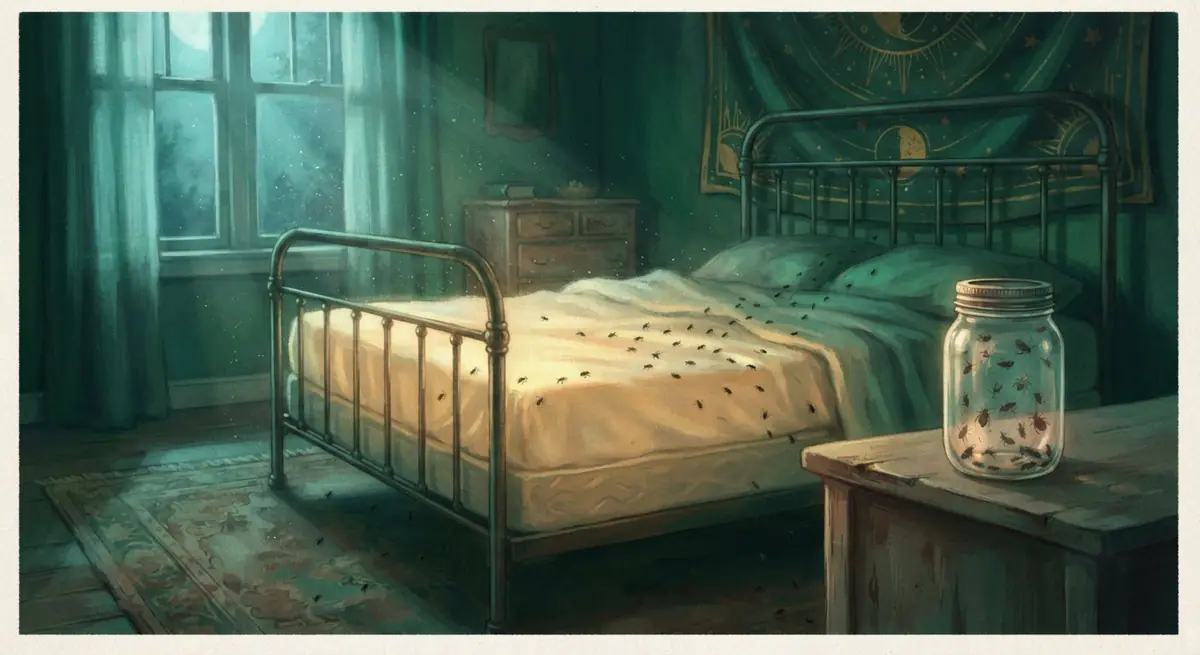
Dreaming about bedbugs commonly points to persistent irritation, hidden stress, violated boundaries, or a problem that survives repeated attempts to remove it. Psychologically, their nighttime biting links the symbol with anxiety, hypervigilance, shame about domestic or intimate life, and small resentments that have multiplied. Finding them in one’s own bed may reflect compromised rest, sexuality, privacy, or trust; finding them in a hotel or another person’s room can suggest unfamiliar influences or suspicion. Spiritually, bedbugs may represent parasitic attachments, draining relationships, envy, impurity, or neglected disorder requiring cleansing and discernment. Killing them often signifies reclaiming authority, while being covered by them warns that avoidance has allowed a minor concern to become overwhelming. Traditions differ: some treat insects as enemies or troublesome dependents, while modern dream psychology emphasizes the dreamer’s bodily sensations and personal associations. The most favorable reading arises when the infestation is exposed, contained, and eradicated; the omen is therefore mixed, with the dream’s emotional tone and outcome decisive.
Get your personalized AI interpretation in seconds
How each tradition reads dreams about Bedbugs
Carl Jung (Archetypes)
Man and His Symbols (1964)
In Jungian analysis, bedbugs are best understood through the personal unconscious and the archetype of the shadow rather than through a fixed dictionary definition. They are small, hidden, nocturnal, and parasitic: qualities that can represent disowned irritation, shame, envy, resentment, or a need that the conscious personality refuses to acknowledge. Their location is decisive. Bedbugs in the dreamer’s own bed invade the temenos of rest, intimacy, and psychological renewal; they may show that the persona’s orderly daytime life is not integrated with troubling feelings beneath it. Bedbugs on a partner’s side of the bed can constellate projections onto the relationship, while insects on the dreamer’s own body suggest that the rejected material has become difficult to keep separate from identity. A swarm may indicate a complex: many small associations organized around one emotionally charged issue. If the dreamer sees only a single insect, the shadow may be approaching consciousness in a manageable form. Crushing bedbugs can represent necessary discrimination, but frantic extermination may show the ego trying to destroy an archetypal message instead of relating to it. A dream in which the insects are placed in a jar, examined, or transformed into harmless creatures suggests the beginning of integration. In a man’s dream, bedbugs may constellate an unacknowledged anima disturbance involving intimacy, dependency, or feeling; in a woman’s dream, the same imagery may involve animus-driven criticism or invasion, though gender does not determine the meaning. The Self is suggested when sunlight, fresh air, or a reorganized room restores proportion. Jungian interpretation therefore asks what “bedbug” personally evokes and what psychic attitude permits the infestation, rather than declaring it simply evil.
Sigmund Freud (Desire)
The Interpretation of Dreams (1899)
Freud would not assign bedbugs one universal meaning; he would investigate the dream’s latent content, childhood memories, bodily stimuli, and the wishes disguised by its manifest scene. Because bedbugs bite during sleep and provoke disgust, the dream may incorporate an actual itch or anxiety about infestation, but the insect can also condense several associations. Their hidden feeding may symbolize a person or obligation secretly taking from the dreamer, while the bed places the material near sexuality, sleep, regression, and the private family sphere. A married dreamer who finds bedbugs between the sheets might be expressing ambivalence about intimacy: desire for closeness coexisting with fear of contamination, betrayal, or loss of autonomy. A single dreamer may connect the insects with forbidden curiosity, shame around masturbation, or an internal censor that punishes pleasure; such possibilities require associations, not assumption. Dreaming of discovering bedbugs in a child’s bed could disguise the parent’s own helplessness, jealousy, or fear of failing to protect, rather than predict danger to the child. Killing the insects may fulfill a wish to master an irritating rival, creditor, sexual rival, or intrusive family member. Failing to kill them can preserve the latent conflict because the wish for control is opposed by guilt or helplessness. A swarm may be dream-work’s condensation of many minor grievances into one disgusting image; a single enlarged bug may displace a more threatening person onto a manageable object. Freud would also examine who supplied the bedding, whether the dreamer recently traveled, and what “bedbug” meant in childhood or family speech. Interpretation rests on free association and the pleasure, anxiety, or disgust accompanying the scene—not on a fixed omen.
Other traditions
Ibn Sirin (Islamic Core)
Muntakhab al-Kalam fi Tafsir al-Ahlam (attributed)
Bedbugs are not a securely attested, separately defined entry in the surviving books attributed to Ibn Sirin; a responsible reading therefore applies his method for small, harmful creeping creatures rather than claiming a verbatim ruling. In that method, the dreamer’s condition, the insect’s number, its location, and the harm it causes determine the meaning. A few bedbugs on one’s garment or bedding may indicate a weak but irritating enemy, an importunate dependent, or a person who speaks unpleasantly without possessing real power. Bedbugs biting the dreamer make the warning more personal: an adversary, creditor, subordinate, or household nuisance is extracting benefit or causing humiliation. If the insects remain hidden while the dreamer feels bites, concealed hostility or suspicion is emphasized. Seeing them in another person’s bed directs the concern toward that household, relationship, or person’s conduct rather than the dreamer’s own body. Killing bedbugs, sweeping them away, or washing the bedding is favorable and signifies overcoming a petty enemy, settling a nuisance, or correcting domestic disorder. Finding many insects emerging from cracks, clothing, or a mattress intensifies the interpretation into numerous weak opponents or accumulated grievances. If the bedbugs are dead, dried, or unable to bite, their harm is already declining. For a sick person, persistent biting may reflect bodily discomfort and should not be treated as a prophecy; for a traveler, insects in an unfamiliar lodging may signify an unpleasant host or unsafe company. The classical principle is concrete: the dream’s injury, concealment, and final victory matter more than the insect’s mere appearance.
Al-Nabulsi
Ta'tir al-Anam fi Ta'bir al-Manam
Al-Nabulsi’s interpretive vocabulary commonly treats vermin and harmful insects through their effects: a creature that bites, consumes, hides, or multiplies can signify a troublesome person, an encroaching concern, or weakness within the household. Bedbugs specifically are not reliably preserved as a distinct, extensively elaborated symbol in his major dream manual, so this entry is an informed application of that vocabulary, not a fabricated quotation. A bedbug in the sleeper’s bed points to an intimate nuisance: a dependent who abuses hospitality, a quarrel within the family, or an influence disturbing rest and marital privacy. A swarm may signify many weak adversaries; their abundance does not necessarily mean that any one enemy is powerful. If they crawl over the body without biting, the dream may show fear of contamination or intrusive company, while actual bites indicate measurable loss, criticism, or hurt. Bedbugs emerging from a wall, mattress, or garment suggest that a concealed matter has become visible in the place where it was sheltered. Removing them by fire, washing, fumigation, or crushing them is a sign of purification and relief, provided the remedy does not destroy the house or injure the dreamer. A traveler who finds bedbugs in an inn may be warned about an inhospitable destination or dishonest companions; a poor person may see them as the pressure of creditors or dependents; a ruler or employer may see them as petty informers and resentful subordinates. Their disappearance without effort can indicate that a nuisance will fade, whereas discovering new insects after cleaning warns of incomplete reform. Al-Nabulsi’s broader principle also requires attention to the dreamer’s religious and physical state: illness, itching, and recent exposure can produce a bodily dream rather than an omen.
Imam Sadiq
No securely authenticated, classical text gives Imam Ja'far al-Sadiq a specific, independent interpretation of modern bedbugs. Later dream dictionaries often assign insect symbols to several possible categories associated with his attributed method—enemy, wealth, benefit, distress, or household matter—yet those attributions are frequently secondary and should not be presented as direct sayings. Applied carefully, bedbugs favor the category of a weak but persistent enemy or a person who lives from another’s resources. One bedbug on a pillow may represent a single intrusive relationship, a secret resentment, or a small obligation disturbing thought. Bedbugs feeding on blood sharpen the image of depletion: the dreamer may feel exploited by a relative, servant, colleague, or intimate partner. If the dreamer catches and kills them, the sign turns favorable, showing discernment and the defeat of a nuisance. If the insects multiply after each attempt to crush them, the dream points to a problem being treated superficially; the cause, not merely the visible pests, must be removed. Bedbugs on a spouse’s clothing may indicate suspicion or domestic tension, but they do not prove infidelity. On a child’s bedding, they may express protective anxiety or concern over the child’s environment. Seeing them on a stranger’s bed directs the warning toward that person or a situation associated with them. Dead bedbugs, clean sheets, or sunlight entering the room signify disclosure, recovery, and the restoration of order; a dark, sealed room with biting insects indicates concealed harm and spiritual or emotional heaviness. Under this cautious reading, the symbol is neither automatically an omen of poverty nor a guaranteed prediction. The dreamer’s conduct, the insects’ power to harm, and the ending determine whether the sign falls under warning or relief.
Biblical Tradition
The Bible (Old Testament)
Bedbugs are not named as a developed dream symbol in the canonical Old or New Testament. Biblical interpretation should therefore distinguish the actual text from later Christian applications of plague, vermin, uncleanness, and devouring creatures. A bedbug dream may evoke the Exodus plagues, especially the broader biblical image of small creatures exposing human powerlessness before disorder, but it should not be equated mechanically with divine judgment. Because the bed is associated with rest, marriage, vulnerability, and private life, insects in it can symbolize hidden corruption within a household, neglected sin, or anxiety that prevents peace. Bedbugs biting a person may portray oppression by a “small” but persistent affliction, recalling the scriptural theme that little things can trouble the mighty. A swarm covering clothing or a home may function as a warning to examine habits, injustice, dishonesty, or relationships that consume others quietly. Yet biblical wisdom also resists reading every disturbing dream as prophecy: Ecclesiastes links dreams with the abundance of concerns, and Scripture repeatedly calls for discernment rather than superstition. Killing the insects, cleansing the bed, or seeing daylight enter the room can symbolize repentance, confession, protection, and restored order. If another person’s bed is infested, the dreamer should not presume guilt; it may instead reveal judgmental suspicion or a call to compassionate help. For a believer, prayer and practical cleaning belong together: spiritual vigilance does not replace ordinary care. The strongest biblical reading is moral and relational—hidden harm should be brought into the light, the vulnerable should be protected, and fear should not become a false accusation. The omen is a warning with a path toward deliverance, not a fixed decree.
Christian Tradition
Christian mysticism generally treats bedbugs as an image of subtle attachment: something small, concealed, and parasitic that feeds on the soul’s peace. This is an application of mystical themes—discernment of spirits, purification of the heart, vigilance, and the struggle against disordered loves—not a universally authorized Christian symbol. Bedbugs in the cell, bedroom, or bed may indicate that prayer, contemplation, marriage, or bodily rest has been invaded by resentment, compulsive thought, envy, or a draining relationship. Their nocturnal feeding is especially apt for hidden habits that grow when consciousness is relaxed. A swarm can represent the multiplication of small concessions: gossip, vanity, bitterness, or fear that individually seem harmless but collectively make the interior life inhospitable. If the dreamer is bitten but cannot find the source, mystical discernment asks what repeatedly steals charity, attention, or gratitude. Discovering the insects and exposing them to light suggests confession and truthful self-examination. Washing linens may symbolize baptismal renewal or a deliberate change of habit; killing the pests may signify renunciation, while merely moving to another room warns that avoidance is not conversion. Bedbugs on another person’s bed should be handled cautiously: the vision may call the dreamer to intercession or compassionate boundaries, not condemnation. A priest, monastic, or caregiver might dream of them as a sign of spiritual exhaustion caused by serving without rest. Conversely, a clean bed after prayer can represent consolation and recovered peace, though it does not guarantee immunity from future temptation. Christian mysticism holds together spiritual and practical causes: one should pray, seek wise counsel, and inspect the physical environment. The symbol becomes hopeful when the dream leads to humility, mercy, and disciplined cleansing rather than fear of invisible enemies.
Zhou Gong
Zhou Gong Jie Meng (周公解梦)
Bedbugs do not have a uniformly established, ancient entry in the received Zhou Gong dream manual, and modern Chinese dream websites often extend older insect categories to contemporary household pests. Within that traditional framework, insects may signify petty people, troublesome affairs, material gain, or worries, with the result depending on whether they harm, multiply, or are removed. Bedbugs in one’s own bed are read most naturally as a disturbance of household peace, private security, or sleep. A few insects may indicate minor quarrels or a small but persistent expense; a dense infestation suggests many petty entanglements rather than one formidable enemy. If the dreamer is bitten, the image emphasizes loss of energy, reputation, or money through annoying people. Seeing bedbugs on a guest’s bedding can reflect distrust of visitors or concern that another person brings disorder into the family. Finding them in a rented room or inn may symbolize an unsuitable journey, unreliable companions, or an environment that looks acceptable but is not safe. Washing sheets, exposing the mattress to sunlight, burning infested bedding, or killing the insects generally reverses the omen: the dreamer has found a practical means to restore order and remove hidden trouble. Bedbugs fleeing toward a door may indicate that a dispute is leaving, while insects continuing to emerge from walls warn that the underlying household issue remains. For a merchant, the swarm can represent numerous small losses or nagging customers; for a student, scattered insects may mirror distracting worries; for an ill person, the dream may simply echo itching or disturbed sleep. Chinese interpretation also values the dream’s emotional color: relief after cleaning favors resolution, whereas disgust and helplessness indicate unresolved pressure. The symbol is therefore conditional, not automatically unlucky.
Hindu / Vedic
Swapna Shastra does not offer one universally standardized classical entry for modern bedbugs, and regional dream manuals differ in their treatment of insects. A careful Hindu reading places the image within broader ideas of impurity, disturbance, hidden depletion, karmic residue, and the psychological effects of rajas and tamas. Bedbugs in one’s sleeping place disturb rest and may signify tamasic heaviness, unresolved domestic friction, or an attachment that consumes prana through repeated worry. A few insects can indicate a small but recurring obstacle; a swarm suggests accumulated samskaras or many minor obligations obscuring clarity. Bites or blood-feeding make the theme one of vitality being drained by a person, habit, debt, or emotional fixation. If the dreamer sees bedbugs on a spouse’s bedding, the image may reflect relationship tension and disturbed household dharma, not proof of misconduct. On a child’s bed, it may express protective concern and the duty to maintain a wholesome environment. Killing the insects, cleaning the room, changing the sheets, or seeing bright sunlight enter the space generally supports a favorable interpretation: tamasic disturbance is being reduced and order restored. If the insects disappear after bathing or ritual purification, the dream may symbolize readiness to release accumulated impressions; if they return despite cleansing, practical and behavioral causes still require attention. A householder may read the dream as a prompt to repair boundaries and routines, while an ascetic may see it as a warning about subtle attachment to comfort, irritation, or bodily identification. Hindu thought also recognizes dreams produced by recent sensory impressions, illness, and disturbed sleep. Thus the proper response is neither panic nor fatalism, but sattvic clarification: cleanliness, calm reflection, ethical action, and, according to one’s practice, prayer or mantra.
Japanese (Yume Uranai)
In Japanese 夢占い, bedbugs are a modern household-pest image rather than a major, consistently attested symbol in older classical dream lore. Contemporary interpretation usually combines the insect’s smallness, hidden movement, biting, and association with bedding. The bed represents rest, private space, romance, and recovery; bedbugs therefore suggest a nagging stress, an invasive relationship, or a problem that is undermining mental and physical refreshment. Seeing one bedbug may point to a specific worry that has been overlooked, while many bedbugs indicate accumulated minor frustrations, social pressure, or anxieties multiplying through attention. Being bitten can symbolize feeling criticized, exploited, or unable to relax; discovering bites without seeing insects suggests unease whose source remains unclear. Bedbugs in a hotel bed may reflect apprehension about travel, unfamiliar environments, or adapting to other people’s expectations. In a partner’s bed, the dream often concerns insecurity or communication rather than literal betrayal; on a child’s bedding, it may express protective overconcern. Killing a bedbug is commonly favorable, representing problem-solving and the recovery of control. Cleaning the room, washing bedding, or finding the insects exposed in daylight strengthens the positive reading: hidden stress has become manageable. If the bugs escape into walls or return after extermination, the dream warns that avoidance or temporary reassurance has not addressed the root issue. Japanese dream reading also pays attention to the dreamer’s feeling: disgust suggests rejection of an unwanted burden, fear suggests vulnerability, and calm observation suggests readiness to handle a practical problem. Recent pest exposure, poor sleep, or skin irritation can produce the image directly. The most balanced interpretation is a prompt to restore boundaries, communicate clearly, and remove small irritants before they damage well-being.
Don't let the message slip away. Get a profound, personalized analysis that reveals what your subconscious is trying to tell you.
Interpret your Bedbugs dream with AIDream Scenarios
Common Questions & Scenarios
What does it mean to dream about bedbugs?
What does it mean when you dream of bedbugs biting you?
Is dreaming about bedbugs a bad sign?
What does it mean to dream of bedbugs in your house?
Why do I keep dreaming about bedbugs?
Written with AI from the traditions named on this page and maintained by the FASSIR English Editor. Last updated . How we interpret dreams
Disclaimer: This analysis utilizes AI based on historical and psychological texts for educational and spiritual insight. It does not constitute professional medical or psychological advice.