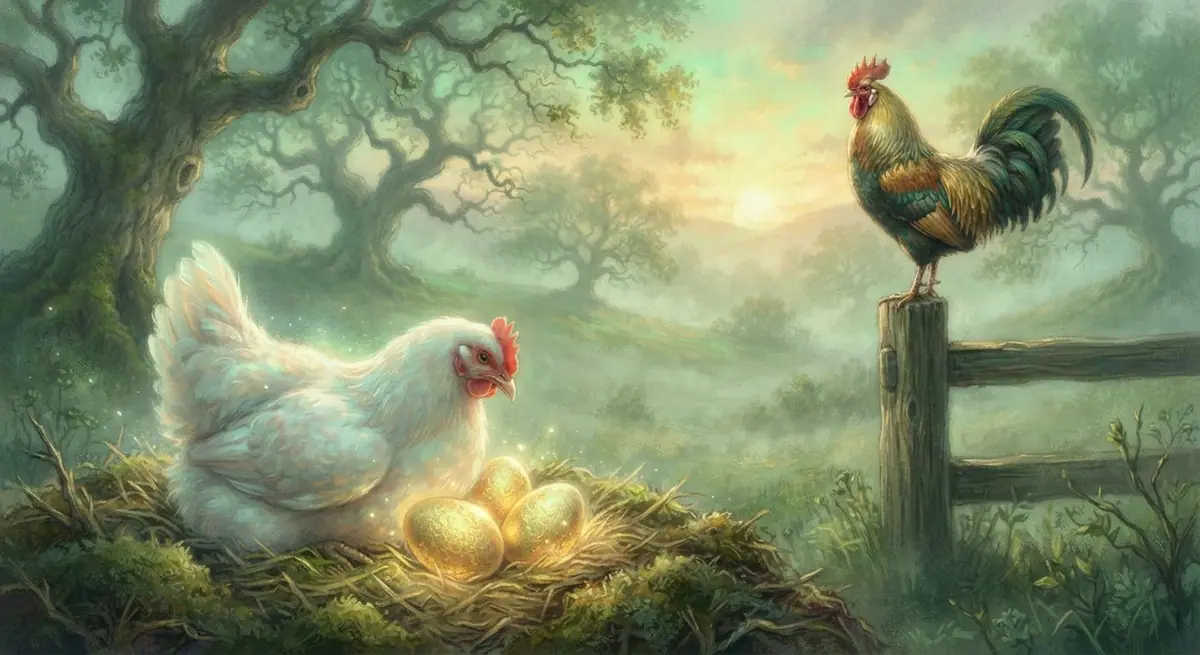
Dreaming of a chicken often centers on nourishment, domestic responsibility, fertility, social alertness, and the tension between ordinary security and exposed vulnerability. Psychologically, a calm hen may reflect caregiving, practical self-sufficiency, or a wish for a protected home; a noisy, fleeing, or pecking chicken can represent scattered attention, gossip, timidity, or anxiety about being judged. Eggs emphasize potential and patient development, while a cooked or slaughtered bird may symbolize sacrifice, completion, or resources made available. Spiritually, chickens can carry themes of watchfulness and renewal: the rooster announces dawn, while the hen shelters life under her care. In Islamic, Chinese, Hindu, Japanese, biblical, and Christian readings, the meaning depends strongly on the bird’s condition, the dreamer’s circumstances, and the emotional tone. A healthy flock may suggest provision and communal fortune, whereas illness, blood, or a trapped bird warns of depleted vitality, household conflict, or opportunities mishandled. The symbol is therefore best read as context-sensitive rather than automatically lucky or ominous.
Get your personalized AI interpretation in seconds
How each tradition reads dreams about Chicken
Carl Jung (Archetypes)
Man and His Symbols (1964)
From a Jungian perspective, the chicken is an image of instinctive, embodied life operating close to the ground. It belongs to the archetypal field of the nourishing mother, the communal flock, the watchful herald, and the vulnerable creature that survives through rhythm rather than abstraction. A dreamer who has become excessively intellectual or isolated may meet a hen as a compensatory reminder of food, routine, sexuality, rest, and ordinary belonging. A hen brooding eggs can represent psychic contents incubating in the unconscious; the dreamer should not force them into consciousness before they are ready. Chicks suggest emerging possibilities or fragile parts of the personality needing containment.
The rooster introduces a different charge. Its dawn call may be an archetypal summons to consciousness, individuation, or a neglected responsibility. A confident rooster can embody healthy assertion and solar energy; an inflated or strutting rooster may reveal the shadow of vanity, performative masculinity, or a persona built around being heard. A flock moving in panic may mirror a collective complex: the dreamer’s thoughts are following social contagion rather than an inner center. Being pecked by chickens can indicate that minor, disowned irritations are demanding recognition.
The shadow appears when the dreamer despises the bird as foolish, dirty, or commonplace. That reaction may disclose rejected instinct, dependence, domestic labor, or fear of appearing ordinary. A dead chicken can mark the loss of vitality, but it can also signal the end of a narrowly adaptive identity. Eating chicken may symbolize assimilating instinct into consciousness; seeing a raw carcass suggests that the transformation is incomplete. Jungian interpretation therefore asks who the chicken resembles in the dreamer’s inner life, what feeling accompanies it, and whether the bird is moving toward individuation or merely repeating flock behavior. The anima may appear through the hen as an image of receptivity and life-bearing relatedness, while the rooster may constellate an assertive counterpart.
Sigmund Freud (Desire)
The Interpretation of Dreams (1899)
Freudian interpretation does not assign chicken a universal dictionary meaning; it treats the bird as manifest dream material whose latent content is shaped by childhood experience, recent impressions, bodily wishes, and repression. A chicken in a kitchen may be connected with remembered family meals, parental authority, or the wish to be cared for, while the same bird in a crowded yard may condense anxieties about exposure, competition, and social judgment. The analyst would ask what the dreamer associates personally with hens, eggs, feathers, slaughter, or the phrase “chicken.”
Eggs can become a condensation of fertility, pregnancy wishes, generative potential, or anxiety about bodily change. For a person preoccupied with parenthood, collecting eggs may express wish-fulfilment: possessing something valuable, protected, and capable of continuation. A cracked egg may give form to fear of failure, loss, or damage caused by forbidden curiosity. The hen sitting on eggs can evoke the desired maternal shelter, but it may also represent confinement and the ambivalence of dependence. A rooster’s crow may carry a phallic or competitive meaning, especially if the dreamer links it with sexual potency, paternal authority, or the demand to awaken and perform.
Eating chicken may fulfill a wish for nourishment, comfort, or aggression safely transformed into food. Slaughtering or plucking the bird could express hostile impulses toward a rival or parent, guilt about those impulses, or an attempt to master fear by controlling the threatening object. A fleeing chicken may be the dreamer’s own cowardice projected outward; being chased by one can reverse the projection and make a disavowed impulse return as persecutor. Freud would also examine puns, memories, and the dream’s day residue rather than impose a spiritual verdict. The emotional tone, substitutions, and free associations reveal whether the chicken serves wish-fulfilment, anxiety, guilt, or compromise formation.
Other traditions
Ibn Sirin (Islamic Core)
Muntakhab al-Kalam fi Tafsir al-Ahlam (attributed)
In the classical Islamic dream vocabulary associated with Ibn Sirin, a chicken is read through the dreamer’s condition, the bird’s behavior, and the household setting rather than as a fixed universal sign. A hen may represent a woman of the house, a servant, or a person who provides practical benefit; her eggs point to children, property, or attainable gain. For a married person, seeing a healthy hen entering the home can indicate domestic provision or a useful woman’s assistance. A hen laying eggs suggests profit that develops in stages, while gathering eggs indicates collecting lawful benefits. Broken eggs, an injured hen, or eggs taken before they mature warn of loss, quarrels, or mishandled opportunity.
A rooster is associated with a man who has authority, a caller to prayer, or a person whose voice is heard without necessarily possessing great power. Hearing its crow at an appropriate time may signify awakening, religious duty, or news; an untimely or disturbing crow can indicate dispute, an intrusive person, or anxiety. Slaughtering a chicken may mean receiving food, money, or relief after effort, but for someone responsible for a household it can also point to sacrificing a domestic comfort. Eating cooked chicken generally signifies benefit and provision, especially when the meat is wholesome; raw, rotten, or bloody flesh reverses the indication toward backbiting, illness, or questionable gain.
A flock that is calm and well-fed favors abundance and family stability. Scattered, stolen, or dead chickens suggest dissipated resources, household disorder, or the loss of a dependent. For a poor dreamer, a chicken may promise modest but concrete sustenance; for an official or wealthy person, it may instead expose obligations toward those under his care. Fear felt during the dream is significant: a bird that merely appears harmless should not be made ominous without supporting details.
Al-Nabulsi
Ta'tir al-Anam fi Ta'bir al-Manam
Abdul Ghani al-Nabulsi treats the chicken within a broader symbolic network of domestic life, livelihood, women, children, and the voice that summons a person from heedlessness. In his interpretive method, a hen can signify a woman who manages a household or a servant whose labor produces benefit. Seeing her in one’s house is favorable when she is healthy, clean, and settled; seeing her depart, become lost, or die can indicate disruption in domestic support. For a married dreamer, a hen with chicks may reflect family increase and the duties of protection. For someone seeking employment, a well-kept chicken may signify a small but reliable source of income rather than sudden wealth.
The rooster has a more public dimension. Its crow can represent the muezzin, a man who calls others to right conduct, or a warning that time is passing. A rooster fighting another rooster may portray rivalry between men, competing claims to authority, or a quarrel in which pride exceeds the material issue. Catching a rooster can mean gaining influence over a loud or commanding person; losing it may signal diminished authority. If the rooster attacks the dreamer, Nabulsi’s contextual approach favors interpreting the scene as conflict with a blunt speaker or an intrusive superior, particularly when the dreamer already faces disputes.
Eggs signify concealed beginnings and property that has not yet been opened. Many sound eggs may indicate accumulated provision, children, or projects; cracked eggs warn that something promising is vulnerable. Eating chicken cooked with a pleasant taste denotes benefit obtained after preparation, whereas raw flesh is linked with blameworthy speech or an impatient taking of benefit. A dead or diseased bird is a warning of wasted livelihood and neglect. Nabulsi would also distinguish the dreamer’s status: a traveler may see the chicken as provisions for the journey, while a householder sees it primarily through family and domestic obligations.
Imam Sadiq
Interpretations attributed to Imam Ja'far al-Sadiq commonly organize a chicken dream by its possible meanings rather than by one rigid omen. The hen may indicate a woman, a servant, livelihood, a child, or a household matter requiring care. Which meaning prevails depends on the dreamer’s circumstances and on whether the bird is useful, vulnerable, aggressive, or dead. A person hoping to marry who sees a composed, fertile hen may be contemplating a capable household partner; a parent who sees a hen sheltering chicks is more directly encountering responsibility, protection, and concern for descendants. The same image for a merchant may signify stock, food, or modest recurring profit.
Eggs are especially significant as concealed potential. Finding a sound egg can suggest a benefit, child, or opportunity; finding many eggs may promise increase but also warn that abundance creates obligations. A broken egg, an egg stolen from the nest, or a chick unable to hatch indicates frustration, premature action, or fear that a plan will not reach completion. Eating cooked chicken can signify lawful enjoyment and a benefit made accessible through work. Eating raw meat, seeing blood, or taking a bird unjustly introduces the themes of suspicion, harmful speech, and gain acquired without proper balance.
The rooster carries the signs of announcement, masculine authority, and religious awakening. Its timely crow may urge prayer, repentance, or attention to an approaching duty. A silent rooster can portray a neglected truth; an aggressive rooster may reflect pride or a quarrelsome man. For a person in hardship, a healthy flock suggests several small avenues of relief rather than one miraculous rescue. For someone already prosperous, dead or starving chickens caution that blessings can disappear through negligence. In this attributed Shi'i framework, the dream’s moral quality matters: care, cleanliness, and gratitude strengthen the favorable reading, while cruelty, waste, and fear of accountability darken it.
Biblical Tradition
The Bible (Old Testament)
Biblical tradition does not provide a fixed dream-dictionary entry for chicken, so interpretation must begin with the bird’s scriptural associations and the dream’s moral setting. The rooster is most strongly linked with Peter’s denial of Jesus: its crow marks recognition, remorse, and the dawning of truth after human weakness. A dream of a rooster crowing may therefore confront a person with a broken promise, fear of confessing, or a call to wake spiritually. It need not predict betrayal; it can signify the moment when conscience becomes impossible to ignore.
The hen evokes protective care in Jesus’ lament, “How often I wanted to gather your children together, as a hen gathers her chicks under her wings.” A hen sheltering chicks can thus symbolize divine compassion, refuge, covenantal protection, or a parent’s responsibility. If the dreamer is hiding beneath the bird’s wings, the image may speak of a need for safety and trust; if chicks are scattered, it may expose spiritual dispersion, family anxiety, or resistance to shelter. A threatening or abandoned hen reverses the image into neglected care.
The ordinary chicken also belongs to the biblical world of food, sacrifice, household labor, and creaturely dependence, though Scripture’s sacrificial vocabulary centers more prominently on other birds. A cooked bird on a table may represent provision and gratitude, while blood, cruelty, or waste raises questions about violence, stewardship, and the treatment of the vulnerable. Eggs may suggest hidden life and providential potential, but biblical interpretation should avoid claiming a specific prophecy from them. For a believer, the dream is tested by repentance, charity, and alignment with Scripture rather than by fortune-telling. A healthy flock can symbolize communal flourishing; a dead or starving flock can function as a warning to restore neglected responsibilities and return to truthful, protective care.
Christian Tradition
Christian mysticism reads the chicken less as a code for future events than as a humble creature through which divine teaching may become perceptible. The hen is a contemplative image of gathered life: wings shelter what is small, warmth sustains what cannot yet stand, and patient sitting honors hidden growth. A dreamer overwhelmed by fear may see a hen enclosing chicks as an invitation to enter recollection, trust, and the protective love traditionally associated with Christ. If the dreamer is the one gathering scattered chicks, the image may indicate a vocation of mercy, spiritual direction, parenting, or reconciliation.
The rooster belongs to watchfulness. Its crow at dawn can represent the soul’s awakening, the call to prayer, or the painful grace of recognizing a denial, attachment, or false self. In monastic symbolism, morning naturally suggests vigilance and renewal. A rooster that crows repeatedly in darkness may indicate scrupulosity or a conscience unable to rest; discernment is needed to distinguish a genuine summons from anxiety. A proud, noisy rooster can expose vanity, spiritual competition, and the temptation to display holiness rather than practice it.
Eggs lend themselves to the mystical theme of hidden life. A dream of protecting an egg may encourage patience with a vocation or virtue not yet mature. A broken egg may signify grief, but it can also expose attachment to controlling outcomes. Eating chicken at a shared table may symbolize fellowship and gratitude for material provision; refusing food or seeing a wasted carcass may point to contempt for embodied life. Christian discernment attends to the fruit of the dream: humility, compassion, truth, and hope support a constructive reading, whereas pride, fear, and condemnation require caution. Prayer, pastoral counsel, and ethical action are more reliable than treating the bird as an automatic omen.
Zhou Gong
Zhou Gong Jie Meng (周公解梦)
In the Zhou Gong dream tradition, the chicken is commonly read through household prosperity, rank, food, family increase, and the distinction between a living bird and prepared meat. A rooster appearing in a household can signify recognition, news, or a man’s public standing; its crow may point to an announcement, an official matter, or a moment when hidden circumstances become visible. A rooster fighting another rooster warns of rivalry, arguments, or competition for status. For a person awaiting a decision, a clear crow is more favorable than a bird that is silent, trapped, or injured.
A hen and chicks favor family continuity, multiplication, and the management of everyday resources. A woman who dreams of a hen nesting may be reflecting pregnancy, maternal work, or the wish to secure the home; for a merchant or farmer, the same image can concern stock and steady returns. Many chickens may indicate abundance and active social connections, yet a disorderly flock can represent scattered money, gossip, or too many obligations. Catching a chicken suggests gaining a practical opportunity, while chasing one without success indicates that a desired advantage remains just beyond control.
Eggs are signs of stored potential, descendants, and wealth that must be protected. Sound eggs favor gradual gain; broken eggs, stolen eggs, or chicks dying before maturity turn the image toward disappointment and careless handling. Eating cooked chicken can signify enjoying the fruits of labor, receiving hospitality, or improving material circumstances. A raw, bloody, or foul-smelling bird is unfavorable, suggesting conflict, illness, or a benefit not yet fit to claim. A dead chicken may indicate an ending in the family economy or the loss of a useful connection. Zhou Gong readings are situational: color, number, season, the dreamer’s work, and the feeling on waking modify the omen. The essential contrast is between orderly nourishment and resources dispersed through conflict or neglect.
Hindu / Vedic
Within Hindu approaches to dream symbolism, including ideas associated with Swapna Shastra, a chicken is interpreted according to its condition, movement, color, timing, and the dreamer’s dharmic situation. It is not uniformly auspicious or inauspicious. A healthy domestic hen may represent household sustenance, fertility, routine duties, and the material side of artha. A hen with chicks can suggest family continuity and the protective obligations of a householder. For someone preparing for a major undertaking, eggs may represent bija-like potential: a seed of action that requires discipline before its result appears.
The rooster’s dawn call can be read as awakening from tamas toward alertness and purposeful action. A clear, timely crow may favor renewed discipline, prayer, study, or the beginning of work. A frantic rooster, a bird trapped in darkness, or a flock running in confusion may reflect rajas—agitation, rivalry, restless desire—or tamas, when vitality and clarity are obstructed. A dreamer engaged in spiritual practice might understand the image as a prompt to examine whether attention is scattered among social noise and appetite.
Eating chicken should be read in relation to the dreamer’s customary diet, vows, and emotional response. Pleasant, clean food may symbolize nourishment and the assimilation of worldly experience; blood, decay, or disgust may warn of impure circumstances, harmful conduct, or depleted prana. A dead chicken can indicate the ending of a livelihood pattern, but it may also point to neglect of ahimsa or disregard for dependent life. Eggs broken by force suggest premature action; eggs carefully protected favor patience. Traditional Indian interpretation also gives weight to whether the dream arose from recent sensory impressions, fever, or anxiety. Karma is not mechanically predicted by one bird: the most useful reading asks how the dreamer can restore dharma, steadiness, compassion, and right use of resources.
Japanese (Yume Uranai)
In Japanese 夢占い, chicken dreams are commonly shaped by the contrast between the rooster’s announcement and the hen’s domestic, reproductive energy. A rooster crowing at dawn may symbolize the start of a new phase, an opportunity to act, or news that brings something into the open. For a student or worker, it can encourage initiative and punctuality; for someone exhausted, a harsh or repeated crow may instead reveal pressure to perform and the need for rest. A proud rooster can suggest confidence, but an aggressive one may point to rivalry, pride, or an intimidating person.
A hen generally relates to home, daily life, nurturing, and practical management. A clean, calm hen with chicks is often read as favorable for family harmony, steady relationships, and gradual growth. A single hen entering a house may highlight domestic concerns or the need to care for one’s body and living environment. Eggs represent potential, luck that has not yet matured, and plans requiring patience. Finding an intact egg favors hope and development; a cracked egg can symbolize disappointment, a fragile relationship, or anxiety about an opportunity being spoiled.
A flock moving together suggests social belonging and cooperation, while chickens scattering may reflect confusion, gossip, or difficulty coordinating with others. Being pecked can indicate irritation from small criticisms; chasing a chicken without catching it may portray a missed chance or an elusive goal. Eating cooked chicken can mean enjoying results and comfort, whereas a bloody, rotten, or dead bird is generally a warning about stress, health, or a relationship losing vitality. Japanese readings give special importance to the dreamer’s feeling on waking: warmth and brightness strengthen the lucky interpretation, while disgust and fear call for caution. The symbol is therefore a prompt to balance ambition with domestic steadiness and attentive care.
Don't let the message slip away. Get a profound, personalized analysis that reveals what your subconscious is trying to tell you.
Interpret your Chicken dream with AIDream Scenarios
Common Questions & Scenarios
What does it mean to dream about a chicken?
Is dreaming of a chicken a good or bad sign?
What does it mean to dream of eating chicken?
What does a chicken chasing or attacking me in a dream mean?
What does it mean to dream about chicken eggs?
Written with AI from the traditions named on this page and maintained by the FASSIR English Editor. Last updated . How we interpret dreams
Disclaimer: This analysis utilizes AI based on historical and psychological texts for educational and spiritual insight. It does not constitute professional medical or psychological advice.