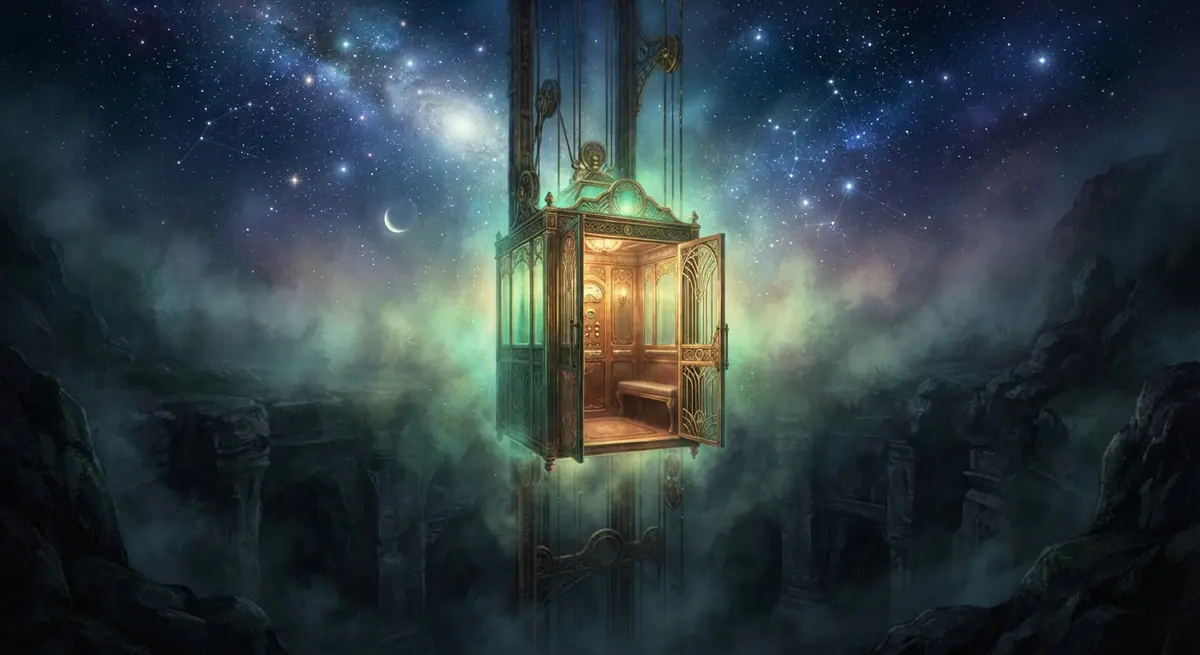
Dreaming of an elevator usually centers on changing status, perspective, control, or emotional depth. Rising suggests ambition, recognition, spiritual aspiration, or confidence; descending may point to introspection, anxiety, hidden feelings, or contact with neglected realities. An elevator that stops, shudders, or traps the dreamer often reflects uncertainty, blocked progress, dependence on systems, or fear of losing control. Psychologically, the symbol compresses movement between levels of consciousness: its direction, speed, destination, occupants, and emotional atmosphere matter more than the machine itself. Spiritually, an elevator can resemble a modern ladder between earthly concerns and higher understanding, though an uncontrolled ascent or descent warns against haste and imbalance. Across traditions, the dream is best read in relation to the dreamer's condition: a promotion, illness, relationship, examination, or crisis can give the same scene different meanings. Overall, the elevator is a mixed omen, promising transition while exposing whether the dreamer feels prepared, guided, and free to choose the next level.
Get your personalized AI interpretation in seconds
How each tradition reads dreams about Elevator
Carl Jung (Archetypes)
Man and His Symbols (1964)
Jung would treat the elevator as a modern image of movement between psychic levels, not as a fixed omen. Because it travels vertically inside a constructed shaft, it dramatizes the relation between conscious identity and the personal or collective unconscious. An ascent into bright air may show libido, in Jung's broad sense of psychic energy, moving toward a new standpoint; it may also reveal inflation if the dreamer feels grand, invulnerable, or destined to rise without doing inner work. A descent can be a necessary encounter with the shadow, ancestral material, instinct, grief, or forgotten memory rather than a simple decline.
The elevator's occupants are psychologically diagnostic. A threatening stranger may carry a projected shadow quality; a wise older passenger can constellate the senex or wise-old-person archetype; a mysterious woman may embody anima imagery for a male dreamer, while a mysterious man may carry animus imagery for a female dreamer, though these figures should not be reduced to gender stereotypes. If the dreamer refuses to enter, the ego may be resisting transformation. If the lift rises without the dreamer's control, the unconscious may be compensating for an overly controlling attitude, or the ego may be overwhelmed by emerging material.
A lift stuck between floors is especially Jungian: the old conscious attitude no longer works, while the new one has not yet formed. The liminal pause can support individuation if the dreamer observes fear, bodily sensation, and symbolic details instead of forcing an answer. A broken shaft or plunge suggests a dangerous collapse of psychic containment; it calls for grounding, not prophetic panic. Reaching a hidden basement may bring shadow material into relation with consciousness, while opening onto a sky or temple may suggest a numinous encounter with the Self. Jung would amplify the dream through personal associations, recurring motifs, and cultural images. The elevator's meaning is therefore compensatory and developmental, determined by the dreamer's one-sided waking attitude and the psyche's movement toward greater wholeness.
Sigmund Freud (Desire)
The Interpretation of Dreams (1899)
Freud did not establish a specific elevator symbol in the way popular dream dictionaries claim. A Freudian reading begins with the dream's manifest scene and asks what latent wish, conflict, memory, or anxiety has been disguised by it. Because an elevator rises and falls within an enclosed compartment, its movement can become a condensation of ambition, dependence, bodily excitation, social advancement, and sexual symbolism. The interpretation must come from free association, not from assigning one universal meaning to every lift.
For a person awaiting promotion, an elevator that shoots upward may fulfill a wish for success, admiration, or escape from a subordinate position. If the dreamer arrives at an inaccessible penthouse, the scene may represent forbidden satisfaction or an idealized self. Conversely, a fall may express fear of losing status, punishment after an ambitious wish, or anxiety about failure. A stuck elevator can preserve an ambivalent wish: the dreamer wants change but fears the consequences. The locked doors and inability to leave may also condense dependency on parents, an employer, or a partner.
Freud would attend closely to embarrassment and privacy. Riding in a crowded lift while inadequately dressed, being watched by a supervisor, or discovering an intimate companion on an unexpected floor may transform the elevator into a setting for exposure, rivalry, voyeurism, or censored sexual desire. The shaft's vertical movement may invite phallic associations, but such a reading is valid only when the dreamer's associations and other material support it. A broken cable may dramatize castration anxiety or loss of potency for one dreamer, while for another it may simply disguise fear of an actual accident.
The destination, passengers, recent experiences, and dream-work mechanisms—condensation, displacement, and secondary revision—matter more than the machine's dictionary label. Freud would also distinguish wish-fulfilment from anxiety dreams: distress can signal that a forbidden wish has been transformed into punishment. The elevator is thus a compromise formation, carrying incompatible wishes and prohibitions between levels of the mind rather than delivering a spiritual prediction.
Other traditions
Ibn Sirin (Islamic Core)
Muntakhab al-Kalam fi Tafsir al-Ahlam (attributed)
Ibn Sirin's classical manuals do not contain the modern elevator as a named object; the responsible interpretation therefore uses his treatment of ascent, descent, stairs, doors, transport, and changes of station rather than pretending that he described an elevator. In this analogical reading, a person of sound faith who enters a clean lift and rises steadily may see an indication of elevation in rank, relief after hardship, gaining authority, or reaching a desired objective. The dreamer's occupation and condition govern the application: for a ruler or official, ascent can signify increased command; for a debtor or sick person, it may indicate release or recovery if the upper place is pleasant and secure.
A descent is not automatically evil. If the dreamer is humble, prays, or deliberately goes downward to help someone, it can signify humility, repentance, investigation of a hidden matter, or returning to an appropriate station. A sudden fall, broken cable, dark shaft, or descent into filth is more adverse, suggesting loss of standing, fear, illness, or exposure to corrupt company. Arrival at a known, illuminated floor is more favorable than stopping in an unknown or ruined place. An elevator that refuses to move may correspond to a delayed affair, obstructed livelihood, or an oath and responsibility that cannot yet be discharged.
The companions are significant. Rising with a just elder, teacher, or parent can represent guidance and good reputation; rising with a tyrant or dishonest associate warns that apparent advancement carries moral danger. Being trapped alone emphasizes confinement and helplessness, while escaping through an open door suggests deliverance. Because classical Islamic dream interpretation distinguishes true vision, personal preoccupation, and disturbing dream, fear, recent travel, work in a tall building, or repeated concern about status may make the image merely psychological. The elevator's direction, destination, and the dreamer's religious and worldly condition must therefore be weighed together.
Al-Nabulsi
Ta'tir al-Anam fi Ta'bir al-Manam
Al-Nabulsi did not discuss electric elevators, which appeared centuries after his work. His method nevertheless provides a precise symbolic bridge through ideas of rising, falling, houses, doors, vehicles, and movement between stations. For him, a dream image can announce honor, authority, livelihood, travel, or reversal according to the dreamer's circumstances and the quality of the destination. Thus an elevator ascending into a spacious, bright, familiar floor may signify elevation in office, success in a petition, recovery, or entrance into a more ordered phase of life. The same ascent for a person behaving arrogantly may caution that worldly elevation is temporary and invites accountability.
The mechanical character adds an important qualification. An elevator depends on an unseen force and a controlling structure; it may therefore resemble a vehicle or means by which a person is carried toward an outcome. Smooth movement indicates facilitated affairs, while jolting, overshooting, or stopping between floors indicates unstable arrangements, unreliable intermediaries, or a project whose apparent progress lacks foundation. A descent into a basement, burial-like darkness, or foul water is a warning of grief, debt, moral compromise, or humiliation. Descent into a clean, secure lower room can instead indicate entering useful knowledge, examining causes, or returning to one's household and duties.
Nabulsi's emphasis on signs surrounding the central image is decisive. Open doors and welcome occupants strengthen a favorable interpretation; locked doors, smoke, panic, and an unknown driver weaken it. A married person rising with a spouse may see joint prosperity, whereas being separated from that spouse between floors suggests estrangement or unequal fortunes. For a sick dreamer, a safe ascent can be hopeful, but a fall should not be treated as a prophecy of death without corroboration. The dream may also be حديث النفس, a reflection of employment, buildings, or ambition. The elevator is consequently an analogy, not an inherited literal symbol: its moral direction and final station matter more than its speed.
Imam Sadiq
No securely transmitted classical statement from Imam Ja'far al-Sadiq names an elevator. A careful entry must therefore adapt the attributed principles associated with his dream tradition—attention to the dreamer's condition, the sign's oppositions, and the difference between benefit and harm—rather than present modern invention as quotation. In that framework, the elevator represents a rapid change of station. Its meaning may turn toward honor, authority, livelihood, or travel when it carries the dreamer upward to a known and beautiful place. A student reaching a high classroom, a worker arriving at a desired office, or a poor person entering a spacious home might each see the same upward movement as a different form of opening.
The dreamer's behavior changes the sign. If the dreamer rises calmly, gives thanks, and helps another enter, the movement suggests legitimate advancement joined to service. If the dreamer pushes others aside, boasts, or demands an impossible height, the ascent becomes a warning about pride, envy, or an ambition detached from proper means. Falling suddenly, missing the intended floor, or finding the lift full of smoke points toward reversal, disappointment, or confusion. An elevator halted between levels signifies an affair suspended between hope and completion: a marriage proposal, appointment, repayment, or journey awaiting a decision.
Companions and destinations provide further distinctions. A trustworthy parent or learned person in the lift can symbolize counsel; an enemy may indicate rivalry over rank. An empty lift with open doors can mean opportunity, while one whose doors close before the dreamer suggests delay or exclusion. Going downward into a clean place may represent self-examination and return to essentials; going downward into darkness, refuse, or a threatening crowd is adverse. For a sick person, no single elevator image should be declared a fixed prognosis. As with other Islamic interpretations, waking preoccupation can produce the dream. The most reliable reading joins direction, emotion, destination, conduct, and the dreamer's actual moral and worldly circumstances.
Biblical Tradition
The Bible (Old Testament)
The Bible contains no elevator, so Biblical interpretation should not claim a direct scriptural definition. The closest patterns are Jacob's ladder or stairway between earth and heaven, Joseph's elevation in Egypt, Nebuchadnezzar's pride and fall, descent into the pit, and Christ's language of ascent and descent. An elevator dream may therefore function as a modern image for movement between earthly circumstance and spiritual perspective, but its interpretation must remain subordinate to biblical themes of humility, calling, judgment, and providence.
A steady ascent toward light, prayer, a place of service, or a welcoming upper room can echo Jacob's connection between heaven and earth or Joseph's rise after suffering. For a person seeking guidance, it may symbolize hope and a new responsibility rather than personal superiority. If the dreamer rises while boasting, displacing others, or demanding to reach heaven by machinery, the image recalls Babel and the warning against self-exaltation. The height is not automatically holy: Scripture repeatedly distinguishes true elevation through obedience from prideful status.
A descent has several possible biblical forms. Going down to help the vulnerable may reflect the pattern of compassionate service and kenosis, while descending into darkness, a pit, or chaotic water may represent danger, sin, grief, or judgment. An elevator that plunges unexpectedly can expose the fragility of human security, yet it should not be declared a prophecy of disaster. A lift halted between floors may picture waiting, wilderness, or a season in which deliverance is not yet visible. Open doors can evoke divine invitation, but a locked door may also call the dreamer to patience rather than force.
The passengers matter ethically. Traveling with the poor, a child, or a fearful stranger and choosing to protect them turns ascent into stewardship; abandoning them for a higher floor exposes ambition. A church, cross, or scriptural word in the destination would guide interpretation, but ordinary office imagery may concern work and status. Biblical discernment tests the dream by prayer, humility, moral fruit, and harmony with Scripture, never by superstition or a mechanical omen chart.
Christian Tradition
Christian mysticism has no inherited doctrine of elevators, yet the symbol can be read through the soul's ascent, descent, purification, and discernment. The vertical cabin resembles a contemporary ladder or scala: a movement through stages of prayer, awareness, and charity. Rising in silence toward light may represent contemplation, grace, or a widening perspective, especially when the dreamer feels humble and more able to serve. It is not evidence of superior holiness; mystical traditions repeatedly warn that consolations and visions can deceive when the ego claims them as possession.
A rapid ascent without preparation may signify spiritual excitement, consolation, or spiritual pride. If the dreamer boasts of reaching the highest floor, the image may expose the temptation to seek extraordinary experience rather than faithful ordinary practice. A descent can be equally meaningful. Entering a basement, crypt, or dark lower level may symbolize purgation, the uncovering of wounds, compassion for human weakness, or the humility of entering one's own poverty. If the descent produces hatred, despair, or fascination with darkness, discernment is needed; not every intense image is a holy invitation.
The elevator's condition makes the spiritual distinction clearer. A trustworthy lift that stops at appropriate floors suggests gradual formation and acceptance of limits. A malfunctioning lift, spinning shaft, or doors that open onto emptiness may represent disorientation, scrupulosity, or reliance on private revelation. Being trapped can invite patience and consent to a season of hiddenness, while finding an emergency exit may symbolize practical grace rather than miraculous rescue. Traveling with a suffering stranger can call the dreamer toward mercy; traveling above others while refusing aid warns against spiritual elitism.
Christian mystical reading asks what virtue follows the dream: humility, courage, compassion, truthfulness, or greater freedom. It also distinguishes consolation from anxiety and considers the dreamer's prayer life and circumstances. The elevator is a metaphor for transition, not a timetable of heaven or hell. Its safest interpretation is fruit-based: a genuine spiritual movement should lead away from vanity and fear and toward love, grounded action, and responsible discernment.
Zhou Gong
Zhou Gong Jie Meng (周公解梦)
Traditional Zhou Gong dream interpretation predates modern elevators, so an elevator must be read through related Chinese motifs: climbing stairs, ascending a tower, entering a high building, falling, doors, vehicles, and changes in rank. In this analogical approach, a smooth rise to a bright, orderly upper floor resembles climbing toward honor, success in examinations, promotion, or the fulfillment of a difficult undertaking. For a student, the image may favor learning and recognition; for a merchant, it may indicate expanding business if the destination is prosperous and secure.
The emotional tone and physical condition alter the result. Rising while calm, carrying clean objects, or being welcomed by elders strengthens the favorable reading. Rising too rapidly, losing balance, or seeing the lift pass beyond the intended floor suggests excess ambition, unstable fortune, or a gain that cannot be retained. A descent into darkness, a broken shaft, or a fall from a great height is traditionally cautionary, associated with decline in reputation, failed plans, illness, or loss of control. Yet descending deliberately to a lower, clean room may indicate returning to practical work, honoring family duties, or uncovering the root of a problem.
Doors and companions are central. Doors opening at the right floor suggest opportunity; doors repeatedly closing suggest missed timing or obstruction. Traveling with parents or respected teachers may signify family support and instruction. Traveling with rivals can expose competition, while an empty elevator may show that success depends on the dreamer's own effort. A crowded lift moving downward can reflect shared financial or social anxiety rather than an individual fate. Being trapped between floors points to a suspended decision, especially when a person is waiting for marriage, employment, examination results, or a move.
Chinese dream lore also recognizes dreams generated by daily impressions. Someone who works in a high-rise or recently rode an elevator should not treat the image as an omen automatically. The elevator's modern mechanism is secondary to the traditional pattern of ascent and descent. Auspiciousness comes from harmony, safe arrival, supportive relationships, and a suitable height; danger comes from abrupt reversal, disorder, darkness, and separation from one's proper responsibilities.
Hindu / Vedic
Classical Hindu Swapna Shastra predates elevators, so the modern image should be interpreted through older signs of climbing, falling, entering high places, descending underground, vehicles, doors, and changes in fortune. An elevator rising smoothly can resemble ascent toward higher knowledge, social elevation, or favorable results from effort. For a student, reaching a clean upper level may suggest progress in learning; for a householder, it may indicate improved prosperity or status when the destination is orderly and the dreamer remains composed.
Direction alone is insufficient. In a spiritual reading, ascent may represent movement through increasingly subtle states, but genuine progress is marked by sattvic qualities—clarity, calm, truth, and nonattachment—not excitement or pride. An elevator that rises violently, opens into dazzling emptiness, or carries the dreamer beyond control may reveal rajasic ambition and unstable desire. A downward journey into darkness or filth can signify tamasic confusion, fear, or the consequences of neglected duties. Deliberate descent into a quiet lower chamber, however, may symbolize returning to the roots of a problem, entering disciplined self-study, or confronting suppressed impressions.
The lift can also reflect karma and agency. If it moves because an unknown person presses the button, the dreamer may feel carried by family, social obligation, or past action. If the dreamer chooses the floor and arrives safely, the image favors intentional effort. A stuck elevator depicts suspended karma or a transition in which attachment to the old identity and fear of the new one prevent movement. A broken lift or fall should not be read as certain catastrophe; it may warn that desire, pride, or careless conduct has disturbed balance.
Companions provide clues: a guru-like elder may represent instruction, parents may signify lineage and duty, and hostile passengers may mirror unresolved vasanas or competitive desire. A temple, light, or peaceful upper room strengthens a dharmic reading, while vulgarity and panic weaken it. Traditional Hindu interpretation also allows ordinary impressions to generate dreams. The elevator is therefore a contemporary vehicle for examining guna, karma, attachment, and the quality of consciousness, not a fixed prediction.
Japanese (Yume Uranai)
Japanese 夢占い commonly reads an elevator through its direction, speed, destination, company, and the dreamer's feelings. Because elevators connect floors in a compressed vertical movement, an upward ride is often associated with rising運気, ambition, recognition, or a wish to improve one's position. Reaching the intended floor smoothly can be encouraging for work, study, or relationships. A bright, spacious elevator and calm passengers strengthen the favorable reading; a sudden ascent that feels frightening may instead show pressure to advance faster than one's inner readiness.
A descending elevator often points to introspection, fatigue, anxiety, or attention turning toward neglected emotions. Going down safely to a familiar floor can be restorative: the dreamer may need to return to basics, home, health, or practical responsibilities. A plunge, dark shaft, or descent that never ends is more cautionary, suggesting loss of control, fear of failure, or a decline in self-confidence. A lift stopping between floors is a classic sign of stalled plans, uncertain relationships, or difficulty choosing between alternatives. It can also reflect the wish to pause before a major change rather than a bad event itself.
The dreamer's interactions refine the reading. Riding upward with a partner may indicate shared goals, while being separated from that person by closing doors can reveal emotional distance or mismatched timing. A crowded car can symbolize workplace comparison and social pressure; an empty car may suggest independence or isolation depending on the mood. Pressing the wrong button points to confusion about priorities, while finding an emergency exit indicates resilience and a practical solution. A broken elevator may be a warning to check schedules, commitments, health, or communication rather than a supernatural forecast.
Japanese dream interpretation also gives weight to recent experience: commuting in a high-rise, job stress, or a real elevator incident can produce the image. The most useful reading combines the dream's atmosphere with current運気 and emotional condition. Upward movement favors opportunity when balanced by preparation; downward movement invites recovery and self-reflection. The elevator is therefore a change symbol whose omen shifts with control, destination, and the quality of the transition.
Don't let the message slip away. Get a profound, personalized analysis that reveals what your subconscious is trying to tell you.
Interpret your Elevator dream with AIDream Scenarios
Common Questions & Scenarios
What does it mean to dream about an elevator?
What does it mean when you dream of an elevator going up?
What does dreaming of an elevator going down mean?
What does it mean to dream about being stuck in an elevator?
What does it mean to dream of an elevator falling?
Written with AI from the traditions named on this page and maintained by the FASSIR English Editor. Last updated . How we interpret dreams
Disclaimer: This analysis utilizes AI based on historical and psychological texts for educational and spiritual insight. It does not constitute professional medical or psychological advice.