

Flying and falling dreams often reflect how you feel about control, freedom or change, rather than predict what will happen. Flying and falling dreams meaning depends on the details: whether you feel exhilarated, frightened, stuck or able to choose where you go. Use these 12 symbols as prompts for reflection, not as fixed diagnoses.
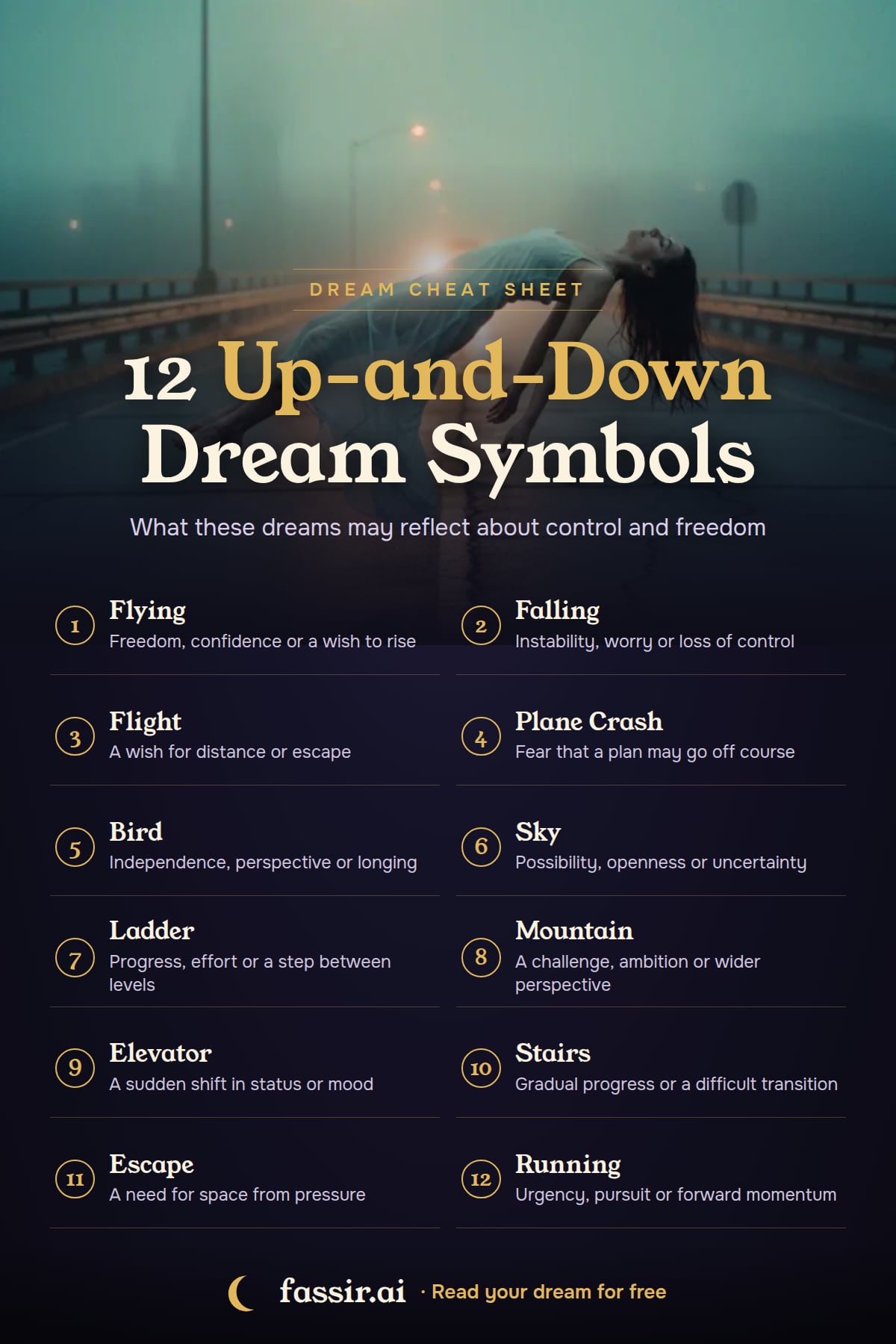 Save this cheat sheet on Pinterest
1. Flying
Flying dreams often suggest freedom, confidence or a wish to rise above a situation. If you glide easily, the dream may feel different from one where you struggle to lift off; the effort can point to how accessible that freedom feels right now. Flying may invite you to ask: where in life do I feel capable, and where do I want more room to move?
Get your personalized AI interpretation in seconds
2. Falling
Falling dreams are commonly associated with feeling unsettled, overwhelmed or less in control. A slow fall may feel more like uncertainty, while a sudden drop can make the dream’s fear more prominent. Falling can prompt you to ask: what feels unstable or difficult to manage at the moment?
3. Flight
A dream of flight may reflect a desire for distance, independence or escape from a demanding situation. If you are choosing your route, the dream may carry more agency than a flight where you are a passenger and cannot steer. Flight invites a useful question: am I moving toward something I want, or away from something I need to face?
4. Plane Crash
A plane crash in a dream may reflect worry about a plan, responsibility or direction that feels beyond your control. Watching a crash from the ground can feel different from being aboard; your position may shape whether the dream centers on concern, helplessness or personal risk. Plane crash can lead you to ask: what am I worried might go off course, and what can I influence?
5. Bird
A bird may symbolize independence, perspective or a wish to move freely. A bird soaring overhead can suggest possibility, while one that is caged or injured may bring attention to limits or vulnerability. Bird raises the question: what would greater freedom look like for me right now?
6. Sky
The sky can represent openness, possibility or uncertainty, depending on the feeling it brings. A clear sky may feel spacious, while a dark or stormy one can make the same vastness seem unsettling. Sky can prompt you to ask: does the future feel open to me, or hard to read?
7. Ladder
A ladder often suggests effort, advancement or a transition between one level and another. Climbing steadily may feel different from finding a broken ladder or being unable to reach the next rung. Ladder invites you to ask: what step am I working toward, and do I have the support to take it?
8. Mountain
A mountain may reflect a challenge, an ambition or the wish to gain a broader view. Reaching the summit can bring a sense of accomplishment, while struggling uphill may emphasize the work or strain involved. Mountain can lead you to ask: what feels like a climb in my life, and what might the view help me understand?
9. Elevator
An elevator may reflect a quick shift in mood, status or circumstances. An elevator that rises smoothly can feel unlike one that drops, stalls or moves unpredictably; those details change whether the dream feels empowering or unsettling. Elevator invites the question: where do I feel carried along by change instead of directing it?
10. Stairs
Stairs often suggest gradual progress, effort or a transition that takes one step at a time. Walking upstairs may feel purposeful, while descending or facing endless steps can shift the dream toward fatigue, uncertainty or reflection. Stairs can prompt you to ask: what small step feels possible next?
11. Escape
An escape dream may reflect a wish for distance from pressure, conflict or a situation that feels restrictive. Getting away safely can feel different from being trapped or pursued, which may point to how available a solution seems to you. Escape raises the question: what do I need space from, and what kind of support would help?
12. Running
Running dreams may reflect urgency, pursuit or a strong push to move forward. Running toward someone or somewhere can feel purposeful, while running away or being unable to speed up can emphasize pressure or frustration. Running invites you to ask: what am I rushing toward, or trying to leave behind?
How this tradition reads these dreams as a group
Psychological approaches treat dream symbols as possible prompts, not universal translations. Jungian perspectives may explore personal associations and recurring patterns; Freudian approaches have often considered wishes and conflict; memory-processing accounts look at how waking experiences can reappear during sleep. None can determine a single meaning from a symbol alone.
In Christian and biblical tradition, Joseph and Daniel are remembered for interpreting dreams in particular scriptural stories. Readers may find spiritual meaning in those accounts, but they do not establish that a modern dream predicts an event or has one certain interpretation. For other perspectives, see how other traditions read this dream through their own cultural and spiritual frameworks.
A free Fassir lucid-dreaming quiz can also help you reflect on how aware and in control you feel during dreams.
Why flying and falling dreams happen
Dreams can draw on recent experiences, emotions, memories and the changing activity of sleep; there is no reliable one-symbol formula that explains every dream. A psychology overview of common dreams associates falling dreams with themes such as anxiety and instability, but that is a general interpretation, not a diagnosis. Stress or disrupted sleep may affect what you remember and how intense a dream feels, while the dream itself cannot confirm a particular cause.
It is worth checking what a source actually studies before using it to interpret a dream: this paper on early phonological processing concerns reading and eye movements, not dream symbolism, and this review of psychedelics concerns psychoactive substances and cognition, not the meaning of flying or falling dreams. Neither establishes a dream interpretation. If a recurring dream is distressing or interfering with rest, consider discussing it with a qualified health professional.
Explore your dream symbols with Fassir.