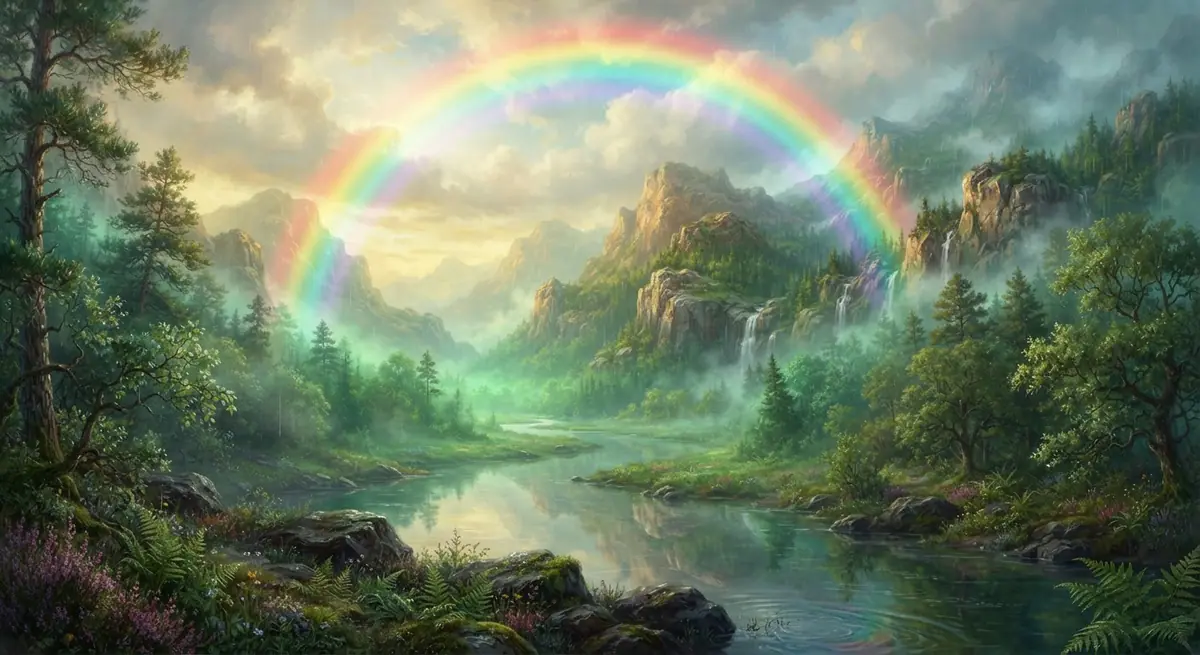
Dreaming of a rainbow commonly signifies hope after difficulty, emotional integration, and a visible promise that circumstances can change. Psychologically, it may appear when the dreamer is reconciling opposing feelings, recovering from grief, or allowing imagination and optimism back into life; its colors can suggest many possibilities rather than one fixed outcome. Spiritually, the rainbow is widely read as a bridge between earthly experience and the sacred, a blessing, or confirmation that endurance has meaning. In Biblical interpretation, it especially recalls God's covenant with Noah and therefore points to protection, mercy, and renewed order after a storm. A bright, complete rainbow usually favors reconciliation and favorable news, while a broken, fading, or obscured rainbow may reflect fragile confidence or an unfulfilled promise. The dreamer's feelings remain decisive: wonder strengthens the hopeful reading, whereas fear or sorrow may show longing for reassurance rather than a prediction of events.
Get your personalized AI interpretation in seconds
How each tradition reads dreams about Rainbow
Carl Jung (Archetypes)
Man and His Symbols (1964)
Jungian psychology treats the rainbow as a striking image of psychic totality: separate colors coexist within one arc, suggesting the movement of consciousness toward integration. It can function as a mandala-like symbol, especially when the dreamer has been divided between duty and desire, reason and feeling, or a public persona and a neglected inner life. A rainbow after a storm may mark a transition in individuation, not because the unconscious promises that trouble has ended, but because the psyche has begun to give form and meaning to what was previously overwhelming.
The dreamer's position changes the emphasis. Someone standing beneath the arc may be approaching a new relation between conscious identity and the unconscious. Someone viewing it from a distance may admire wholeness while still feeling unable to participate in it. If the rainbow leads toward a forest, cave, or house, the image may be directing attention into unexplored psychic territory. A rainbow joining two mountains can symbolize reconciliation between opposing complexes or the establishment of a symbolic bridge between life phases. When it appears beside a threatening shadow, the shadow is not simply banished; the colorful image may be compensating for conscious pessimism while inviting the dreamer to acknowledge anger, grief, or envy.
Jung would also ask whether the rainbow carries anima or animus qualities. In a man's dream it might personify a neglected feeling life or a creative feminine dimension; in a woman's dream it might constellate a mediating inner spirit, though such assignments must remain personal rather than stereotyped. A fading rainbow can indicate premature inflation—the ego claiming spiritual transformation before it is lived. A double rainbow may show a conscious and unconscious version of the same transition. The essential question is what opposites the image is holding together and what associations its colors awaken in the individual dreamer.
Sigmund Freud (Desire)
The Interpretation of Dreams (1899)
Freudian interpretation would not accept the rainbow as a universal code for hope. It would investigate the dreamer's recent memories, infantile wishes, emotional conflicts, and the mechanisms by which latent content became the manifest image. The rainbow's beauty may be a form of wish-fulfilment: after frustration, the mind constructs a scene in which difficulty is followed by reward, reconciliation, or admiration. For a person awaiting approval, the arc may represent a fantasy of being recognized as exceptional; for someone in conflict with a partner, it may disguise a wish that quarrel and separation be magically repaired.
The rain preceding the rainbow can matter. Water may connect with affect, bodily sensation, or memories of childhood scenes, while the sudden appearance of color can condense several wishes into one spectacular object. The curved form may invite associations with enclosure, protection, bodily symbolism, or a bridge between separated places; Freud would not impose one of these readings without the dreamer's free associations. A rainbow that cannot be reached may express an unattainable ideal, delayed gratification, or ambivalence about obtaining what is desired. If it disappears when the dreamer approaches, the manifest beauty may conceal anxiety that pleasure will not last.
The dreamer's role is equally revealing. Photographing or displaying the rainbow may reflect exhibitionistic wishes or a need for validation; hiding it from others may indicate guilt about pleasure or rivalry. A double rainbow can condense two competing wishes, such as domestic security and erotic freedom. A dark storm beneath bright colors may show defensive optimism covering anger or fear. Freud would therefore treat the image as psychologically meaningful but not prophetic. Interpretation proceeds through associations, resistance, repetition across dreams, and the dreamer's personal history; the conventional reading of hope is only a starting point, not the conclusion.
Other traditions
Ibn Sirin (Islamic Core)
Muntakhab al-Kalam fi Tafsir al-Ahlam (attributed)
In the classical Islamic dream books attributed to Ibn Sirin, the rainbow is not treated with the fixed, universal symbolism often found in modern dream dictionaries. Its meaning is inferred from the dreamer's condition, the rainbow's direction, color, and emotional effect, following the principle that a vision is interpreted in relation to the person's circumstances. A rainbow appearing after rain may indicate relief after fear, the passing of hardship, or good news following a period of uncertainty. For a poor or distressed person, its brightness can signify an opening, livelihood, or restored hope; for a traveler, it may mark safety after danger or the end of an anxious journey.
The dreamer's religious and social position matters. If a righteous person sees a clear rainbow without terror, it may represent divine mercy, protection, or a favorable change. If a ruler, official, or person responsible for others sees a rainbow over the city, the image may concern public security and the settling of conflict, though a threatening storm beneath it would qualify the promise. A rainbow on the right side is conventionally read more favorably than one on the left, while an arch that fades before being reached suggests a promise, opportunity, or expectation that remains incomplete.
Color variations also modify the reading. Strong, harmonious colors support prosperity and reconciliation; a pale or dirty rainbow may indicate temporary comfort or mixed circumstances. Seeing two rainbows can suggest two connected benefits, alliances, or competing interpretations, whereas a broken rainbow warns that relief is partial. Ibn Sirin's method would not make the image an automatic prophecy: the dreamer's faith, conduct, recent concerns, and waking response must be weighed. Fear at a beautiful rainbow can turn it into a warning against vanity or misplaced confidence, while gratitude and tranquility reinforce its auspicious meaning.
Al-Nabulsi
Ta'tir al-Anam fi Ta'bir al-Manam
Al-Nabulsi's approach places unusual atmospheric signs within a wider vocabulary of authority, divine mercy, fear, and changing worldly conditions. A rainbow in a dream is therefore read through its setting rather than as a simple promise of happiness. When it appears after heavy rain and the dreamer feels calm, it can indicate the removal of distress, safety after danger, reconciliation between separated parties, or the arrival of good news. For someone ill, the change in weather may suggest recovery if the rainbow is bright and the air becomes clear; if thunder, darkness, or destructive rain remains, the vision carries a warning that relief is not yet complete.
The observer's station is significant. A ruler or administrator who sees a rainbow spanning his territory may be receiving a sign concerning security, justice, or the settlement of public disorder. For a merchant, it may indicate a favorable turn after commercial anxiety, but a rainbow that vanishes over the marketplace counsels against relying on uncertain profit. For a traveler, a clear arc can signify protection and the end of an exposed passage. A prisoner or oppressed person may read the same image as hope of release or easing, provided no ominous feature dominates the dream.
Al-Nabulsi's symbolic logic also attends to color and position. A complete, vivid arc supports blessing and renewed confidence; a fragmented or obscured arc points to divided affairs, a broken agreement, or benefit that arrives only in part. A rainbow rising from the east may be associated with an emerging opportunity, while one in the west can suggest closure or the completion of a matter. Multiple rainbows may represent layered favors or several claims upon the dreamer. Yet the tradition does not license certainty: the rainbow can also expose attachment to worldly display. Its interpretation must be balanced against the dreamer's piety, profession, health, and the emotional tone of the entire vision.
Imam Sadiq
Reports associated with Imam Ja'far al-Sadiq commonly organize dream symbols into several possible roots—glad tidings, warning, benefit, trial, or reflection of the dreamer's circumstances—rather than assigning one meaning to every occurrence. Applied to a rainbow, this method emphasizes discernment. A brilliant arc appearing after rain to a person burdened by debt, illness, or estrangement favors relief, restored trust, and an opening toward lawful benefit. If the dreamer is awaiting a decision, the rainbow may point to encouraging news, but only when its appearance produces composure rather than dread.
For a married person, a rainbow over the household can symbolize harmony after quarrel and the joining of different temperaments. For an unmarried dreamer, it may indicate a hopeful meeting or the readiness to begin a new stage, not necessarily a guaranteed marriage. A student who sees distinct colors clearly may be entering a period in which scattered abilities become coordinated. A traveler may take a rainbow across the road as a sign to proceed with patience, while a rainbow that dissolves before the traveler reaches it warns that expectation has outrun preparation.
The state of the rainbow is decisive. A complete arch in a clear sky represents an integrated blessing; a double rainbow can signify two opportunities, two sources of support, or a choice whose consequences must be weighed. A dark, colorless, inverted, or broken arc suggests confusion, delayed benefit, or a promise dependent on repentance and practical effort. If lightning and destructive wind accompany it, the beautiful sign does not erase the warning. Seeing the rainbow reflected in water may concern reputation, emotion, or a blessing experienced indirectly through another person. In this interpretive framework, the dreamer's character and immediate need determine which possibility is strongest; gratitude and ethical action are the proper response to a favorable sign.
Biblical Tradition
The Bible (Old Testament)
Biblical tradition gives the rainbow a distinctive covenantal meaning. In Genesis 9, after the Flood, God sets the bow in the clouds as a sign of the covenant with Noah and every living creature: the waters will not again become a flood to destroy all flesh. A dream of a complete rainbow therefore recalls preservation after judgment, mercy following catastrophe, and a renewed order in which life can begin again. For a survivor of crisis, bereaved person, or family rebuilding after conflict, the image can symbolize reassurance that destruction is not the final word.
The rainbow also appears in the prophetic and apocalyptic imagination. Ezekiel describes a likeness of a rainbow around the divine glory, and Revelation places a rainbow around the heavenly throne. In these settings it is not merely decorative optimism; it surrounds holiness, sovereignty, mystery, and the authority of divine judgment. A dreamer who sees a rainbow above a church, mountain, or throne-like light may be confronting the sacred and being called to reverence, trust, or renewed vocation. A rainbow obscured by smoke or storm may express the human inability to perceive a promise clearly, rather than the cancellation of that promise.
Concrete variations matter. A rainbow after destructive rain favors restoration and covenant faithfulness. A rainbow over a threatened home may represent protection, though it should not be treated as a guarantee that no hardship will occur. A broken or fading rainbow can point to the dreamer's wavering trust, a need to remember an obligation, or the incompleteness of earthly peace. A double rainbow may evoke layered blessing or the joining of heaven and earth, but Scripture does not establish a fixed interpretation for it. Christian readers should distinguish biblical symbolism from personal prophecy: the dream may invite hope, repentance, gratitude, and faithful action, while its practical meaning depends on prayer, circumstance, and the dreamer's response.
Christian Tradition
Christian mysticism often understands a dream rainbow as an image of divine consolation, the soul's passage through purification, and the meeting of created beauty with transcendent light. Its colors can suggest the many graces of one divine source, while its arc resembles a bridge between the visible world and the mystery beyond it. In a contemplative dream, a rainbow emerging from darkness may indicate that suffering is being gathered into a larger pattern—not that suffering is good, but that it can become a place of transformation and compassion.
The dreamer's state determines the spiritual emphasis. For someone practicing prayer during desolation, a clear rainbow may be experienced as consolation and an invitation to persevere without clinging to unusual signs. For a person recovering from sin or estrangement, it can symbolize mercy, reconciliation, and the restoration of relationship with God or neighbor. A rainbow over water may evoke baptismal renewal; over a church or altar, communal worship and sacramental life; over a barren landscape, hope for spiritual fruitfulness. If it appears above another person, the dream may call the dreamer to bless, forgive, or recognize grace in that relationship rather than to claim special status.
A brilliant rainbow that produces pride can carry a corrective message. Mystical traditions caution against spiritual vanity, treating visions as possessions, or confusing emotional uplift with holiness. A fading rainbow may teach detachment: consolation changes, but faith need not depend on continual sweetness. A broken arc can represent divided attention, wounded community, or a promise perceived only partially. The mature Christian reading is therefore hopeful but discerning. The image encourages gratitude, charity, patience, and trust in covenant mercy; it does not replace Scripture, conscience, pastoral wisdom, or practical responsibility.
Zhou Gong
Zhou Gong Jie Meng (周公解梦)
In the Zhou Gong dream-interpretation tradition, a rainbow is read through the classical concern with changing qi, omens of transition, household fortune, and the relation between Heaven and human affairs. A clear rainbow appearing after rain generally favors the ending of difficulty and the arrival of better circumstances. For a person engaged in business, it may indicate that a blocked transaction can move forward; for a household troubled by dispute, it may signify reconciliation. The vision is strongest when the sky clears and the dreamer feels peaceful rather than alarmed.
Concrete details alter the omen. A rainbow spanning the sky suggests a matter of broad consequence or a turning point that affects the family, workplace, or reputation. A small rainbow seen over a garden or home points to a more private blessing, such as improved domestic harmony. A double rainbow may indicate two favorable chances or the meeting of two families, but it can also warn that the dreamer must choose between parallel paths. A rainbow reflected in water concerns emotion, reputation, or an opportunity that appears attractive but is not yet secure. If the colors are vivid and orderly, the five-phase imagination may support balance and coordinated action; muddy colors or an incomplete arc suggest qi that is scattered and benefit that remains unstable.
For a traveler, a rainbow over the road is usually encouraging if the route is open, whereas a rainbow hidden behind mountains may mean delay before success. Seeing one vanish suddenly can signal changing fortune, a missed opportunity, or the need to avoid premature celebration. A rainbow accompanied by violent wind, hail, or a collapsing sky should be read as mixed rather than purely auspicious: beauty is present, but instability remains. The tradition values timing and conduct. The dreamer should respond to a favorable rainbow by restoring harmony, acting prudently, and accepting change, not by assuming that luck removes the need for effort.
Hindu / Vedic
Within Hindu approaches to dream symbolism, including the broad framework associated with Swapna Shastra, a rainbow is best understood through auspiciousness, the condition of the dreamer, and the surrounding signs rather than through one universally fixed rule. Its many colors and appearance after rain can suggest the play of prakriti, the emergence of possibility after obstruction, and a transition from disturbance toward balance. A calm dreamer who sees a bright, complete rainbow may receive it as a favorable sign for renewed energy, successful effort, learning, or the restoration of harmony.
The context gives the image its practical direction. For a student, a rainbow over a temple, river, or open field may indicate clarity after confusion and the gathering of diverse talents into one purpose. For a householder facing family tension, it may favor reconciliation and the return of auspicious domestic energy. For someone beginning a journey or undertaking, a rainbow in a clear sky can support progress, while a rainbow hidden by smoke, dust, or violent weather counsels delay and purification of intention. Seeing the colors reflected in water may connect the omen to emotional life and the mind's fluctuating quality rather than to an external event.
A double rainbow can symbolize two paths, paired support, or the meeting of complementary forces; it may also warn against indecision if the dreamer feels pulled between them. A fading arc suggests that opportunity requires disciplined action, charity, prayer, or other personally meaningful practice before it bears fruit. A vivid rainbow accompanied by fear should not automatically be called auspicious, since the dreamer's samskaras and current anxieties may be shaping the image. Traditional Hindu interpretation also distinguishes spiritually significant dreams from impressions caused by food, illness, repetition, or daytime preoccupation. The rainbow thus encourages hope and balanced action, while inviting the dreamer to examine desire, duty, and inner steadiness.
Japanese (Yume Uranai)
In Japanese 夢占い, a rainbow is commonly associated with luck turning upward, emotional recovery, and the opening of a new phase after difficulty. The image is especially favorable when it appears vividly after rain and gives the dreamer a feeling of wonder. For someone exhausted by work or relationship problems, it can represent the return of motivation and the possibility of reconciliation. For a person starting a project, changing jobs, or meeting someone new, a clear rainbow often signifies supportive momentum and an encouraging opportunity.
Details distinguish the kind of good fortune. A large rainbow stretching across the sky suggests a major turning point or success visible to others, while a small rainbow seen close to home points to modest but meaningful happiness in daily life. A double rainbow is frequently read as doubled luck, a strengthening partnership, or two opportunities arriving together; if the dreamer feels confused, however, it may reflect a choice between alternatives. A rainbow over the sea can symbolize broad horizons and travel, whereas one over a garden or room emphasizes private relationships and domestic renewal. Photographing it may show a desire to preserve a fleeting chance or share good news.
A rainbow that fades quickly carries a more cautious message: happiness may be temporary, timing may be delicate, or the dreamer may need to act rather than merely admire possibility. A broken arc can reflect incomplete recovery, interrupted plans, or a relationship requiring repair. Dark clouds beneath brilliant colors indicate that optimism coexists with unresolved stress. In Japanese popular dream interpretation, the emotional response remains important: joy strengthens the auspicious reading, while anxiety may show pressure to appear positive. The rainbow is therefore a sign of hope and changing fortune, not a guarantee. It encourages appreciation of emerging opportunities, communication with others, and steady preparation for the next stage.
Don't let the message slip away. Get a profound, personalized analysis that reveals what your subconscious is trying to tell you.
Interpret your Rainbow dream with AIDream Scenarios
Common Questions & Scenarios
What does it mean to dream about a rainbow?
Is dreaming of a rainbow a good sign?
What does it mean to see a rainbow after rain in a dream?
What does a double rainbow mean in a dream?
Why do I keep dreaming about rainbows?
Written with AI from the traditions named on this page and maintained by the FASSIR English Editor. Last updated . How we interpret dreams
Disclaimer: This analysis utilizes AI based on historical and psychological texts for educational and spiritual insight. It does not constitute professional medical or psychological advice.