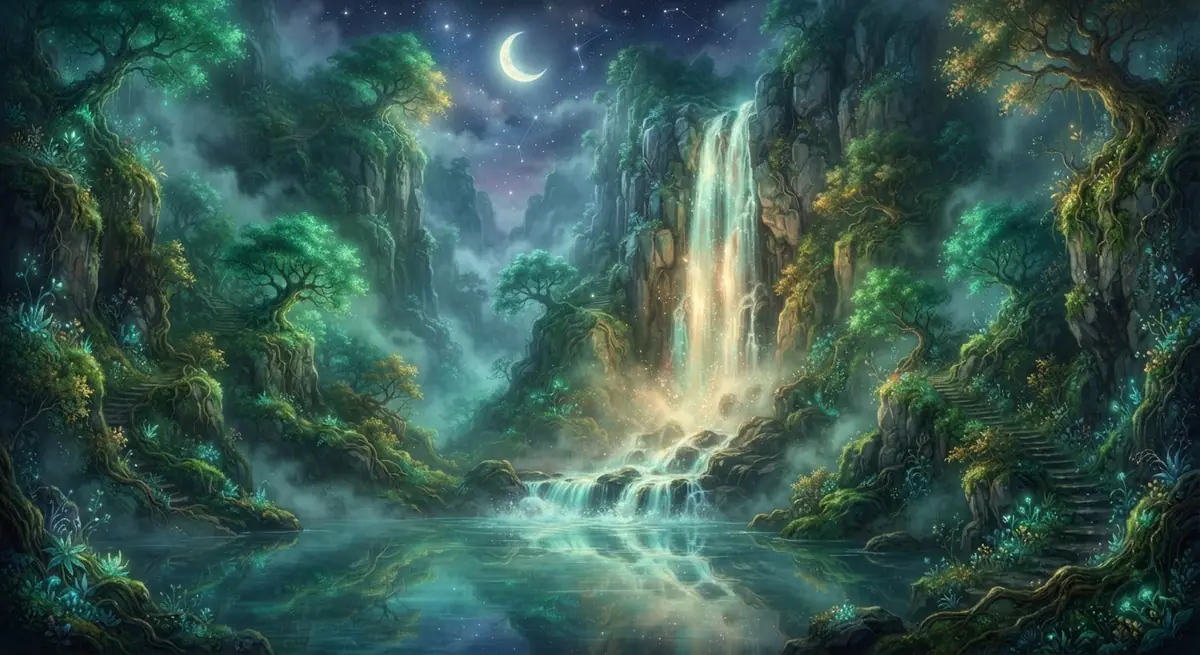
Dreaming of a waterfall commonly symbolizes emotional release, cleansing, and a powerful transition from inner pressure to outward expression. Psychologically, its falling water may represent feelings that can no longer be contained: grief, anger, desire, relief, or creative energy. A calm, luminous waterfall suggests renewal and acceptance, while violent water, fear, or being swept away can indicate overwhelm and loss of control. In Jungian terms, the waterfall connects conscious life with the unconscious, inviting the dreamer to confront shadow material and emerge changed. Spiritually, many traditions associate flowing water with purification, blessing, revelation, and the movement of divine or ancestral power. Seeing oneself safely beside it favors healing and renewed vitality; climbing toward its source suggests seeking truth, while falling into it may signal surrender, crisis, or transformation. The dream’s omen depends on water quality, personal emotion, and whether the flow nourishes, threatens, or clears an obstacle.
Get your personalized AI interpretation in seconds
How each tradition reads dreams about Waterfall
Carl Jung (Archetypes)
Man and His Symbols (1964)
For Jungian analysis, a waterfall is a particularly vivid image of the unconscious breaking into conscious life. Water represents psychic depth, while the vertical descent dramatizes a movement from an elevated, controlled position into feeling, instinct, and transformation. The dream does not simply predict an event; it presents the psyche’s compensating response to the dreamer’s waking attitude. Someone who is overly rational, emotionally restrained, or identified with social duty may dream of a vast waterfall because neglected affect is demanding recognition. The fall’s force may be frightening, yet it can also restore vitality.
A dreamer who watches clear water plunge into a receptive pool may be approaching emotional integration. The pool can function as a vessel for unconscious contents, and the continuous cycle from height to depth suggests renewal rather than catastrophe. If the dreamer stands safely at the edge, the ego is observing powerful inner material without being possessed by it. Entering the pool suggests willingness to experience feeling; being swept away indicates that the ego’s current defenses are insufficient. Climbing behind the curtain of water may symbolize movement toward a hidden truth or a confrontation with the shadow.
The waterfall can also carry archetypal associations of death and rebirth. Passing through it and emerging unharmed resembles an initiation, particularly when the scene changes from darkness to sunlight. A black or polluted fall may embody shadow material: rage, shame, envy, or destructive impulses that have been denied. The dreamer should not moralize these contents, but should ask what energy they contain and how it can be made conscious. A luminous, feminine cascade may constellate the anima, especially for a man whose emotional life has been neglected; for any dreamer, it may represent an inner source of relatedness, imagination, or eros. A blocked fall indicates arrested psychic energy, while a dry bed suggests emotional dissociation or exhausted libido. Individuation requires neither stopping the water nor submitting blindly to it, but developing a conscious relationship with its depth and direction.
Sigmund Freud (Desire)
The Interpretation of Dreams (1899)
A Freudian reading treats the waterfall as manifest dream imagery whose latent content must be reconstructed from the dreamer’s associations, recent experiences, and conflicts. Its downward movement, volume, pressure, and release can symbolize the discharge of repressed excitation. The image may therefore appear after prolonged inhibition, an argument in which anger was not expressed, sexual tension, or a wish for relief from obligations. Yet no universal sexual translation is justified: the same fall can represent tears, urination, ejaculation, panic, or a longed-for emotional outpouring, depending on the dreamer’s memories and affect.
A person who stands before a powerful waterfall with awe may be experiencing an ambivalent wish: to surrender control while also fearing punishment for doing so. If the dreamer secretly wants to cry but feels forbidden to show weakness, water cascading over a cliff may provide a disguised fulfillment of that wish. Someone dreaming of hiding behind the fall may be protecting a forbidden desire or fantasy from observation. Entering the water can express a wish for immersion, return, or escape from the demands of reality; being carried away may reveal anxiety that gratification will become uncontrollable. A dry waterfall, by contrast, may point to inhibition, impotence, emotional deadening, or disappointment following anticipated release.
Freud would attend closely to who owns the landscape and who is endangered. A childhood waterfall may connect to early memories of bathing, parental authority, toilet training, fear of drowning, or a formative scene involving secrecy. If a parent stands above the fall, the image may organize dependence and fear of judgment; if a lover appears beside it, the dream may condense sexual desire with anxiety about exposure. Dirty water can disguise guilt or an unacceptable wish, while transparent water may reflect a wish to make the unconscious content permissible. The interpretation must remain personal: the waterfall’s latent meaning emerges through free association, dream-work such as displacement and condensation, and the conflict between wish-fulfilment and the censor.
Other traditions
Ibn Sirin (Islamic Core)
Muntakhab al-Kalam fi Tafsir al-Ahlam (attributed)
Classical works attributed to Ibn Sirin do not establish a separate, fixed entry for the modern category “waterfall.” The image is therefore read through the established Islamic symbols of water, flowing streams, springs, torrents, height, and falling. In that framework, the dreamer’s condition is decisive. Clear, abundant water descending into a fertile valley may indicate provision, beneficial knowledge, relief after hardship, or authority whose effects reach other people. For a poor person, drinking clean water gathered below the fall can signify lawful sustenance and the easing of need; for a sick person, cool water without harm may point toward recovery, though the dream cannot replace medical judgment.
A waterfall that is muddy, foul-smelling, blood-colored, or destructive carries the opposite implication. If it ruins houses, fields, or clothing, it may represent affliction, oppressive power, public disorder, or a trial arriving from an unexpected direction. A merchant who sees merchandise swept away should examine debts and risky ventures; a ruler or official who sees a torrent descend upon the people should fear injustice or a disturbance connected with his authority. Falling from a cliff into deep water suggests danger, humiliation, or being drawn into a matter beyond one’s control, especially when the dreamer cannot climb out.
Standing safely beside the fall, hearing its sound without fear, is more favorable than being carried by it. Climbing toward the source can signify pursuing knowledge, a difficult ambition, or approaching a person of rank. Crossing the stream safely favors overcoming an obstacle. Drinking only enough to quench thirst differs from drowning in it: moderation signifies benefit, while excess warns of temptation or worldly absorption. Thus the classical method does not assign one universal omen to a waterfall; purity, damage, the dreamer’s religious and worldly state, and the emotional outcome determine whether its force is mercy or trial.
Al-Nabulsi
Ta'tir al-Anam fi Ta'bir al-Manam
Al-Nabulsi’s interpretive vocabulary treats water according to its source, taste, movement, quantity, and effect on the dreamer. A waterfall is best understood as a powerful descent of running water rather than as a separately codified object. Clear water falling in an orderly channel may signify life, livelihood, certainty, or a visible benefit that travels from a superior source to those below. For someone awaiting news, the descending current can represent an event finally arriving. For a traveler, a safe waterfall beside a road may indicate refreshment and continuity; for a student, its constant flow may signify knowledge received from a teacher and passed onward.
Al-Nabulsi’s distinctions become unfavorable when water exceeds its proper place. A fall that breaks banks, uproots trees, or enters a home can signify distress, illness, overwhelming authority, or a communal calamity. If the dreamer is struck by stones or dragged beneath the current, the warning concerns consequences rather than mere emotion: an enemy, debt, accusation, or forceful dispute may become difficult to escape. Muddy water suggests confused intention or doubtful gain, while a foul odor points toward corrupt conduct or a harmful association. Water that dries abruptly may indicate interrupted provision, disappointment, or the withdrawal of support.
The dreamer’s action modifies the sign. Washing at a clean fall favors repentance, removal of sorrow, and restoration of dignity; washing in polluted water warns that an apparent solution will worsen the matter. Collecting water in a vessel suggests preserving benefit, money, or counsel. Seeing another person beneath the fall may describe that person’s influence over the dreamer: a parent, patron, or ruler who gives generously when the water is gentle, or dominates destructively when it is violent. A woman who sees a beautiful, contained cascade may read it as household blessing or renewed affection, whereas a fall that exposes or sweeps away her garments indicates vulnerability and scandal. The essential Nabulsi principle is proportion: abundant water is favorable when useful and contained, ominous when destructive or impossible to control.
Imam Sadiq
Waterfall imagery is not preserved as a distinct technical entry in the early sayings attributed to Imam Ja‘far al-Sadiq; later dream manuals commonly apply his reported symbolic method to unusual forms of flowing water. In that method, water may gather meanings such as life, knowledge, prosperity, authority, trial, and purification. The condition of the water and the dreamer’s response decide which meaning governs. A bright cascade descending into a clear basin can therefore signify an opening in provision, useful learning, or a blessing moving from an elevated source toward the household. For a believer burdened by sorrow, standing beneath gentle spray without fear favors relief and spiritual cleansing.
The same image changes for different dreamers. A merchant who sees the fall feeding orchards may expect expanding trade or a profitable connection, provided the water is clean and does not destroy the crop. A student who climbs beside the cascade may be seeking a higher rank in knowledge; reaching the spring indicates attainment, while slipping backward warns against impatience or pride. A sick dreamer who drinks cool water and remains strong may take the scene as hope and renewed vitality, whereas drinking until breath fails signifies excess and should be read as a warning rather than a promise of cure. For a person in authority, water descending upon subjects can reflect generosity if it nourishes them, but tyranny if it crushes their homes.
Dark, salty, stagnant, or bloodlike water signifies grief, doubtful earnings, conflict, or spiritual disturbance. Being carried over the edge points to surrender to a powerful circumstance; escaping onto firm ground indicates repentance or rescue after a trial. A dry waterfall may show delayed mercy, interrupted income, or a relationship whose outward force has ended. Seeing the waterfall from a distance is less threatening than entering it, and hearing its continuous sound may indicate persistent news or an unresolved matter. In this interpretive tradition, the waterfall is thus a test of discernment: abundance becomes blessing when joined to purity, lawful use, and safety, but becomes trial when joined to excess, fear, or harm.
Biblical Tradition
The Bible (Old Testament)
The Bible does not provide a fixed dream-dictionary entry for waterfalls, so biblical interpretation should begin with scriptural themes rather than claim a direct prophetic rule. Water can signify creation, life, cleansing, danger, judgment, and the presence of God. A waterfall may therefore condense several biblical images: the waters of the deep, a river of blessing, rain that revives the land, or floodwaters that overwhelm human security. The dreamer’s relationship to the water determines the emphasis. Clear water flowing toward thirsty ground resembles provision and restoration; violent water destroying a house recalls judgment and the vulnerability of foundations.
For a person in grief, a gentle waterfall may symbolize tears acknowledged before God and the beginning of consolation. For someone carrying guilt, washing in clean falling water may suggest repentance and purification, though Christian discernment should not treat a dream as proof of forgiveness apart from faith and moral action. A dreamer who crosses safely from one bank to another may see an image of deliverance through trial. Standing beneath the fall with fear but not being harmed can represent reverence before divine power. Being swept into darkness, particularly when the current carries away family, possessions, or a dwelling, calls attention to misplaced trust, crisis, or the consequences of injustice.
The waterfall’s source also matters. Water descending from a high rock may evoke biblical portrayals of water issuing from stone and of God as the source of sustaining grace. A dry fall can signify spiritual drought, delayed hope, or a community that has neglected justice and mercy. Muddy or poisoned water recalls judgment and corruption rather than blessing. In a New Testament frame, the image may invite reflection on living water, baptism, and the movement from death into renewed life; yet it should not be equated mechanically with any one doctrine. Biblical tradition tests dream imagery by its fruits: does it lead to humility, repentance, compassion, courage, and wise action, or to vanity and fear? The waterfall is a sign of power and transition, not an automatic promise or threat.
Christian Tradition
Christian mysticism often reads a waterfall as an image of grace descending from the transcendent into the receptive soul. Its vertical movement can suggest the meeting of heaven and earth, while its ceaseless flow evokes prayer, divine love, and the contemplative movement from intellectual control into surrender. This is symbolic theology rather than a universal prediction. The dreamer’s spiritual condition and the fruit of the experience remain more important than the spectacle itself.
A luminous waterfall falling into a quiet pool may represent consolation, baptismal renewal, or the soul receiving grace after a season of dryness. A person praying for direction who sees clear water descend without destroying the landscape may be encouraged to trust a gradual process of purification and discernment. Standing beneath the spray can symbolize willingness to be cleansed of resentment; emerging from the water suggests a new vocation or a renewed commitment. A waterfall hidden behind a veil of mist may point to apophatic mystery: God experienced as real but not fully grasped by the senses.
The image also has a demanding side. A roaring fall that drowns out every voice may indicate spiritual emotion overwhelming discernment. A dreamer who leaps into it seeking escape should examine whether “surrender” is masking avoidance, despair, or a refusal of responsibility. Polluted water, dead fish, or a destructive torrent may symbolize false consolation, scrupulosity, communal conflict, or passions that imitate grace while producing harm. A dry cascade can portray desolation, the felt absence of God, or a call to faithful practice without emotional reward. A blocked flow may suggest unforgiveness or fear obstructing compassion.
Mystical tradition would distinguish ecstasy from transformation. The dream is spiritually fruitful when it leads to humility, charity, patience, and truthful self-knowledge, not merely fascination with power. The waterfall may represent the Holy Spirit’s movement, the tears of repentance, or the abundance of divine mercy, but the dreamer should test these possibilities through prayer, Scripture, community wisdom, and practical consequences. Its central Christian message is release into renewal: what is surrendered can be cleansed, redirected, and offered in service rather than possessed as private spiritual grandeur.
Zhou Gong
Zhou Gong Jie Meng (周公解梦)
In the Zhou Gong tradition, a waterfall is interpreted through the older Chinese categories of water, river, flood, spring, well, rain, height, and travel rather than through a single modern entry. Flowing water may signify wealth, movement, opportunity, or the circulation of qi, but violent overflow may signify trouble that cannot be contained. A clear cascade descending into a clean pool is generally favorable for a person seeking advancement: it suggests fortune arriving from above, useful connections, or a change that refreshes the household. If the water irrigates fields, the sign is especially auspicious for work, harvest, and material growth.
The dreamer’s position is crucial. Watching a waterfall from a secure bank indicates that change can be observed and managed. Crossing the stream or finding a bridge favors overcoming distance, negotiation, and travel. Climbing toward the source suggests ambition and pursuit of status; reaching the upper spring may indicate success through effort, while falling backward warns of a setback caused by haste. Drinking clear water may signify health and renewed strength, whereas swallowing muddy water points toward disputes, sickness, or compromised profit. A person preparing for an examination may read a steady, bright cascade as favorable momentum, but a broken or blocked fall as delay and frustration.
A waterfall that floods a home, carries away tools, or turns black is ominous because it violates proper boundaries and disrupts family stability. For a married person, water entering the bedroom may represent emotional turbulence or an intimate matter requiring discretion. Seeing a dragon, fish, or auspicious light associated with the fall can elevate the sign toward power, opportunity, and transformation, while dead animals or a foul smell reverse it. A waterfall that stops suddenly may indicate lost income, a canceled journey, or an authority withdrawing support. The traditional reading is therefore not simply “water means wealth.” Direction, containment, purity, season, the dreamer’s occupation, and the result of contact determine whether the descending current carries fortune or washes it away.
Hindu / Vedic
In Hindu dream interpretation associated with Swapna Shastra, a waterfall is approached through the auspicious and inauspicious qualities of water, its purity, movement, sound, and relation to sacred landscape. Flowing clear water commonly supports meanings of vitality, purification, prosperity, and the removal of obstacles. A bright waterfall descending from a mountain can resemble the sacred descent of Ganga, joining elevation, divine grace, and the transformation of destructive force into life-giving flow. For a person beginning a religious practice, bathing safely beneath such water may indicate samskara being cleansed and a favorable transition.
The dreamer’s circumstances alter the reading. A student who sees a steady cascade feeding a river may receive a sign of learning that continues through disciplined effort. A householder who watches the water irrigate fields may associate it with fertility, household prosperity, and obligations fulfilled. A traveler who crosses below the fall without slipping may overcome a difficult passage. Seeing sunlight or a rainbow in the spray strengthens the interpretation of hope and auspicious change. Reaching the source at the mountain may symbolize tapas, ascent, and the search for higher knowledge rather than mere worldly gain.
Water that is muddy, stagnant beneath the fall, or mixed with blood is unfavorable and may point toward emotional disturbance, illness, confused karma, or consequences of harmful action. A torrent that sweeps away a shrine, home, or family member warns of instability and the need for dharmic correction. Falling into a chasm may indicate loss of control or attachment to lower impulses; emerging safely can turn the same event into transformation and release. A dry waterfall may signify blocked prana, delayed results, or a period in which spiritual practice feels fruitless.
The symbolism should not be reduced to fortune-telling. Hindu thought distinguishes dream impressions produced by memory, bodily condition, desire, and deeper spiritual tendencies. A waterfall may reflect stored emotion as well as a favorable sign. Its most constructive reading concerns purification and flow: letting go of anger, grief, or attachment so energy can serve dharma. The dreamer should consider the water’s quality, the emotional tone, and whether the scene ends in nourishment, danger, or renewed clarity.
Japanese (Yume Uranai)
In Japanese 夢占い, a waterfall is commonly read through the paired ideas of water, emotional flow, cleansing, energy, and sudden change. Because waterfalls are also associated with mountain temples, ascetic training, and 滝行, the image may carry a spiritual nuance of purification and disciplined renewal. A clear, beautiful waterfall seen with calm or admiration is generally favorable: it suggests stress being released, luck beginning to move, and a stagnant situation gaining momentum. For someone facing a decision, a bright cascade may indicate that action and emotional honesty are preferable to continued suppression.
The dreamer’s activity creates important distinctions. Standing safely before the fall suggests awareness of strong feelings without being ruled by them. Washing or bathing in clean water can symbolize resetting one’s condition, recovering from fatigue, or separating from an unhealthy relationship. Climbing a mountain path toward the waterfall points to effort, self-cultivation, and a goal that requires persistence. Seeing a rainbow, sunlight, or fresh greenery after the spray strengthens the sign of recovery and fortunate change. Hearing the waterfall from a distance may mean that an emotional release is approaching but has not yet occurred.
A dark, muddy, or excessively loud fall is less favorable. Being swept away may reflect work pressure, relationship conflict, or feelings that have exceeded the dreamer’s coping capacity. Falling from the cliff can indicate a sudden reversal, anxiety about failure, or fear of losing status. A waterfall beside a crumbling bridge warns that the usual means of transition are unreliable. A dry fall suggests emotional exhaustion, creative blockage, or a period when motivation has stopped flowing. If the dreamer sees another person disappear beneath the water, concern for that relationship may be more important than a literal prediction.
Japanese interpretations often emphasize the dream’s atmosphere on waking. Relief, brightness, and spaciousness support cleansing and renewal; dread, coldness, and darkness suggest accumulated stress requiring attention. The waterfall is therefore a mixed omen: its power can wash away what has become burdensome, but uncontrolled volume warns against ignoring mental or emotional overload. Rest, honest conversation, and measured change are practical responses to its message.
Don't let the message slip away. Get a profound, personalized analysis that reveals what your subconscious is trying to tell you.
Interpret your Waterfall dream with AIDream Scenarios
Common Questions & Scenarios
What does it mean to dream about a waterfall?
What does it mean to dream of a beautiful waterfall?
What does it mean to dream of falling down a waterfall?
What does it mean to dream of swimming under a waterfall?
What does a waterfall dream mean spiritually?
Written with AI from the traditions named on this page and maintained by the FASSIR English Editor. Last updated . How we interpret dreams
Disclaimer: This analysis utilizes AI based on historical and psychological texts for educational and spiritual insight. It does not constitute professional medical or psychological advice.