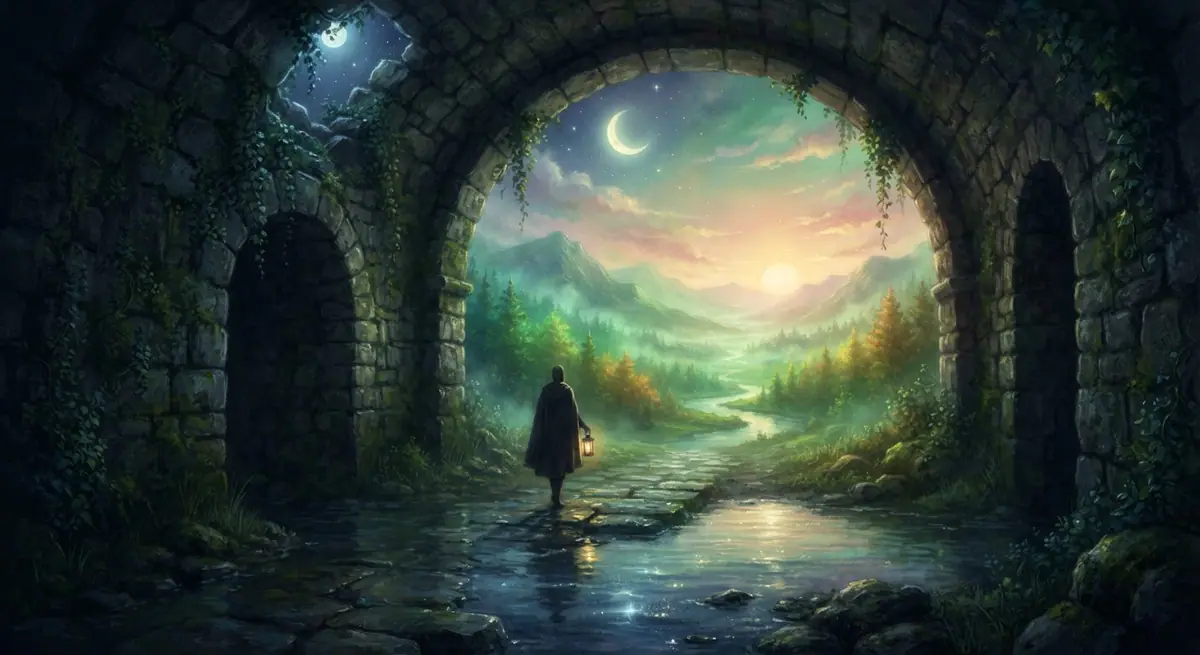
Dreaming of a tunnel commonly symbolizes passage through a difficult, hidden, or transformative phase. Psychologically, it can represent movement from one identity or situation into another, with darkness reflecting uncertainty and the distant opening suggesting hope, insight, or rebirth. A tunnel may also express anxiety about confinement, limited choices, suppressed memories, or the need to confront material that consciousness has avoided. Its meaning depends strongly on direction and feeling: entering willingly suggests readiness for change, while being trapped or unable to see an exit may indicate overwhelm. Spiritually, tunnels resemble initiatory passages, caves, graves, birth canals, and the mysterious interval between an old life and a new one. Emerging into light is generally auspicious, especially after fear or hardship; collapse, flooding, or a blocked passage warns of delay and unresolved obstacles. Across traditions, the tunnel is therefore a threshold symbol: neither destination nor dead end by itself, but a test of endurance, faith, and inner transformation.
Get your personalized AI interpretation in seconds
How each tradition reads dreams about Tunnel
Carl Jung (Archetypes)
Man and His Symbols (1964)
In Jungian analytical psychology, a tunnel is a concentrated image of the threshold between conscious life and the unconscious. Its architecture matters: the entrance marks a voluntary or involuntary descent, the darkness indicates material not yet understood, and the far opening represents a possible enlargement of consciousness rather than a guaranteed happy ending. Unlike a simple road, the tunnel removes peripheral vision. The dreamer must confront an inner process without the usual social distractions.
For someone beginning therapy or undergoing a major life change, entering a tunnel calmly may show readiness to encounter the shadow: rejected anger, grief, envy, sexuality, or other traits the ego has excluded. If the dreamer is chased into it, the shadow is not being approached freely; pressure from a neglected conflict may be forcing recognition. A tunnel containing a threatening stranger can personify the shadow, while a helpful stranger may be a psychopomp-like expression of an unconscious guiding function. In a woman's dream, a male guide may sometimes carry animus associations; in a man's dream, a female guide may constellate the anima, though personal associations always outrank gender formulas.
A blocked tunnel often indicates that the ego's current attitude cannot complete an individuation process. A collapsing roof may show that a defensive structure is failing; flooding can suggest overwhelming feeling or an unconscious complex breaking into awareness. A branching tunnel presents a choice among psychic attitudes, while a circular tunnel may reveal repetition rather than progress. Emerging into sunlight, a garden, or a wider landscape suggests integration, but emerging into another tunnel means the work is unfinished. Jung would not reduce the symbol to rebirth alone: the passage may lead to transformation, regression, or confrontation with the unknown. The dreamer's affect, associations with enclosed spaces, and waking-life situation are essential for distinguishing initiation from claustrophobic anxiety.
Sigmund Freud (Desire)
The Interpretation of Dreams (1899)
From a Freudian perspective, a tunnel is interpreted through the distinction between manifest content and latent content rather than through a universal omen. Its enclosed, elongated, and often dark form can become a condensation of several wishes and anxieties: return to an earlier state, concealment of forbidden desire, fear of confinement, or sexual symbolism. Freud's method would ask what the particular dreamer associates with tunnels, trains, caves, corridors, childbirth, or secret entrances instead of assigning one meaning to every dream.
A person dreaming of entering a warm, inviting tunnel may be expressing a wish for retreat, protection, or return to the security of the maternal environment. In a different dreamer, the same image may disguise a sexual wish through displacement and symbolic substitution. The tunnel's opening and emergence can evoke birth imagery, especially when the dream includes water, pressure, darkness followed by light, or a sense of being pushed through. Yet this does not prove a birth interpretation: a commuter may simply be processing travel, while someone with claustrophobia may be repeating a recent fear. Free association determines the latent content.
Being trapped in a tunnel may represent anxiety produced by conflict between an instinctual wish and the ego's defenses. A blocked exit can dramatize repression: desire seeks expression but is stopped by guilt, prohibition, or fear of consequences. Running from an unseen pursuer may displace a forbidden impulse onto an external threat. Finding a secret side passage may reveal compromise formation, allowing a wish partial satisfaction while preserving concealment. A tunnel filled with people can connect desire to rivalry, exposure, or social judgment; an empty tunnel may emphasize solitary fantasy. Freud would also examine repetition, bodily sensations during sleep, and day residue. The dream's apparent rebirth is therefore not automatically spiritual: it may be the disguised return of repressed material, with interpretation resting on the dreamer's associations and conflict.
Other traditions
Ibn Sirin (Islamic Core)
Muntakhab al-Kalam fi Tafsir al-Ahlam (attributed)
Ibn Sirin's surviving dream manuals do not establish a single technical entry for the modern word tunnel. A covered passage is therefore interpreted through related images: a road, narrow way, underground place, cave, well, prison, or doorway, always according to the dreamer's condition and the passage's outcome. For a traveler, entering a straight and secure passage may signify undertaking a difficult journey or crossing a stage of danger; reaching daylight or a familiar place favors safe arrival and relief. For a sick person, going through darkness and emerging can signify recovery or a change of condition, while remaining below ground, losing the route, or finding the way sealed carries the gravity of confinement and may warn of prolonged illness or distress.
A poor or indebted person who sees a spacious tunnel with a visible exit may receive a sign of gradual relief, particularly if the dream includes walking calmly, prayer, water, or a companion known for good character. A narrow, foul, or collapsing passage reverses the indication: it can represent hardship, humiliation, debt, or an affair whose consequences are hidden. Crawling through it may show that advancement requires humility; being carried through suggests dependence on another person. If the dreamer digs the passage, the act may point to seeking a livelihood or uncovering a concealed matter, but reckless digging can indicate intrigue or self-created trouble.
The decisive sign is not darkness alone but whether the dreamer exits, becomes lost, or turns back. Light, fresh air, a sound gate, and a known destination strengthen a favorable reading. Snakes, filth, fire, oppressive darkness, or a blocked end warn of enemies, fear, or obstruction. The classical method also gives weight to the dreamer's piety, profession, season, and emotional state; the same passage may be a trial for one person and a lawful route to safety for another.
Al-Nabulsi
Ta'tir al-Anam fi Ta'bir al-Manam
Al-Nabulsi does not treat the modern tunnel as an independent symbol in the way a contemporary dream dictionary might. His method reads an enclosed route through associated categories such as the road, cave, subterranean chamber, well, prison, and door. A tunnel consequently signifies a concealed transition whose meaning is determined by entry, conduct within it, and emergence. For a person preparing to travel, a clear passage can indicate a road made manageable after difficulty. For someone facing litigation, debt, illness, or fear, a dark and obstructed passage more closely resembles confinement and warns that relief is delayed.
A tunnel that is broad, clean, and supported by firm walls may signify protection, secrecy kept for a legitimate purpose, or movement under the care of an influential person. If the dreamer passes beneath a mountain and comes out into cultivated land, the symbolism favors deliverance after a severe trial and the opening of provision. A passage beneath a house, however, may point to hidden family affairs or a concealed source of gain; if it undermines the house, it warns that secrecy is damaging the household. Finding a door at the end and opening it is stronger than merely seeing light, because it indicates an available means of release.
Al-Nabulsi's framework gives special importance to what accompanies the journey. A righteous guide, Qur'anic recitation, clean water, or a peaceful animal strengthens the hopeful side. Pursuit by an enemy, poisonous creatures, smoke, stagnant water, or the collapse of the roof makes the tunnel an image of trial, deception, or constriction. Entering willingly differs from being forced inside: the former can signify chosen withdrawal, study, worship, or a necessary undertaking; the latter may reflect oppression. Emerging backward or returning safely may show avoidance of danger, whereas becoming lost after turning from the exit suggests hesitation. The dreamer's actual circumstances remain decisive, and the symbol should not be read as a fixed prediction.
Imam Sadiq
Attributions of dream symbolism to Imam Ja'far al-Sadiq circulate in later Islamic compilations, and a modern tunnel is not a plainly attested, standalone category in the earliest material. In that attributed interpretive scheme, its meaning is best organized under the ideas of a road, hidden place, obstruction, escape, and passage from one condition to another. The tunnel is thus a sign whose moral and practical value depends on what the dreamer seeks and whether the passage leads toward safety or confusion.
For a ruler, official, or person responsible for others, entering a tunnel with a lamp and emerging before companions may indicate managing a concealed problem and restoring order. Entering without light, losing authority inside, or finding the exit guarded can warn of a policy or decision that has become difficult to control. For a merchant, a level passage leading to a market may suggest a profitable but demanding route; a flooded or collapsing tunnel cautions against uncertain contracts and hidden losses. For a sick person, emergence into clean air is a favorable image of changing condition, while entrapment and suffocation represent intensified distress rather than a simple prediction of death.
The tradition's moral categories are especially useful in variations. A tunnel dug by the dreamer may signify effort, investigation, or pursuit of livelihood; if the digging exposes treasure lawfully, benefit follows, but if it opens into another person's dwelling, suspicion and intrusion are indicated. A companion who guides the dreamer toward light can represent wise counsel, whereas a stranger leading deeper into darkness may embody temptation or misleading advice. Walking calmly suggests patience; running in panic suggests fear governing judgment. A white or illuminated opening, flowing water, and a clean floor favor relief and spiritual guidance. Blackness, filth, serpents, fire, and a blocked end favor warning. The dreamer's intention, conduct, and trust in God determine whether the passage becomes a trial that purifies or a snare that delays.
Biblical Tradition
The Bible (Old Testament)
The Bible has no modern tunnel symbol as a fixed dream-dictionary entry, so Biblical interpretation proceeds by analogy with wilderness roads, pits, caves, prisons, passages through the sea, and movement from darkness into light. A tunnel dream can therefore portray a hidden interval in which a person is tested, protected, corrected, or prepared for deliverance. Its meaning depends on whether the passage leads toward God-given freedom or deeper concealment and disobedience.
A dreamer who enters darkness and emerges into light may recall the Biblical pattern of exodus: an apparently impossible passage becomes a route to liberation. Water surrounding the tunnel can suggest both danger and deliverance, echoing the Red Sea and baptismal imagery. A narrow passage may evoke the “narrow gate” teaching in Matthew, where the difficult way is associated with life; the image does not promise comfort but calls for discernment, repentance, and faithful perseverance. For someone facing persecution or fear, a cave-like tunnel can resemble Elijah's retreat or David's hiding place: concealment may be temporary protection, but it can also become withdrawal that delays obedience.
A blocked or collapsing tunnel can parallel the Biblical pit, prison, or dungeon. For a person concealing wrongdoing, the dream may function as a warning that secrecy is becoming bondage. For one who is unjustly confined, finding a door or hearing a call from outside may symbolize hope and divine intervention, without guaranteeing a specific earthly outcome. A tunnel beneath a house may represent foundations and hidden works; flooding can recall judgment, while clean water may point to cleansing and renewed life. A guide carrying a lamp can be read alongside the scriptural contrast between light and darkness, provided the dreamer's faith and context support that reading.
Biblical tradition cautions against treating every dream as prophecy. Prayer, moral examination, Scripture, and wise counsel are more reliable than sensational symbolism. The tunnel is spiritually mixed: darkness may precede revelation, but an attractive hidden route can also represent temptation. The final direction, ethical choices, and emergence into truth determine its force.
Christian Tradition
Christian mysticism often understands a tunnel as the soul's passage through purgation, hiddenness, and transformation. It resembles the cave, the wilderness, the dark night, and the tomb from which resurrection life emerges. In this reading, darkness is not automatically evil. A person may lose familiar consolations while being invited into deeper faith, silence, and dependence on God. The tunnel becomes a liminal space in which the old self is stripped away and a new orientation is formed.
For someone undergoing grief, illness, conversion, or vocational uncertainty, walking steadily through a dark passage may signify perseverance during a “dark night” of the soul. The absence of visible guidance need not mean abandonment; it can describe faith that continues without emotional certainty. A small light, a cross, a voice calling the dreamer by name, or a trustworthy companion may symbolize grace, conscience, Christ, or the communion of the faithful, but personal prayerful discernment is necessary before making such identifications. A tunnel opening into a chapel, garden, or sunrise favors consolation and renewed vocation.
Being trapped can have several Christian meanings. It may reveal scrupulosity, despair, bondage to sin, or an inability to accept forgiveness. A door that will not open may call for surrender rather than greater self-reliance; a passage opened through prayer may represent release from a false attachment. Crawling through a narrow place can evoke humility and the stripping of pride, while returning to rescue another person suggests charity and shared suffering. A tunnel filled with seductive lights, voices, or shortcuts warns against confusing spiritual intensity with truth.
Christian mysticism does not treat every dream as a divine message. Discernment tests the fruit: does the interpretation produce humility, love, patience, repentance, and freedom, or fear, vanity, and compulsion? The tunnel's rebirth symbolism is therefore paschal rather than merely optimistic. Descent, death of an old pattern, waiting, and emergence belong together. The dream may promise no timetable, but it can invite the dreamer to remain faithful through an obscure transition.
Zhou Gong
Zhou Gong Jie Meng (周公解梦)
Traditional Chinese dream interpretation associated with Zhou Gong does not contain a simple, historically secure entry for the modern engineered tunnel. A contemporary tunnel is therefore read by analogy with an underground passage, cave, hole, city gate, road, well, or movement beneath an obstacle. The central question is whether the dreamer passes through constriction into an open and auspicious environment, or becomes hidden, trapped, or polluted below the surface. The symbol concerns changing circumstances, concealed affairs, and the interval before resolution.
For a traveler or official, passing through a straight tunnel and seeing daylight, a gate, or a busy road can signify that a difficult undertaking will reach completion. If the passage leads into a broad field, home, or place of abundance, the favorable meaning is strengthened. A person seeking employment or advancement may take a clean, well-lit tunnel as a sign that a hidden opportunity is becoming accessible, though the narrowness indicates effort before recognition. A merchant who sees goods moving safely through a tunnel may anticipate successful transport; broken walls, theft, or flooding advise caution about logistics and agreements.
For a sick dreamer, fresh air and emergence can symbolize recovery or a change from obstruction to movement, whereas foul underground water, suffocation, or inability to return suggests depleted qi in the language of later popular interpretation. A tunnel beneath one's house may expose family secrets or an unstable foundation in domestic affairs. Digging beneath another person's property warns against intrusion and disputes. Meeting ancestors or an elderly guide underground can represent memory, lineage, or instruction, but frightening dead figures and a sealed route call for attention to grief and unresolved obligations rather than a literal prophecy.
The emotional tone and final scene are decisive. Red, gold, lantern light, flowing clean water, and an open gate favor auspicious transformation; mud, collapse, darkness without end, and pursuit indicate blockage. The tunnel is a passage, not inherently good or bad: successful emergence turns hidden difficulty into progress, while entrapment shows that timing, preparation, or conduct must change.
Hindu / Vedic
In Hindu dream interpretation, including popular readings associated with Swapna Shastra, a modern tunnel is interpreted through related images such as a cave, subterranean route, narrow passage, womb-like enclosure, or journey through darkness. Classical lists vary by text and lineage, and a tunnel should not be presented as a single universally fixed omen. Its significance depends on the dreamer's guna-like mental condition, conduct, timing, and the final movement of the dream. A passage from darkness into light commonly suggests transition, purification, and the surfacing of knowledge.
For a person beginning spiritual practice, entering a quiet cave or tunnel and emerging near a temple, river, mountain, or rising sun may indicate inward withdrawal followed by insight. The cave association can favor meditation and contact with hidden knowledge, but only when the dream is peaceful and disciplined rather than fearful. A student or worker who crosses a narrow passage successfully may be moving through obstacles created by karma, habit, or confusion. Seeing a guru, deity, lamp, or sacred sound at the far end strengthens the reading of guidance, though such imagery should be approached with reverence rather than treated as automatic authorization.
A tunnel flooded with dirty water, filled with insects, or ending in a pit may signify tamasic heaviness, unresolved impressions, fear, or entanglement in worldly confusion. For someone ill or exhausted, suffocation and inability to emerge may reflect disturbed sleep, depleted vitality, or anxiety rather than a prophecy. A blocked exit can indicate that a desired result is delayed by attachment or improper action. Crawling through and finally reaching open ground suggests tapas: sustained effort that burns through resistance. Turning back may show discernment if danger is real, or avoidance if fear dominates.
The auspicious sign is not darkness by itself but conscious passage toward clarity. Clean water, a flame, open sky, mantra, flowers, or a sacred threshold favor renewal. The dreamer should consider diet, stress, recent impressions, and ethical conduct, since Hindu traditions often distinguish spiritually significant dreams from ordinary mental residue. Tunnel symbolism ultimately concerns samsaric transition and the possibility of moving from ignorance toward awareness.
Japanese (Yume Uranai)
In Japanese 夢占い, a tunnel is commonly treated as a symbol of transition, uncertainty, pressure, and the movement from one phase of life into another. Popular interpretations draw on the tunnel's physical features rather than on one canonical classical rule: its darkness suggests the unknown, its narrowness suggests constraint, and its exit suggests a coming change. The dreamer's feeling is decisive. Calm forward movement can indicate readiness, while panic or entrapment may reflect stress in work, relationships, health, or family life.
A bright tunnel with a clear opening is generally read favorably. For a student, job seeker, or person starting a relationship, it can signify that effort is leading toward opportunity and that a current period of uncertainty will become more intelligible. Emerging into sunlight, a broad road, flowers, or an open sea strengthens the association with renewal and fresh possibilities. A tunnel with lamps or orderly walls may suggest practical support and a structured route through difficulty. Walking with a trusted companion can point to cooperation, while reaching the exit alone may emphasize personal independence.
A dark tunnel with no visible end is a common warning image for anxiety, burnout, or feeling unable to see options. A collapse, flood, obstruction, or repeated return to the entrance may indicate postponed plans and the need to revise expectations. For someone in a strained relationship, a tunnel can symbolize emotional distance or a transition whose outcome has not been discussed. A train tunnel adds themes of schedule, social pressure, and being carried along a route chosen by circumstances; stopping or missing the train may reflect fear of falling behind. A tunnel beneath a shrine, mountain, or sea can intensify themes of hidden feelings and major inner change.
Japanese dream interpretation also recognizes that recent images, fatigue, and media can generate ordinary dreams. The most favorable reading comes from passing through safely, seeing light, or feeling relief on emergence. The symbol is therefore mixed rather than uniformly lucky: it asks whether the dreamer is moving patiently toward change or remaining trapped in fear. Rebirth here means renewal after transition, not a fixed prediction.
Don't let the message slip away. Get a profound, personalized analysis that reveals what your subconscious is trying to tell you.
Interpret your Tunnel dream with AIDream Scenarios
Common Questions & Scenarios
What does it mean to dream about a tunnel?
What does a dark tunnel mean in a dream?
What does it mean to dream of walking through a tunnel?
What does it mean to dream of being trapped in a tunnel?
What does it mean to dream of a tunnel leading to light?
Written with AI from the traditions named on this page and maintained by the FASSIR English Editor. Last updated . How we interpret dreams
Disclaimer: This analysis utilizes AI based on historical and psychological texts for educational and spiritual insight. It does not constitute professional medical or psychological advice.