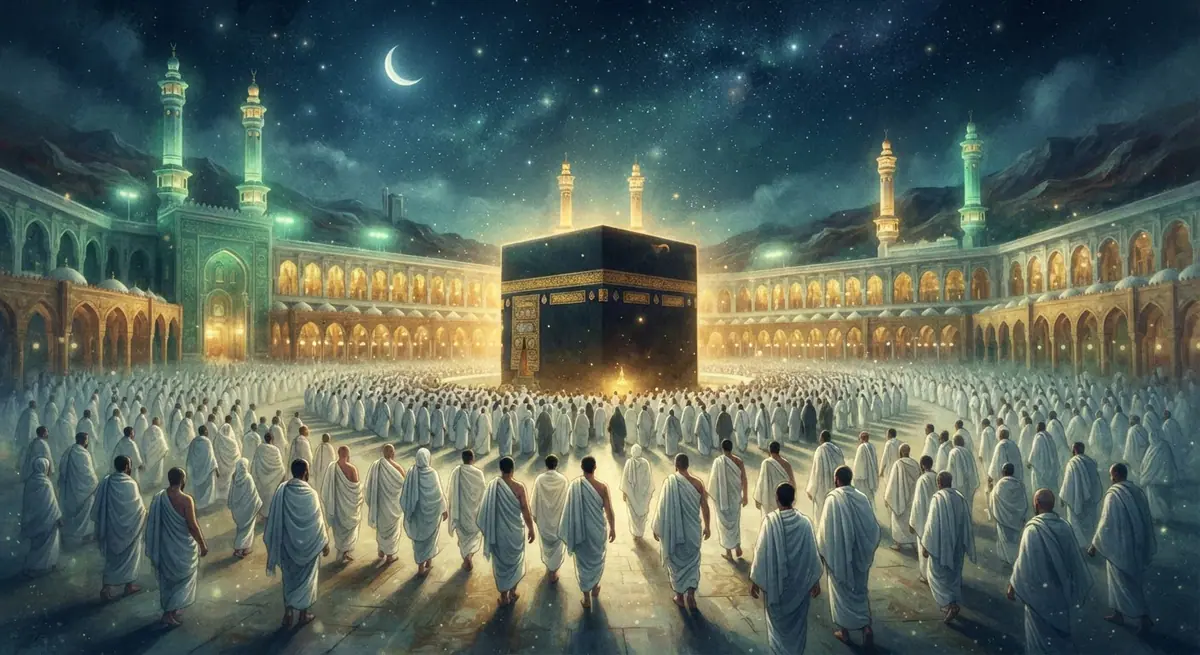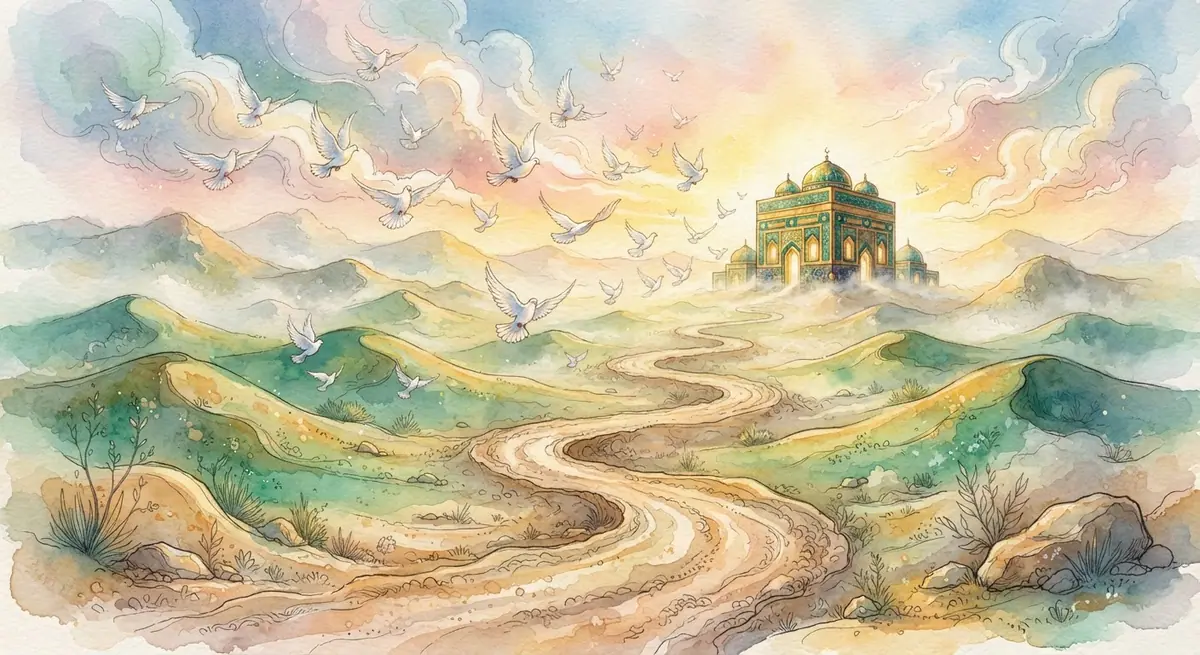
Dreaming of Umrah, the lesser pilgrimage to Mecca, carries layered meanings across spiritual and psychological traditions. In Islamic interpretation, it often signals a return to purity, the fulfillment of a postponed vow, or relief from hardship, especially when the dreamer is ill, indebted, or estranged from family. The dream may compensate for an unperformed pilgrimage or announce that a spiritual obligation will soon be met. Psychologically, Umrah represents the archetype of the sacred journey: a deliberate simplification of life, the laying down of burdens, and the reintegration of the self around a central purpose. Jungians read it as individuation—the ego circling the Self. Freudians may see it as wish-fulfilment of absolution or escape from guilt. Cross-culturally, the dream is generally auspicious, though its tone depends on the dreamer's state: performing Umrah with ease suggests forgiveness and social repair; being blocked from it warns of inner resistance or external obstacles. The symbol speaks to the universal human need for renewal, ritual closure, and return to origin.
Get your personalized AI interpretation in seconds
How each tradition reads dreams about Umrah
Carl Jung (Archetypes)
Man and His Symbols (1964)
Jung would approach the dream of Umrah as an archetypal image of the sacred journey and the circumambulation of the Self. The Kaaba, as the axis mundi, represents the center of the psyche, and the act of tawaf—circling seven times—symbolizes the ego's repeated approach to the Self from different angles until integration occurs. The dreamer who performs Umrah in a dream is often in a liminal phase of individuation, having left behind a former identity and not yet arrived at a new one. The state of ihram, with its plain garments and prohibitions, corresponds to the temporary dissolution of persona and the stripping away of social masks. If the dreamer sees himself in ihram but anxious about his appearance, it suggests resistance to the individuation process, a fear of losing social identity. If he sees himself performing sa'i between Safa and Marwa, Jung would read it as the tension of opposites: the dreamer runs between two poles, seeking a resolution that cannot be found in either alone but only in the movement itself. If the dreamer sees the Black Stone but cannot touch it, it indicates that the Self is constellated but not yet accessible, often because the shadow has not been acknowledged. If a woman dreams of Umrah, Jung might interpret it as the animus leading her toward a spiritual goal that her conscious attitude has neglected. If the dreamer sees himself performing Umrah with a crowd, it points to the collective unconscious and the need to belong to a meaningful tradition. If he sees himself alone in the desert near Mecca, it signifies the via negativa, a solitary encounter with the numinous. Jung also noted that such dreams often occur during periods of midlife transition, when the ego must surrender its heroic stance and submit to a greater ordering principle.
Sigmund Freud (Desire)
The Interpretation of Dreams (1899)
Freud would treat the dream of Umrah as a disguised expression of unconscious wishes, often rooted in early experiences of guilt, authority, and the desire for absolution. The pilgrimage, with its prescribed rituals and submission to divine law, may represent the superego's demand for reparation. If the dreamer is someone who has transgressed a moral or familial rule, the dream may be a wish-fulfilment of forgiveness without the need for actual confession or restitution. The act of circling the Kaaba could symbolize a compulsive return to a traumatic scene, the repetition compulsion in the service of mastery. If the dreamer sees himself performing Umrah but is late or has forgotten a ritual, it may express castration anxiety—the fear of being found inadequate before a paternal authority. The ihram garments, which erase social distinctions, may represent a regression to a pre-Oedipal state of undifferentiation, a longing for the mother's body. If the dreamer sees himself drinking Zamzam water, Freud might interpret it as oral gratification, a substitute for a forbidden desire. If a man dreams of performing Umrah with his mother, it could indicate an unresolved Oedipal attachment, the wish to be the sole companion of the mother in a sacred space. If a woman dreams of Umrah, it may express penis envy in a sublimated form—the wish to participate in a male-dominated ritual—or a desire to be purified of a perceived sexual transgression. If the dreamer sees himself unable to complete the Umrah because of a missing document or lost money, it points to anxiety about performance and the fear of exposure. Freud would also note that the manifest content of Umrah may conceal a latent wish for travel, escape from a monotonous marriage, or the death of a rival. The dream's affect is key: calm satisfaction suggests the wish is being partially fulfilled, while anxiety indicates resistance.
Other traditions
Ibn Sirin (Islamic Core)
Muntakhab al-Kalam fi Tafsir al-Ahlam (attributed)
Ibn Sirin held that the dream of Umrah belongs to the class of visions that announce relief after constraint, because the pilgrim lays down ordinary identity and enters a state of ihram, or consecration. If a healthy person sees himself performing Umrah, it indicates a journey undertaken for a noble purpose, often religious or familial, and a return with increased standing. If the dreamer is sick, the dream is read as a sign of recovery, since the pilgrim's movement mirrors the body's return to balance. If he is in debt or entangled in litigation, it portends the removal of that burden through unexpected means, sometimes a benefactor or a legal settlement. If a woman sees herself in Umrah while menstruating—normally a barrier to ritual—the interpretation shifts: it may point to a matter she believes closed but which will reopen favorably, or to a social reconciliation she thought impossible. If the dreamer sees himself completing the tawaf but unable to reach the Black Stone, Ibn Sirin warns of a goal nearly attained but delayed by a small unresolved matter, often a promise to a relative. If he sees himself performing sa'i between Safa and Marwa, it signifies effort that will be rewarded after apparent exhaustion. Seeing the Kaaba without performing the rites suggests the blessing is present but the dreamer has not yet taken the practical step to receive it. If the dream occurs outside the pilgrimage season, it may indicate a spiritual obligation the dreamer has postponed, and the dream functions as a summons. Ibn Sirin also noted that the dream's color matters: a dream of Umrah in winter or rain points to a difficult path made easier, while in summer heat it warns of a trial that must be endured with patience.
Al-Nabulsi
Ta'tir al-Anam fi Ta'bir al-Manam
Al-Nabulsi, in his comprehensive dictionary of dream symbolism, treats Umrah as a symbol of visitation and repair. He distinguishes between the dreamer who sees himself entering ihram and one who sees himself already in Mecca. Entering ihram in a dream signifies a vow or covenant the dreamer is about to make, often concerning a family matter or a financial pledge. If the dreamer is a merchant, it may indicate a profitable journey that also carries moral weight, such as settling a debt or restoring a partnership. If he is a ruler or official, it points to a just decision that will be remembered. Al-Nabulsi gives special attention to the dreamer who sees himself performing Umrah on behalf of another: this indicates intercession, either the dreamer will plead for someone's case or someone will plead for his. If the dreamer sees himself unable to complete the rites because of a missing garment or lost sandals, it warns of a deficiency in preparation—often a neglected duty to a parent or teacher. If he sees the crowds of pilgrims but cannot join them, it suggests social isolation or a feeling of unworthiness that must be addressed. A dream of drinking Zamzam water during Umrah indicates knowledge that benefits others; a dream of shaving the head or cutting hair signifies the end of a period of mourning or the release from a heavy obligation. Al-Nabulsi also notes that seeing the Kaaba in a dream without performing Umrah may mean the dreamer is near a great opportunity but has not yet recognized it. If the dreamer is a woman and sees herself performing Umrah with her husband, it portends harmony and the resolution of a long-standing dispute. If she sees herself performing it alone, it may indicate a personal spiritual calling that her household does not share, and she should pursue it quietly.
Imam Sadiq
Imam Jafar al-Sadiq, in the tradition of Shia dream interpretation, approached the dream of Umrah as a sign of the dreamer's inner state relative to the divine covenant. He taught that the dream is a mirror of the heart's orientation. If a person sees himself performing Umrah with humility and tears, it indicates that his repentance has been accepted and that a period of spiritual dryness is ending. If he sees himself performing the rites with haste or irritation, it warns that he is treating a sacred obligation as a burden, and he should examine his intentions. If the dreamer is a young person, the dream may signal the approach of a marriage or a serious commitment, because Umrah in youth is often a prelude to a change of state. If an elder sees it, it points to the completion of a life-task and the settling of accounts with heirs. If a sick person sees himself performing Umrah and then drinking Zamzam, it is a strong sign of recovery, especially if the dream occurs on a Thursday night or Friday. If the dreamer sees himself performing Umrah but the Kaaba is veiled or distant, it indicates that a teacher or guide is needed before the goal can be reached. If he sees himself performing Umrah in a dream during the month of Rajab or Sha'ban, it is considered especially auspicious, as these months prepare the heart for Ramadan. Imam al-Sadiq also warned that seeing oneself perform Umrah while neglecting prayer in waking life is a call to return to the daily practice, not a guarantee of forgiveness. If the dreamer sees himself performing Umrah and then committing a sin in the same dream, it indicates a struggle between two impulses, and the dreamer should seek counsel. If a woman sees herself performing Umrah while pregnant, it may indicate a safe delivery and a child who will be a source of honor.
Biblical Tradition
The Bible (Old Testament)
Biblical tradition, while not addressing Umrah directly, provides a rich framework for interpreting the dream through the symbolism of pilgrimage to a holy city. The Psalms of Ascent describe the pilgrim's journey to Jerusalem as a movement from exile to presence, from sorrow to joy. A dream of Umrah can be read as a modern echo of that ascent: the dreamer is leaving a state of spiritual distance and approaching the dwelling place of God. If the dreamer sees himself traveling with others, it recalls the communal pilgrimages of Israel and the early church, suggesting that the dreamer will find strength in fellowship. If he sees himself alone, it evokes the solitary journeys of Abraham and Elijah, indicating a personal call that requires leaving familiar surroundings. The act of circumambulation may be compared to the Israelites marching around Jericho—a ritual of faith that precedes the collapse of obstacles. If the dreamer sees himself performing Umrah but is hindered by a crowd or a locked gate, it echoes the experience of the exiles returning to rebuild the temple, facing opposition but ultimately prevailing. If he sees himself drinking from a spring or well during the pilgrimage, it recalls the water from the rock and the well of Bethlehem, symbolizing divine provision. If a woman dreams of Umrah, it may connect to the stories of Hannah and Mary, who traveled to the temple to pray and received promises. The dream may also be a call to repentance, as the prophets called Israel to return to the Lord. If the dreamer sees himself performing Umrah and then weeping, it suggests that a season of mourning is turning into dancing. The dream is generally auspicious, but if the dreamer feels unworthy or impure, it may indicate a need for reconciliation with God and neighbor before the journey can be completed.
Christian Tradition
Christian mysticism would interpret a dream of Umrah as an image of the soul's pilgrimage toward union with God, a theme that runs from Augustine's restless heart to the dark night of the soul. The dreamer who performs Umrah is engaged in a via purgativa, a purgative way, stripping away attachments and distractions. The ihram garments correspond to the white robe of the baptized, the new self put on in Christ. If the dreamer sees himself circling the Kaaba, it may symbolize the soul's repeated acts of devotion, the prayer of the heart that returns again and again to the center, which is God. If he sees himself performing sa'i between two hills, it evokes the tension between Martha and Mary—the active and contemplative lives—and the need to integrate both. If the dreamer sees the Kaaba but cannot approach, it suggests a period of spiritual dryness, where God seems distant, and the dreamer is called to persevere in faith. If he sees himself drinking Zamzam, it may be a symbol of the living water that Jesus promised to the Samaritan woman, a grace that satisfies the deepest thirst. If a woman dreams of Umrah, it may connect to the pilgrimage of the Virgin Mary to the temple and her Magnificat, a song of reversal and mercy. If the dreamer sees himself performing Umrah with a crowd, it points to the communion of saints, the great cloud of witnesses. If he sees himself unable to complete the rites because of a sin, it may be a call to confession and absolution. Christian mystics would caution that the dream is not a substitute for actual sacramental life but a invitation to deeper conversion. The dream's fruit is tested by its effects: if it leads to humility, charity, and peace, it is from God; if to pride or confusion, it is not.
Zhou Gong
Zhou Gong Jie Meng (周公解梦)
Zhou Gong's dream tradition, though rooted in Chinese cosmology, would interpret a dream of Umrah through the lens of journey, purification, and the mandate of heaven. The pilgrimage to a distant sacred center corresponds to the archetype of the imperial tour, in which the ruler visits the four quarters to renew the harmony between heaven and earth. If a person dreams of performing Umrah, it suggests that a period of disorder in the family or workplace is ending, and a new mandate—whether literal or figurative—is being conferred. If the dreamer is a leader, it indicates that he will be called to mediate a dispute and restore balance. If he is a student, it points to success in examinations, because the dreamer has traveled to the source of knowledge. If the dreamer sees himself performing the rites with a large crowd, it signifies social harmony and the support of many people. If he sees himself performing Umrah alone, it may indicate a solitary task that will bring honor but little companionship. If the dreamer is sick, the dream is a sign of recovery, as the journey to the sacred center mirrors the return of the vital force to the heart. If he sees himself unable to reach Mecca, it warns of an obstacle in the form of a jealous relative or a corrupt official. If he sees himself performing Umrah and then returning home, it indicates that a matter will be resolved and the dreamer will return to his daily life with greater authority. If a woman dreams of Umrah, it may indicate that she will take on a role of spiritual leadership in her family, or that a son will bring honor. Zhou Gong also notes that the dream's timing matters: a dream of Umrah in spring indicates growth and new beginnings; in autumn, it points to a harvest of past efforts; in winter, it warns of a trial that must be endured before renewal.
Hindu / Vedic
Hindu Swapna Shastra, the classical science of dreams, would interpret a dream of Umrah through the categories of tirtha, or sacred crossing, and yatra, or journey. A pilgrimage in a dream is generally auspicious, indicating that the dreamer is moving from a state of impurity to purity, from ignorance to knowledge. The dreamer who performs Umrah is making a yatra to a distant sacred center, which corresponds to the inner journey toward the Self, the atman. If the dreamer is a householder, the dream may indicate that a period of worldly entanglement is ending and a time of spiritual focus is beginning. If he is a renunciate, it confirms his path and may signal the approach of a teacher or a final liberation. If the dreamer sees himself performing the rites with devotion, it indicates that past karma is being exhausted and new merit is being accumulated. If he sees himself performing Umrah with a crowd, it suggests the influence of satsang, the company of the good, which accelerates spiritual growth. If he sees himself unable to complete the pilgrimage because of a missing item, it warns of a lingering desire or attachment that must be addressed. If he sees himself drinking water during the pilgrimage, it signifies the nectar of immortality, the realization of the deathless within. If a woman dreams of Umrah, it may indicate that she will be the bearer of a spiritual lineage, or that a child will bring honor. Swapna Shastra also notes that the dream's timing and the dreamer's state matter: a dream of pilgrimage during the waxing moon is especially auspicious, while during the waning moon it may indicate a need for purification. The dream is generally a good omen, but it must be followed by right action, not mere passivity.
Japanese (Yume Uranai)
Japanese 夢占い, or dream divination, would approach a dream of Umrah as a sign of purification and the beginning of a new cycle. The pilgrimage to a distant sacred place corresponds to the Shinto concept of misogi, ritual purification, and the Buddhist practice of junrei, pilgrimage to sacred sites. If a person dreams of performing Umrah, it suggests that a period of stagnation or misfortune is ending, and the kami or buddhas are guiding the dreamer toward renewal. If the dreamer sees himself wearing the ihram garments, it indicates a change of status or a new role in life, often accompanied by a sense of humility. If he sees himself circling the Kaaba, it may symbolize the cyclical nature of life and the importance of returning to one's origins. If he sees himself performing the rites with others, it points to harmony in the community and the support of ancestors. If he sees himself unable to complete the pilgrimage, it warns of an obstacle in the form of a neglected duty or a broken promise. If he sees himself drinking water during the pilgrimage, it signifies the flow of good fortune and the quenching of a long-standing thirst. If a woman dreams of Umrah, it may indicate that she will be the one to restore harmony in her family, or that a child will bring news of success. Japanese dream lore also notes that the dream's color and season matter: a dream of Umrah in spring indicates new beginnings; in summer, a test of endurance; in autumn, a harvest of efforts; in winter, a period of waiting before renewal. The dream is generally auspicious, but the dreamer should take concrete steps to purify his intentions and actions.
Don't let the message slip away. Get a profound, personalized analysis that reveals what your subconscious is trying to tell you.
Interpret your Umrah dream with AIDream Scenarios
Common Questions & Scenarios
What does it mean to dream of performing Umrah?
What does dreaming about going to Umrah with family mean?
What does it mean to dream of preparing for Umrah?
What does it mean to dream of returning from Umrah?
What does seeing the Kaaba during an Umrah dream mean?
Written with AI from the traditions named on this page and maintained by the FASSIR English Editor. Last updated . How we interpret dreams
Disclaimer: This analysis utilizes AI based on historical and psychological texts for educational and spiritual insight. It does not constitute professional medical or psychological advice.