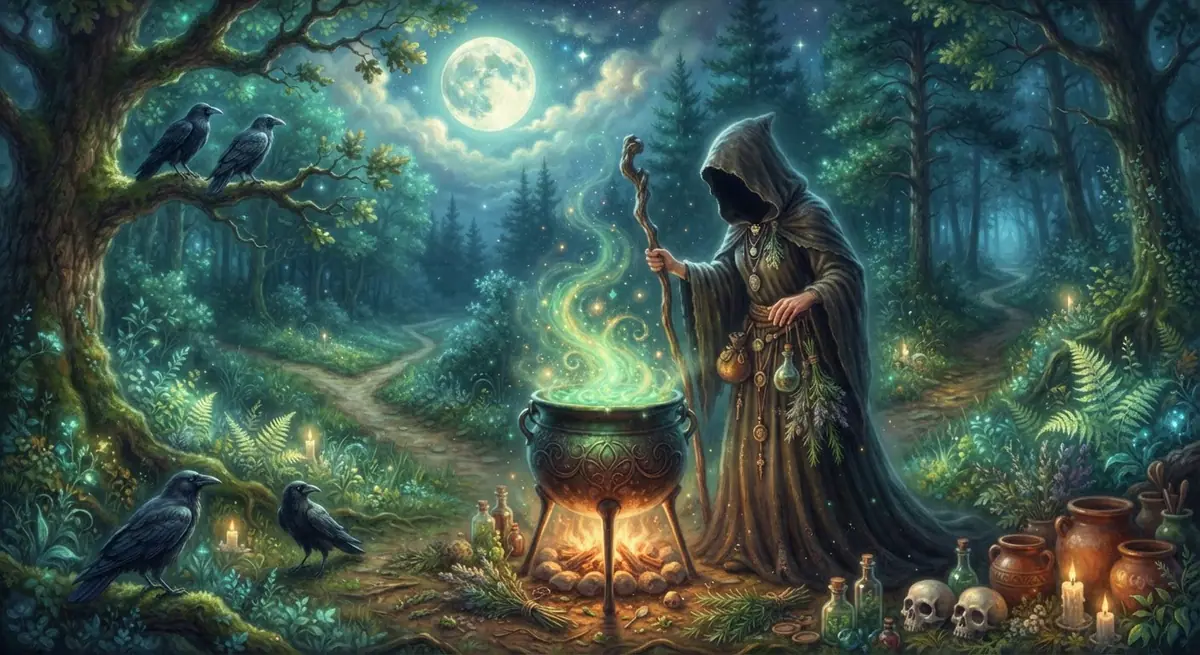
Dreaming of a witch often centers on feared influence, hidden knowledge, transformation, and the uneasy boundary between healing and harm. Psychologically, the witch may personify a disowned “shadow” quality—anger, independence, sensuality, intuition, or the wish to control events—or represent someone whose power feels manipulative. A frightening witch can reflect anxiety about betrayal, gossip, coercion, aging, or social judgment; a helpful witch may signal neglected wisdom and a need to trust instinct. Spiritually, many traditions treat the image as a warning to examine attachments, deception, envy, and misuse of power, while others regard the wise woman as an initiatory guide through change. Details alter the meaning: being chased suggests avoidance, defeating the witch suggests restored agency, and becoming one suggests integration or a new relationship with personal authority. The dream’s emotional tone, the witch’s actions, and the dreamer’s cultural beliefs should guide interpretation rather than assuming a literal supernatural cause.
Get your personalized AI interpretation in seconds
How each tradition reads dreams about Witch
Carl Jung (Archetypes)
Man and His Symbols (1964)
In Jungian analytical psychology, the witch is a concentrated archetypal image rather than proof of an external occult agent. She often combines the Great Mother’s nourishing and devouring aspects: the woman who knows herbs, births transformation, and guards hidden wisdom can become the devouring mother who poisons, imprisons, or threatens the dreamer’s independence. Her appearance frequently signals contact with the shadow, the rejected portion of personality that contains anger, instinct, sexuality, ambition, or unruly creativity. The dreamer’s gender does not fix the meaning. A woman who sees a witch may be confronting a disowned form of her own authority or the negative cultural image of powerful femininity; a man may meet an anima figure carrying feeling, intuition, and fear of dependence.
A witch pursuing the dreamer suggests that neglected psychic material is demanding recognition. Killing her may bring temporary relief but can also indicate premature rejection of valuable instinct. Speaking with her, accepting a herb, or entering her cottage suggests a more productive encounter with the unconscious; the question is whether the gift is integrated consciously or obeyed blindly. If the dreamer becomes the witch, individuation may be asking for ownership of intuition and creative power, while shame about the transformation reveals a persona built on excessive conformity. A beautiful witch may embody the seductive anima or the shadow’s attractive energy; an old witch may represent the Crone, a threshold of aging, endings, and wisdom. Repeated dreams call for amplification through personal associations, active imagination, and attention to compensatory dynamics: a hyper-rational waking life may produce an enchantress, while a chaotic life may produce a witch who imposes dangerous control. Jung would interpret the whole drama, not a dictionary definition.
Sigmund Freud (Desire)
The Interpretation of Dreams (1899)
Freudian interpretation approaches the witch through latent content, childhood fantasy, repression, and the dream-work rather than through supernatural symbolism. The manifest image of an old or magical woman may condense several figures: a feared mother, a rival, a sexually significant woman, and the dreamer’s own forbidden wishes. Her power to change bodies or command events can express a wish for omnipotence, while her threatening cauldron may condense anxiety about pregnancy, sexuality, bodily processes, or punishment. The dream’s apparent horror does not prove that the latent wish is hostile; fear may be the censor’s disguise for desire, envy, curiosity, or a wish to reverse dependence.
If a child or adult dreams that a witch is chasing them, Freud would examine the current authority conflict and the earlier memory attached to pursuit. The witch may represent a parent whose demands have been displaced onto a fairy-tale figure, or a rival whom the dreamer wants removed. Defeating her can fulfill a hostile wish against an authority, while being transformed into her may satisfy a wish to possess the feared person’s power. A witch who offers food can connect oral wishes, forbidden gratification, and fear of incorporation; refusing the food may show repression, whereas eating it may dramatize both desire and guilt. For a person anxious about marriage or pregnancy, the witch may condense sexual jealousy and castration anxiety, with magical knives, missing objects, or damaged bodies serving as displaced symbols. Freud would ask for free associations to the costume, age, voice, broom, house, and spell, then compare them with recent events and infantile memories. The dream’s emotional tone matters, but the decisive evidence lies in the dreamer’s personal associations, not inherited folklore.
Other traditions
Ibn Sirin (Islamic Core)
Muntakhab al-Kalam fi Tafsir al-Ahlam (attributed)
Classical Islamic dream manuals do not offer a single modern category equivalent to every use of “witch.” The closest readings concern the sahir or sorcerer, the deceptive magician, and the person who turns people from truth through trickery. In an Ibn Sirin-style interpretation, the dreamer’s condition is decisive. For a sick person, seeing a sorceress performing an enchantment can signify worsening confusion, a harmful regimen, or an enemy exploiting weakness; escaping her or breaking the spell reverses the indication and points toward relief. For a traveler or merchant, a witch at a road, market, or house suggests fraud, concealed rivalry, or an agreement whose appearance differs from its substance. If she steals an object, the object’s function matters: stolen clothing may indicate exposed reputation, while stolen money points to deceitful expense or litigation.
A married person who sees a witch entering the home should examine domestic discord, slander, and the influence of a meddling person, not assume literal magic. A woman appearing as a witch may represent a worldly temptation or a woman whose speech causes division; a man appearing as one may indicate false claims, dishonest counsel, or religious hypocrisy. If the dreamer confronts the witch with Qur’anic recitation, prayer, or a clear proof, the image favors protection and victory over deception. Being transformed into a witch is more severe: it indicates practicing intrigue, seeking unlawful influence, or gaining reputation through falsehood. A witch who is old, weak, or dead may represent an exhausted plot; one who is beautiful and persuasive warns that deception may arrive in attractive form. The dream is judged alongside the dreamer’s piety, illness, occupation, and waking conflicts.
Al-Nabulsi
Ta'tir al-Anam fi Ta'bir al-Manam
Al-Nabulsi’s interpretive vocabulary places the witch near the magician, soothsayer, and deceiver rather than treating the figure as an independent supernatural diagnosis. In this framework, a witch in a dream can signify a person who separates allies, confuses evidence, or uses charm to conceal corruption. Seeing her in a marketplace or beside scales is particularly unfavorable for a trader: it points to fraud, adulterated goods, or a partner whose apparent skill is theatrical. Seeing her in a mosque or sacred setting indicates religious manipulation, ostentation, or the misuse of pious language for worldly gain. If she is found in the dreamer’s house, the relevant concern is an intrusive influence—an argumentative relative, a secretive associate, or household speech that breeds suspicion.
Al-Nabulsi’s method also weighs what happens to the witch. If she casts a spell and the dreamer becomes unable to speak, the image may indicate helplessness before slander or a binding contract. If the dreamer recognizes the trick, exposes the hidden object, or causes the witch to flee, the dream favors discernment and the defeat of an enemy. A witch who gives food or drink can represent seductive but harmful counsel; accepting it warns of involvement, while refusing it shows moral caution. If she gives beneficial medicine or directs the dreamer toward a remedy, the figure may instead symbolize an unconventional healer, provided the dream contains no deception or fear. Becoming a witch denotes acquiring influence through forbidden or blameworthy means. For a ruler or official, the image warns of advisers who manufacture appearances; for a poor person, it may reflect anxiety about dependence on a powerful patron. The moral result, not the costume alone, determines whether the sign is harmful or mixed.
Imam Sadiq
Attributions to Imam Ja‘far al-Sadiq commonly organize dream signs through several possible roots—glad tidings, warning, inner preoccupation, and disturbing illusion—rather than assigning one fixed meaning to every image. A witch should therefore be read by her act, the dreamer’s state, and the dream’s ending. In a symbolic reading associated with this tradition, a threatening witch represents an enemy who conceals hostility, a trial involving falsehood, or a person who seeks influence without rightful authority. For a person engaged in trade, her hidden tools or secret mixture warn against an unreliable bargain. For someone preparing marriage, her presence between two people points to jealousy, interference, or words designed to separate them. For a student or seeker, a witch who offers dazzling but contradictory teachings signifies knowledge pursued without sound guidance.
The sign changes when the witch is defeated by remembrance of God, truthful speech, or a protective prayer. Such a scene may indicate deliverance from fear, exposure of an adversary, or recovery of moral clarity. If the witch is imprisoned, bound, or stripped of her instruments, the dreamer is gaining control over a concealed problem. If she is dead, the danger may have passed, although finding her belongings afterward warns that consequences remain. A witch who appears kindly and teaches the dreamer a useful craft can represent hidden practical knowledge or an unexpected teacher, but accepting a promise that requires secrecy keeps the omen adverse. Becoming the witch is a warning against pride, manipulation, and using insight to dominate others. A devout dreamer should not conclude that an actual spell has been cast solely from this image; the tradition’s categories allow anxiety and daily preoccupation as well as warning. The dream’s emotional residue and ethical choice provide the final distinction between admonition and reassurance.
Biblical Tradition
The Bible (Old Testament)
The Bible does not present a standardized dream-dictionary entry for a modern “witch,” and its terminology varies among sorcerer, medium, diviner, enchanter, and the woman described in translations of Exodus 22:18. Biblical symbolism therefore treats the figure primarily as an emblem of forbidden spiritual practice, deception, rebellion, and reliance on powers other than God. A dream of a witch standing before the dreamer may function as a warning to test counsel, reject manipulation, and examine whether fear or fascination has displaced trust in divine guidance. A witch offering a potion, prophecy, or secret name represents seductive knowledge that demands allegiance; accepting it can symbolize compromise, while refusing it signifies discernment.
Specific dream circumstances refine the warning. If the witch is in a household, the image may concern hidden practices, divided loyalty, or destructive counsel within the community. If she appears among officials or religious leaders, it can represent hypocrisy and the corruption of authority. A dreamer who is chased through darkness may be experiencing conviction, spiritual fear, or pressure from a deceptive influence; finding light, prayer, or a safe refuge shifts the scene toward deliverance. Seeing the witch defeated should not be read as permission for personal vengeance: biblical narratives emphasize truth, repentance, and God’s judgment rather than magical counterattack. Becoming a witch indicates identification with practices condemned by the biblical witness, but it can also expose the dreamer’s anxiety about being labeled dangerous or impure. A witch who is revealed as an ordinary person may signify false accusation and the need for justice. Biblical discernment asks whether the dream produces humility, truth, and compassion, since not every disturbing dream is a prophecy or evidence of actual occult activity.
Christian Tradition
Christian mysticism commonly reads a witch symbol through discernment of spirits, purification, temptation, and the transformation of the soul. The image may represent an influence that imitates wisdom while drawing the dreamer toward fear, vanity, domination, or spiritual curiosity without love. Yet mystical traditions also distinguish the malicious sorceress from the wise woman, healer, or crone who symbolizes creation’s hidden patterns. The decisive question is the fruit of the encounter: does it produce charity, humility, courage, and freedom, or compulsion, pride, isolation, and dread? A beautiful witch offering secret power is therefore a classic image of temptation disguised as illumination.
For a person in prayer, a witch interrupting a chapel, appearing beside an icon, or stealing a candle may symbolize distraction, desolation, or the ego’s wish to control an encounter with God. If the dreamer responds with quiet prayer rather than panic and the figure loses power, the dream can indicate growing freedom from fear. A witch who curses the dreamer may represent condemnation and scrupulosity; if the curse is broken by forgiveness or blessing, the psyche may be releasing an inherited shame. Someone serving in ministry may dream of a witch in the congregation when concerned about manipulation, charismatic authority, or hidden conflict, not necessarily about a specific person. Becoming a witch can expose a rejected capacity for spiritual authority, healing, or feminine wisdom; it calls for ethical integration under love rather than suppression or theatrical use of power. A dead or repentant witch may signify the end of an old temptation. Christian mysticism advises humility, testing, counsel, and attention to waking conduct; it does not require treating a frightening dream as proof of possession or literal enchantment.
Zhou Gong
Zhou Gong Jie Meng (周公解梦)
Zhou Gong dream interpretation traditionally reads omens through the action and social consequence of the image, and “witch” is best related to the frightening sorceress, spirit-worker, or person using uncanny arts. A witch appearing at the gate or in the bedroom is an unfavorable sign of disturbance, suspicion, or an outsider intruding into family affairs. If she speaks but her words cannot be understood, the dream points to rumors and confused communication; if she calls the dreamer by name, attention should be paid to a particular obligation or relationship rather than to a literal spirit. For a traveler, a witch blocking a bridge or crossroads indicates delay, deceptive guidance, or a poor choice of companions. For a businessperson, seeing magical objects mixed with documents warns that appearances and promises may conceal an irregular transaction.
The omen improves when the dreamer remains calm, exposes the trick, or sees the witch retreat at dawn. Such details traditionally favor overcoming a hidden rival and restoring order. A witch who is captured, tied, or forced to reveal her tools suggests that concealed facts will become known. If the witch gives a red garment, jewel, or food, the result depends on the dreamer’s feeling: delight may signal temptation or an alluring but unstable gain, while disgust warns against accepting a questionable benefit. A witch entering a sick person’s room may reflect fear of worsening illness, but her departure, burning talismans, or clear sunlight can symbolize recovery. Becoming a witch often signifies adopting cunning, secrecy, or an unconventional skill; it may bring advantage in a competitive setting but warns of damaged trust. As in other Chinese omen texts, timing, household circumstances, and the dream’s final movement—from darkness to light or order to disorder—are essential.
Hindu / Vedic
Swapna Shastra and related Hindu dream traditions interpret disturbing female supernatural figures through omens, mental impressions, karmic anxiety, and the dream’s timing and result. A witch-like figure may overlap with the dakini, rakshasi, pishachi, or an inauspicious female apparition, but these categories are not interchangeable, and regional traditions differ. A terrifying woman in darkness, especially one pursuing or sitting upon the dreamer, is generally an adverse sign associated with fear, obstruction, depleted vitality, or hostile influence. For a person already ill, accepting food or drink from such a figure intensifies the warning; the dream may call for purification, prayer, and practical attention to health rather than panic.
The details can reverse or soften the omen. A witch seen at sunrise, driven away by a deity, or defeated through mantra suggests protection and the removal of obstacles. A figure who gives medicinal herbs, teaches a craft, or appears as an old wise woman may represent hidden knowledge, a guardian aspect of Shakti, or the transformation of fear into disciplined power. The dreamer’s varna, stage of life, vows, and devotional practice traditionally matter: a renunciant may read the image as a test of detachment, while a householder may connect it with domestic conflict, gossip, or financial strain. Becoming the witch can indicate contact with suppressed shakti and the need to channel energy through dharma, but if the dream includes cruelty, intoxication, or deceit it warns of tamasic conduct and harmful ambition. Repeated dreams may arise from samskaras—impressions carried by the mind—rather than an external being. Traditional responses can include mantra, charitable action, bathing, temple worship, and consultation with a trusted teacher, while modern interpretation should also consider stress, trauma, and sleep disturbance.
Japanese (Yume Uranai)
Japanese 夢占い has no single classical category that exactly matches the Western fairy-tale witch. The image is usually interpreted through related figures such as a yōkai, an old woman with uncanny power, a hag, or a frightening supernatural presence, alongside the dreamer’s emotions and current relationships. A witch who pursues the dreamer often symbolizes pressure, jealousy, gossip, or an unresolved fear that has become larger in the imagination. If she appears in the home, the dream may point to unease about family boundaries; in a workplace or school, she can represent a domineering senior person, a rival, or anxiety about being judged.
A witch who laughs, curses, or changes appearance emphasizes distrust and the instability of appearances. A dreamer who cannot move while she approaches may be experiencing the familiar boundary between dreaming and sleep paralysis; Japanese interpretation should not automatically turn that sensation into a supernatural prediction. Conversely, a calm old woman offering tea, medicine, or a protective charm may symbolize advice from experience, the wisdom of an ancestor, or the need to accept a difficult life transition. If the dreamer defeats the witch, opens a window, reaches daylight, or sees her become harmless, the sign favors recovery of confidence and resolution of a strained relationship. Becoming a witch can express a wish to gain independence, sharp intuition, or social power, while shame about the transformation shows fear of standing apart from expectations. Seasonal imagery matters: autumn leaves and an aging witch may concern endings, whereas spring light can signal renewal. Contemporary Japanese dream interpretation therefore combines popular omen language with psychological self-reflection, and the ending, color, setting, and waking emotion are more important than the label alone.
Don't let the message slip away. Get a profound, personalized analysis that reveals what your subconscious is trying to tell you.
Interpret your Witch dream with AIDream Scenarios
Common Questions & Scenarios
What does it mean to dream of a witch?
Is dreaming about a witch a bad sign?
What does it mean when a witch attacks you in a dream?
What does it mean to dream about a witch casting a spell?
What does it mean if I dream that I am a witch?
Written with AI from the traditions named on this page and maintained by the FASSIR English Editor. Last updated . How we interpret dreams
Disclaimer: This analysis utilizes AI based on historical and psychological texts for educational and spiritual insight. It does not constitute professional medical or psychological advice.